What Pakistan needs to do under the IMF program

The logo of the International Monetary Fund is visible on its building, April 5, 2021, in Washington. (AP/File)
Short Url
Updated 30 June 2023
Follow

What Pakistan needs to do under the IMF program

  • IMF and Pakistan have struck $3 billion bailout deal under a stand-by arrangement 
  • Deal not under Pakistan’s Extended Fund Facility program country entered in 2019

KARACHI: The International Monetary Fund and Pakistan have struck a staff-level agreement for the provision on $3 billion in bailout funds under a stand-by arrangement (SBA).

The deal comes under an SBA instead of Pakistan’s Extended Fund Facility (EFF) program that the country entered in 2019 and which was set to expire on Friday. The IMF said the SBA “builds on” efforts under the EFF.

The IMF board will meet in mid-July to approve the staff-level agreement.

Here are some key facts about the agreement:

CHALLENGING REFORMS

- Pakistan’s power sector has been specifically mentioned by the IMF, which called for a “timely” rebasing of tariffs to ensure that costs are recovered. This means hiking prices for consumers despite already record high inflation in what is an election year.

- Pakistan’s central bank should withdraw import restrictions put in place to control external payments in the face of fast-depleting foreign exchange reserves, but which had throttled economic growth. Reserves stand at $3.5 billion, barely enough to cover a month’s worth of controlled imports.

- The country has been asked to commit fully to a market determined exchange rate, remove controls and eliminate multiple exchange rate practices in different markets, even as the rupee has depreciated to record lows in recent weeks.

- The central bank has also been asked to remain “proactive” to reduce inflation. The bank paused its rate hike process at a scheduled meeting this month. Days later, it implemented an off-cycle 100 basis point hike to take its policy rate to 22 percent on the demand of the IMF.

- Losses in state-owned enterprises, which are burning a hole in government finances, will need stronger governance. The government has budgeted only about 15 billion Pakistani rupees ($52.42 million) in receipts from a stalled privatization process.

MORE FUNDING

- Despite the larger than expected IMF bailout, the agreement stressed that Pakistan will have to continue to mobilize multilateral and bilateral financial support.

- Saudi Arabia and the United Arab Emirates have pledged a combined $3 billion that is expected to come in now that the IMF deal has materialized. Debt rollovers from China, Pakistan’s largest creditor, will also be key.

- Ensuring the materialization and building of a spending framework for pledges secured earlier this year in an international donor conference will be key. Over $9 billion in climate-related pledges were made to help Pakistan recover from devastating floods in 2022.

- Pakistan needs $22 billion to fund its external payment obligations, including international debt servicing, in the financial year 2024, that starts on Saturday, July 1, and ends on June 30, 2024.

STAYING THE COURSE

- The IMF has stressed that it is important that the revised annual budget is executed as planned, and the authorities resist pressures for unbudgeted spending or tax exemptions in the period ahead.

- The agreement states that the full and timely implementation of the program will be critical for its success in light of the difficult challenges.

- The fund has called on Pakistan for “steadfast policy implementation” and “fiscal discipline” to overcome its current challenges, which include record high inflation, a gaping fiscal deficit and building up low reserves. 

($1 = 286.1500 Pakistani rupees) 


Dozens killed as security forces repulse separatist attacks in Pakistan’s Balochistan

Updated 4 sec ago
Follow

Dozens killed as security forces repulse separatist attacks in Pakistan’s Balochistan

  • The attacks unfolded early Saturday when outlawed Baloch Liberation Army members attacked several cities in the restive region
  • Security official says 37 militants, 10 security personnel killed in skirmishes that revived memories of similar attack in 2024

QUETTA/ISLAMABAD: Dozens of militants and security personnel and policemen were killed as Pakistani security forces repulsed coordinated attacks by separatist militants in the southwestern Balochistan province, officials said on Saturday, in the latest incident of violence in the insurgency-hit region.

Separatist militants, affiliated with the Balochistan Liberation Army (BLA), launched “coordinated” attacks in several cities of Balochistan early Saturday, according to a senior police official, who requested anonymity.

The attacks in the provincial capital of Quetta began at around 6am with a powerful explosion, followed by intense gunfire that lasted for two hours along with multiple explosions. Residents of Dalbandin and Nuhski said they heard explosions and gunfire, while similar attacks were launched in Mastung, Gwadar, Pasni and Turbat.

A security official said Pakistani forces had repulsed the attacks and killed 37 “Indian-backed militants,” who were in continuous contact with “their handlers in Afghanistan.” Islamabad has frequently blamed such attacks on India and Afghanistan, an allegation consistently denied by Kabul and New Delhi.

“The terrorists of Fitna Al-Hindustan (Indian-backed Baloch separatist groups) launched coordinated attacks this morning at more than 12 locations, including Quetta, Noshki, Dalbandin, Pasni, and Gwadar,” the security official said.

“In these attacks, 37 terrorists have been eliminated. Throughout the operation, the terrorists were reportedly in continuous contact with their handlers in Afghanistan. Ten security personnel were martyred while few others were injured.”

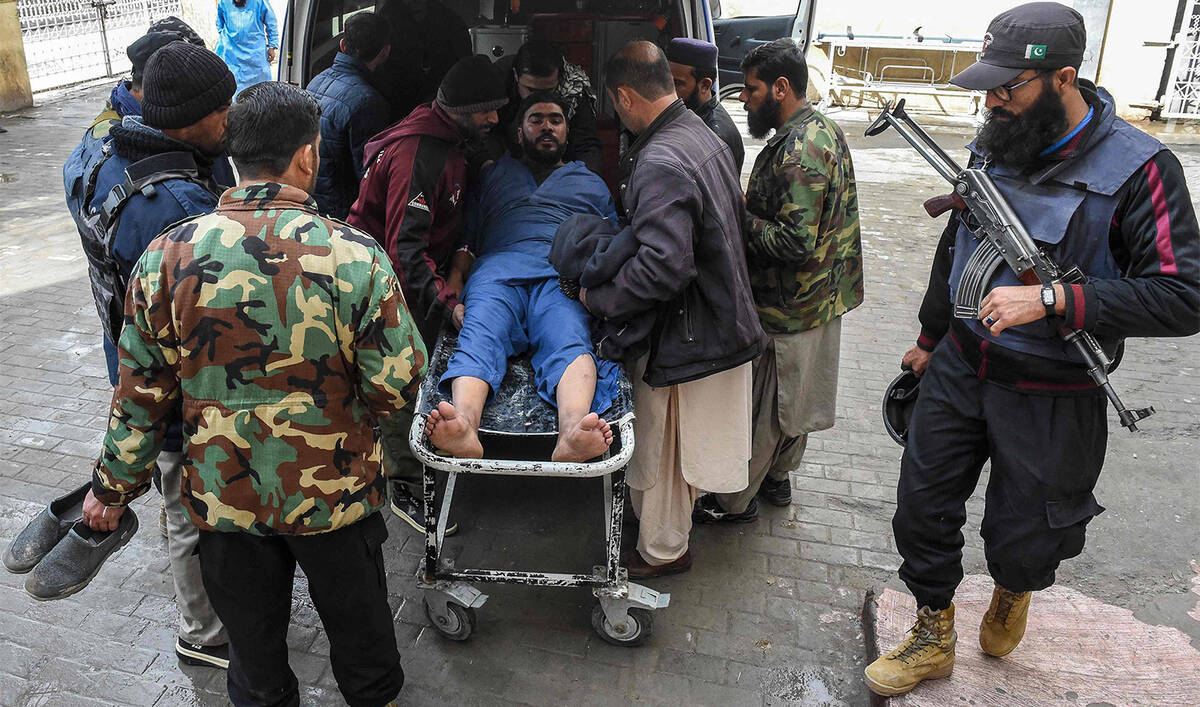
Security personnel shift an injured man at a hospital in Quetta on January 31, 2026, following an attack by Baloch separatists. Ethnic Baloch separatists launched "coordinated" attacks across Pakistan's Balochistan province on January 31, killing at least four policemen, officials said, the latest violence in insurgency-hit southwest region. (AFP)

A senior official at the Civil Hospital in Quetta told Arab News they had received 15 bodies, including nine policemen.

“Eight injured with bullet wounds were brought to the hospital,” said the official, who spoke on condition of anonymity. “Five of them were later shifted to the Combined Military Hospital (CMH) Quetta.”

Balochistan, which borders Iran and Afghanistan, is the site of a decades-long insurgency waged by Baloch separatist groups who often attack security forces and foreigners, and kidnap government officials.

Shahid Rind, the Balochistan chief minister’s aide for media and political affairs, said police and paramilitary Frontier Corps (FC) had foiled the attacks and were chasing the assailants.

“After the killing of more than 70 terrorists at different places in Balochistan in the last two days, terrorists have attempted to attack at a few places in Balochistan, which have been foiled by timely action by the police and FC,” he said on X.

“At present, the pursuit of the fleeing terrorists is underway. More details will be revealed very soon.”

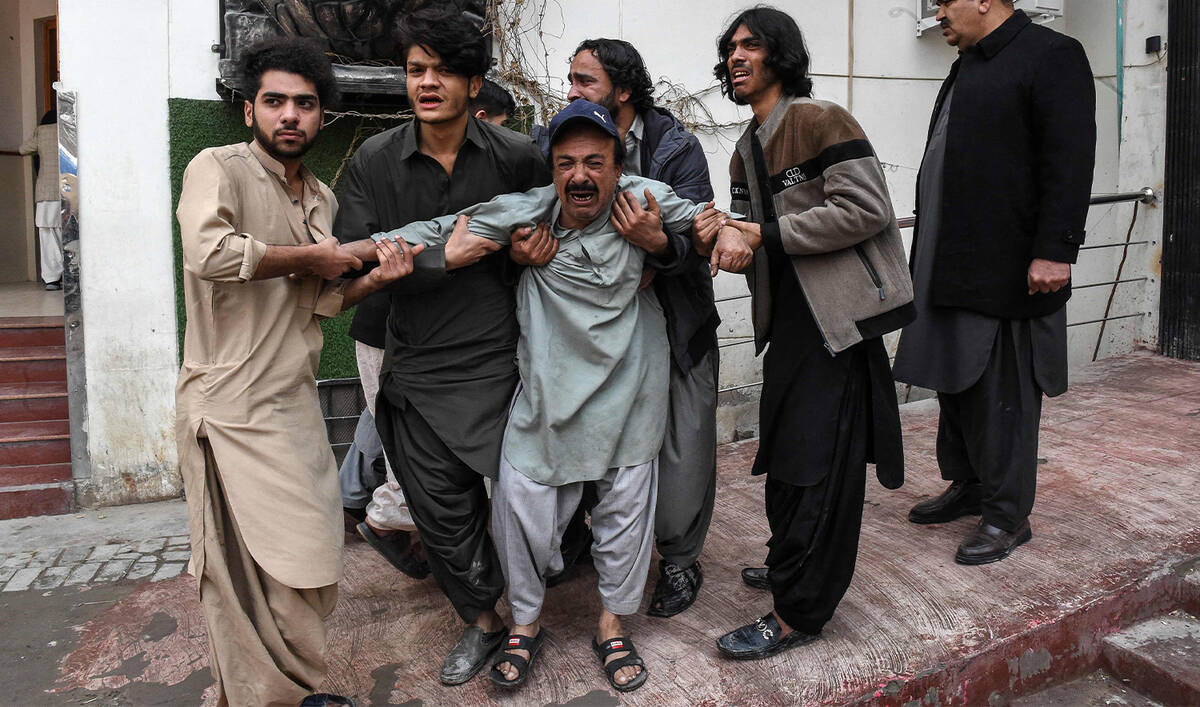
Family members mourn the death of a relative killed in an attack by Baloch separatists, at a hospital in Quetta on January 31, 2026. Ethnic Baloch separatists launched "coordinated" attacks across Pakistan's Balochistan province on January 31, killing at least four policemen, officials said, the latest violence in insurgency-hit southwest region. (AFP)

In a statement issued on Saturday, BLA said the group had launched ‘Operation Herof 2.0,’ which included a series of attacks in multiple cities of Balochistan.

Saturday’s attacks follow coordinated attacks carried out by the group in Aug. 2024 in various districts of Balochistan which killed dozens of people.

The separatists accuse the central government of stealing the region’s resources to fund development elsewhere in the country. The Pakistani government denies the allegations and says it is working for the uplift of local communities in Balochistan.

Pakistan Railways suspended train service from Balochistan to other parts of the country for a day, following Saturday’s attacks.

“Quetta-Peshawar bound Jaffar Express, and Quetta-Chaman passenger trains have been canceled due to the prevailing security situation in Balochistan,” Muhammad Kashif, the railways controller in Quetta division, told Arab News.