

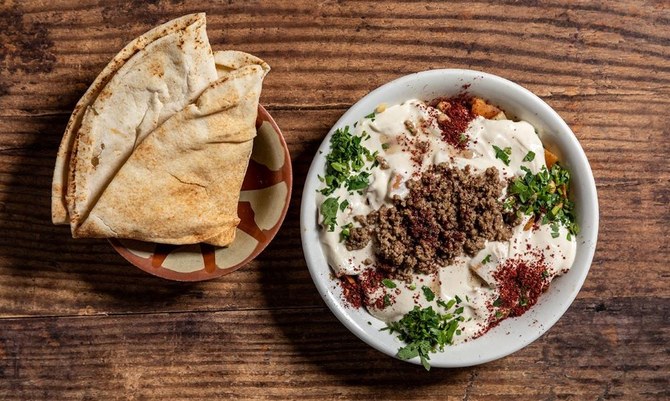

CAIRO: Eaten in the grandest of royal palaces and the humblest of homes, fatteh is one of Egypt’s best-loved dishes.
While it is usually associated with the feast of sacrifice, Eid Al-Adha, this simple dish has a history that dates back millennia.
“Fatteh is one of the foods that is associated with the era of the pharaohs, as they were the first to make it,” Dr. Ahmed Afifi, a professor of ancient history at Tanta University, told Arab News.
Although made from simple ingredients — generally breadcrumbs, mixed with rice and meat — the dish occupied pride of place at royal banquets as it was highly valued by the pharaohs, he said.
Fatteh flourished during the Fatimid era, when a sauce was added to the dish to give it extra flavor. That was also the time when it became irrevocably associated with Eid Al-Adha.
“The Fatimid kings would slaughter a large number of sacrificial animals on the first day of Eid Al-Adha and order their cooks to make fatteh dishes and distribute them to the public to celebrate the occasion,” Afifi said.
“And that is how it became the food to eat on the first day of Eid.”
Though it has many names, fatteh is widely consumed across the Arab world. In Gulf countries it is known as al-fatat, in Libya al-mathrooda, in Syria al-tasqiyyah and in Tunisia al-lalababy.
Egyptian chef Alaa El-Sherbiny told Arab News that there were also many variants to the basic dish.
“In the past, fatteh was eaten with vinegar and garlic, not with sauce. And the people of Alexandria still eat it that way,” he said.
While most Egyptians preferred tomato sauce, the Alexandrians used vinegar and garlic as it worked better with the mutton they used in their fatteh, he added.
Cairo housewife Hoson Mahmoud told Arab News that the dish was a key part of the feast of sacrifice.
“Without fatteh, we cannot taste Eid Al-Adha. You can smell it coming from every home in every street in Egypt,” she said.
Mahmoud said her family ate fatteh for breakfast, served with meat and soup.
“Fatteh is a cheap dish because it consists of rice, breadcrumbs, vinegar, garlic and tomatoes.”
But she added that the price of meat had been rising, meaning many families were having to cut back.
“This year we bought 3 kg of meat — 1 kg for breakfast and 2 kg for lunch — and unlike in previous years, we will spend Eid eating some meals that do not rely too much on meat.”
Despite the increased costs, Mahmoud is in no doubt about the origins of her beloved dish.
“It’s authentic Egyptian food,” she said. “I can’t imagine it has another origin other than Egypt.”
But Syrian housewife Alma Salem, who also lives in Cairo, disagrees.
“It originated in the Levant,” she said. “The Egyptians later took it and added their own special touches.
“But what distinguishes us in the Levant is that we make different dishes from fatteh, with chickpeas, makdous (oil-cured eggplant) and chicken.”
She added: “There is a well-known proverb in the Levant about the fatteh that does not include meat, which is: if you don’t have mutton, you should have chickpeas.”


