

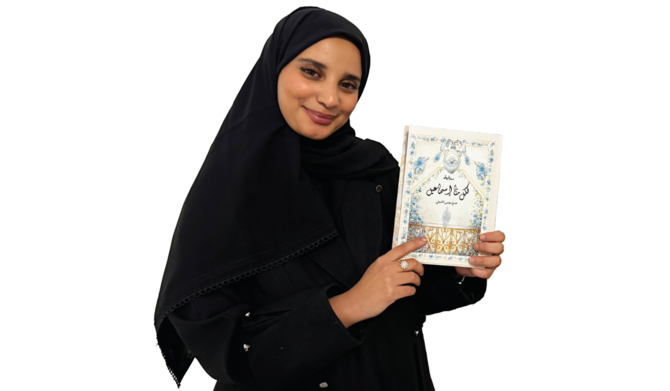
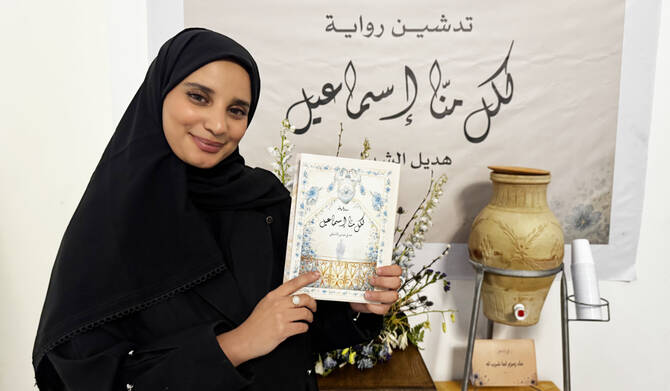
RIYADH: While many authors travel the world in search of human stories, Saudi novelist Hadeel Al-Shubaili found hers growing up in the holy city of Makkah, where encounters with pilgrims from around the world inspired her second novel, “For Each of Us, an Ismail.”
“The natural instinct in Makkah is (to) give unconditionally, to offer everything you can, and link your relationship with God to the situations happening around you with other people,” Al-Shubaili told Arab News.
“Especially since my novels reflect human and social experiences ... Just from Tawaf alone, you can comprehend the amount of joy and pain that the world experiences, while you are in a place where the whole world has come to you. You didn’t go to the world; the world came to you,” she explained.

Hosted at the Sard Cultural Center in Riyadh, the immersive literary exhibition translates the novel’s themes into a multi-sensory experience using storytelling, sound and visuals. (Supplied)
Reflecting on how her upbringing shaped her duty to share Makkah’s heritage with the world, the writer described herself as “deeply blessed” to have grown up in the holy city.
Today, she views that privilege as both a responsibility and an opportunity to serve Makkah and its pilgrims by authentically capturing their stories through her writing.
She describes growing up surrounded by millions of pilgrims — listening to a vibrant tapestry of languages and observing the joys and griefs woven into the steps of Tawaf.
HIGHLIGHTS
• Hadeel Al-Shubaili spent a year and a half writing inside the boundaries of Masjid Al-Haram.
• She transformed universal human encounters into literary and visual art in her new book, ‘For Each of Us, an Ismail.’
• An immersive literary exhibition at Sard Cultural Center in Riyadh translates the novel’s themes into a multi-sensory experience using storytelling, sound and visuals.
After spending a year and a half writing inside the boundaries of Masjid Al-Haram, Al-Shubaili transformed universal human encounters into literary and visual art in her new book.
The Arabic novel centers on the character, Ismail, and his quest for identity as he interacts with pilgrims of diverse backgrounds in Makkah.
On his journey to discover his true name and identity, Ismail encounters people from diverse cultures, each meeting leaves a mark, and every place poses a new question regarding identity and belonging.

Hadeel Alshobili (L), author of “For Each of Us, an Ismail" partnered with contemporary artist and Arabic calligrapher, Bayan Barboud to bring her words to life in an exhibition hosted in Sard Cultural Center in Riyadh. (Supplied)
Amid the paths and faces, he discovers that the true journey is not merely outward into the world but inward into the self, realizing that every human personality is shaped by experiences and piovtal moments.
Al-Shubaili said that her environment naturally shaped her craft: “I was raised around pilgrims, and going to Haram was just a natural part of my life and daily routine.”
Living in Makkah, it was those constant, personal interactions with pilgrims from around the world that sparked the inspiration behind her novel.
I was raised around pilgrims, and going to Haram was just a natural part of my life and daily routine.
Hadeel Al-Shubaili, Saudi author
“The thing I think was the spark, which I now at this age realized, was when I was in the fourth grade of elementary school. I had just finished school and went to buy ice cream from a shop called Al-Asema that is very famous” she said. “After Umrah, it’s a ritual for everyone going to the Haram to buy Al-Asema ice cream.”
“As I was buying the ice cream, holding it in my hand, suddenly the call for Adhan Al-Mayyit (funeral prayer) sounded.
“I was a child eating ice cream, and praying for the deceased with the other hand ... This experience taught me unconditional giving ... (It) shaped my personality and made me understand the responsibility toward people and the world in Makkah,” the author explained.
To bring her words to life in an interactive art exhibition, Al-Shubaili partnered with contemporary artist and Arabic calligrapher Bayan Barboud.
Hosted at the Sard Cultural Center in Riyadh, the immersive literary exhibition translates the novel’s themes into a multi-sensory experience using storytelling, sound and visuals.
“Real stories from the book were transformed into an art exhibition. The artist Bayan Barboud was the one who decided to create an art exhibition,” Al-Shubaili said.
As an Arabic calligrapher, Barboud represented Saudi Arabia internationally in Expo Japan as a calligrapher and has worked on multiple exhibitions across the Kingdom to showcase her craft.
Barboud told Arab News: “The exhibition tells the story of the novel in an abstract way, taking the visitor on an experience. All the elements present in the exhibition, whether the colors or the shapes, symbolize who Ismail is.”
“It was supposed to be just paintings, but I felt why don’t we present a conceptual installation artwork that explains the whole work,” she said.
As visitors enter, they encounter text and mirrors woven into the installation, allowing them to see Ismail’s story and character reflected directly back at them.
“The paint was mixed with Zamzam water because it holds meaning in the story,” Barboud said.
Leaving readers with a final message, Al-Shubaili said: “Anyone who goes to Makkah, goes to the Haram, performs Umrah or Hajj, should decide to ‘observe.’
“Because there are those who see and those who do not see. And honestly, the experiences in the Haram are filled with human and social experiences and it is certainly connected to religion, but it also shapes and builds one’s personality significantly if a person decides to invest in it,” she said.


