Indian Muslims must drop ‘victimhood mentality,’ top businessman says

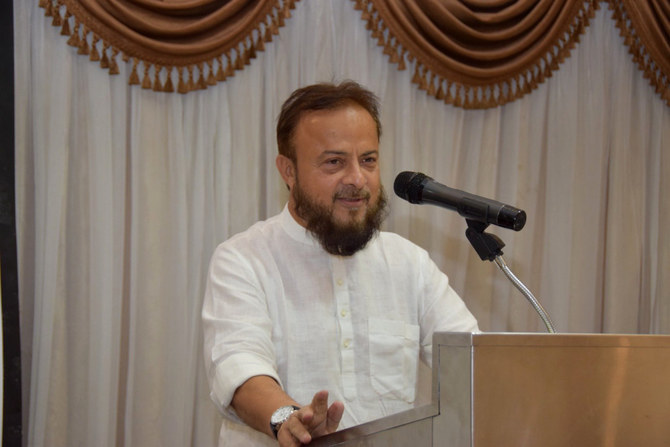
Indian businessman and former chancellor of Maulana Azad National Urdu University Zafar Sareshwala speaking during a community event in Jeddah. (Supplied)
Short Url
Updated 21 June 2023
Follow

Indian Muslims must drop ‘victimhood mentality,’ top businessman says

  • Entrepreneur cites education, not agitation, as key to future prosperity
  • This is the era of specialization and super-specialization, he says

JEDDAH: A leading Indian businessman and former university chancellor has urged Indian Muslims to focus on education and rid themselves of a “victimhood mentality.”
Speaking during a visit to Jeddah, Zafar Sareshwala, former chancellor of Maulana Azad National Urdu University, acknowledged there is discrimination against Muslims in India, but said this is mainly “incidents carried out by fringe elements.”
However, he added: “The focus for the community should be on education, rather than wasting its energies on complaining about discrimination. The community cannot be in a state of perpetual agitation and needs to put the victimhood mentality behind it.”
Sareshwala, the owner and founder of the financial services company Parsoli Corp., told members of Jeddah’s Indian community to focus not only on education but on quality and high-tech education.
“The era of getting your child graduated with a degree is in the past,” he said. “The world has moved beyond that. Unless and until you are a specialist in your field, you will not be able to make your mark. This is the era of specialization and super-specialization.”
Sareshwala also highlighted poor participation by Indian Muslims in civil service examinations, saying: “If you do not take part in the race, how do you expect to win it?”
The percentage of Muslims taking recent civil service examinations was very low and the success rate “left much to be desired,” he said.
Sareshwala recalled efforts made through his Taleem-o-Tarbiyat initiative to provide financial literacy programs to mainstream Indian Muslims from underprivileged backgrounds, adding that there is “a dire need for these programs to be studied and popularized in the Muslim community.”
“As chancellor of MANUU, I oversaw several ways to educate students from rural and madrasa backgrounds about financial markets, how they operate and how young Muslims can become entrepreneurs.”
He also encouraged Muslims to set a good example by “projecting the best image as shown to us by the Prophet Muhammad.”
Sareshwala said: “We have to keep talking to our Hindu brothers and sisters, and to present the best image to them. Unless and until we do this, the problem of division and conflict will persist.”
Most Hindus are peace-loving people with no grudge against Muslims, he said, adding: “We, the community, are to blame for not reaching out to them.”
He warned Muslims against becoming “pawns in the hands of political parties who use them for their own vested interests and political capital.”
Sareshwala said the most important thing other than concentrating on education, good behavior and contact with fellow Indians, was the need for engagement with the government of the day.
“If we have a problem, we need to find a solution and the solution can only be provided by those who are in power. We cannot remain isolated and we cannot remain detached from the government of the day,” he said.
“We cannot and must not remain aloof from the government of the day. On the contrary, we must make constant efforts to engage and have a dialogue with the government. Communal riots have taken place in the past, and there have been terrible instances of fringe elements creating havoc as well, and these things will likely not go away.
“We have to decide how to make the best of a difficult situation,” he said.


8 in 10 British Muslims face ‘financial faith penalty’ when seeking home finance, survey finds

Updated 04 February 2026
Follow

8 in 10 British Muslims face ‘financial faith penalty’ when seeking home finance, survey finds

  • Restricted choices plague potential buyers

LONDON: Eight in 10 British Muslims say their home finance choices are restricted because of their faith, according to a new national survey that highlighted what researchers describe as a growing “financial faith penalty” in the UK housing market.

The report, published by Islamic home finance fintech firm Offa, found that 80 percent of Muslim respondents believe their religious beliefs limit their access to suitable home finance, while those who do use Islamic products often face slower decisions, heavier paperwork and poorer customer experiences than in the conventional mortgage market.

Based on surveys of 1,000 British Muslims conducted by Muslim Census, and 2,000 non-Muslims carried out by OnePoll, the research calls on providers, brokers and policymakers to modernize Islamic home finance and improve access to Sharia-compliant products.

Among the 24.3 percent of British Muslims who have used Islamic home finance, just 5 percent said they had received a same-day decision.

Some 62 percent waited up to two weeks, while 33 percent waited more than 15 days, including 16 percent who waited over a month.

Long decision times were cited as the biggest challenge by 28 percent of respondents, followed by excessive paperwork (22.6 percent) and poor customer service (18.9 percent).

Islamic home finance differs from conventional mortgages by avoiding interest and steering investment away from sectors considered harmful to society, including gambling, alcohol, tobacco, arms trading and animal testing.

Sagheer Malik, chief commercial officer and managing director of home finance at Offa, said the findings showed British Muslims were being underserved by outdated systems.

Malik said: “Property is the asset class of choice for many of the UK’s 3.87 million Muslims, both as a route to generational wealth and as a long-term financial foundation, yet our insightful research report reveals that British Muslims are being underserved and deterred by slow, outdated and opaque Islamic home finance provision.

“This is not a niche concern. It goes to the heart of financial fairness and inclusion in modern Britain.”

He added that Muslims deserved Sharia-compliant products that matched mainstream standards on “price, speed and simplicity.”

Despite strong demand, uptake remains low.

Only 12.8 percent of British Muslims surveyed said they currently use Islamic home finance, with a further 11.5 percent having done so in the past. More than three quarters (75.7 percent) have never used it.

Faith plays a central role in financial decisions, with 94.2 percent saying it is important that their financial products align with their ethical or religious beliefs. Yet more than half of those using conventional mortgages said they felt unhappy or uneasy about doing so because of their faith.

The study also found that British Muslims share similar home ownership aspirations to the wider population, with 79.1 percent citing the desire to provide a stable home for their family, while 18.6 percent said building generational wealth was their main motivation. Only 2.2 percent said they did not want to own a home.

The report suggests Islamic finance could appeal beyond Muslim communities. While 64 percent of non-Muslim respondents had never heard of Islamic home finance, 63 percent said they favored its ethical principles once explained.

Younger generations were the most receptive, with 43 percent of Generation Z and 37 percent of millennials saying they would consider using Islamic home finance, compared with just 7 percent of baby boomers. More than three quarters of Gen Z and 72 percent of millennials also said it was important that their finance provider avoided investing in ethically harmful sectors.

Offa said the findings pointed to an opportunity to expand ethical finance in the UK, provided the industry can deliver faster, simpler and more transparent services.