

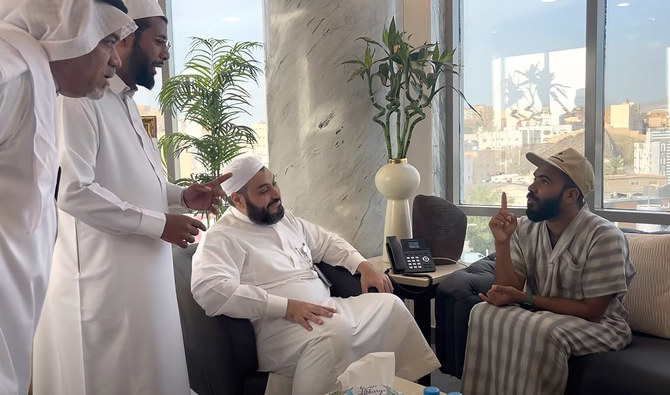
How Indian pilgrim walked 8,600 km to reach Makkah for Hajj

In this photo taken in early June 2023, Indian pilgrim Shihab Chottur, right, is welcomed in Makkah, Saudi Arabia, after walking for over one year from Kerala to perform the Hajj. (Shihab Chottur)
Short Url
Updated 18 June 2023
Follow

How Indian pilgrim walked 8,600 km to reach Makkah for Hajj

  • Shihab Chottur arrived in Makkah after over a year of walking
  • Journey to Saudi Arabia led through Pakistan, Iran, Iraq, and Kuwait

NEW DELHI: Many Muslims try to go the extra mile in fulfilling the sacred obligation of pilgrimage — an effort Shihab Chottur took to another level as he walked over 8,600 km from southern India to reach Makkah for Hajj.

Chottur departed from his home in Malappuram in Kerala on June 2, 2022, and on his year-long journey crossed Pakistan, Iran, Iraq, and Kuwait before reaching his destination.

He arrived in Saudi Arabia in late May and after spending three weeks in Madinah entered Makkah on June 7.

“I achieved my dream. This was my dream, childhood dream. I reached here, Makkah. Very proud moment that I achieved my dream,” he told Arab News.

“Everything is possible. We can do anything.”

Now 31 years old, Chottur first imagined the journey when he was eight. He remembered a dream in which he saw the Kaaba shrine, the towering black cube at the center of the Great Mosque of Makkah, which the most sacred place for Islam and considered the House of God.

“I started thinking, why can’t I reach the Kaaba walking?” Chottur said. “At that time, I was not aware of the route and how many countries I would cross.”

The journey was not easy. While in Pakistan he was warmly welcomed in the villages and towns he crossed and often accompanied for some time by locals, when he entered Iran, the journey was mostly lonely.

“Different experiences in Iran and Iraq ... Climate is very different. It was minus 14 degrees. That time I was alone with my 12 kg of luggage,” he said.

A father of two and owner of a shop in Malappuram, Chottur enjoyed the support of his family, especially mother, as told them about the plan to reach Makkah by foot.

Later, he was also assisted by Saudi authorities and exempted from all fees.

“I carried $8,500 when I started, and I did not use that money because the Saudi government and the Indian consulate supported my free Hajj,” he said. “That money that I carried, my mother will use to for performing the Hajj.”

Now waiting for the pilgrimage to begin next week, Chottur has found a new resolve, which is to encourage other young Muslims to embark on the spiritual journey when they are still physically fit.

“Everyone thinks of going on Hajj after completing 70 years, at old age. I would like to change that thinking. I would like to do that in my youth,” he said. “In our healthy time we can do the Hajj.”

After he completes the rites of pilgrimage, his journey will be nearly complete.

He still hopes he will be able to go to Palestine and see Al-Aqsa Mosque — the third most sacred place after the Great Mosque of Makkah and the Prophet’s Mosque in Madinah.

“There are three holy sites,” he said. “I would like to go to Al-Aqsa Mosque, and then fly back to India.”


Saudi Arabia Railways breaks records in 2025: 14 million passengers and 30 million tons of freight

Updated 43 min 33 sec ago
Follow

Saudi Arabia Railways breaks records in 2025: 14 million passengers and 30 million tons of freight

  • Transporting 30 million tons of freight via rail in 2025 meant 2 million truck journeys removed from Kingdom’s highways and 139 million liters of fuel saved
  • It also meant a reduction of carbon emissions by 364,000 tons, contributing directly to the Saudi Green Initiative

RIYADH: Saudi Arabia Railways (SAR) has announced record-breaking operational milestones for the year 2025, solidifying its position as a cornerstone of the Kingdom’s logistics and tourism sectors.

SAR transported over 14 million passengers, representing a significant leap from the 11.2 million passengers recorded in 2023, highlighting the increasing adoption of rail travel for both commuting and pilgrimage, the Saudi Press Agency reported.

Similarly, freight operations have expanded robustly from approximately 24 million tons in 2023 to the current 30 million tons, driven by increased industrial demand and mining logistics.

By transporting 30 million tons of freight via rail in 2025, the network successfully removed two million truck journeys from the Kingdom’s highways, resulting in 139 million liters of fuel saved.

It also meant a reduction of carbon emissions by 364,000 tons, contributing directly to the Saudi Green Initiative, the report said.

These figures underscore SAR’s pivotal role in realizing the National Transport and Logistics Strategy (NTLS) and Saudi Vision 2030, delivering a network that is not only efficient but also environmentally sustainable.

“Dream of the Desert”

A standout achievement of 2025 was the official launch of the Dream of the Desert, the first luxury train service in the Middle East and North Africa.

Minister of Transport and Logistic Services and SAR Chairman Saleh Al-Jasser unveiled the first “Dream of the Desert” carriage last October as one of the FII9 highlights. (SPA file photo)

Developed in partnership with the Italian luxury hospitality company Arsenale Group, this service has redefined rail tourism. The train features 40 custom-designed luxury cabins, offering a “rail cruise” experience inspired by the classic Orient Express but with a distinct Saudi Arabian identity. The route traverses the Kingdom from Riyadh to Al Qurayyat, stopping at key cultural heritage sites including Ha’il and Al-Jouf, effectively turning the journey itself into a destination.

In a major move to capitalize on Transit-Oriented Development (TOD), SAR announced the establishment of a SAR6 billion real estate fund focused on Makkah.

This fund is dedicated to developing prime lands adjacent to the Haramain High Speed Railway station in Makkah. The initiative aims to enhance the pilgrim experience by constructing high-capacity hotels, commercial centers, and residential units directly linked to the station. This development not only diversifies SAR’s revenue streams but also supports the government’s goal of hosting 30 million Umrah pilgrims annually by seamlessly integrating transport and accommodation.

Global Recognition

Internationally, SAR’s commitment to excellence was recognized on the global stage. SAR became the first company to win the prestigious International Union of Railways (UIC) award for long-distance tourist trains.

The ceremony was held at the union’s headquarters in Paris, France, with broad participation from major railway companies worldwide.

The UIC, known as the worldwide railway organization, presented the award in recognition of SAR’s innovation in integrating luxury tourism with heavy rail infrastructure. 

This accolade cements SAR’s reputation for service quality and places the Kingdom on the map as a premier destination for railway enthusiasts and luxury travelers alike.