

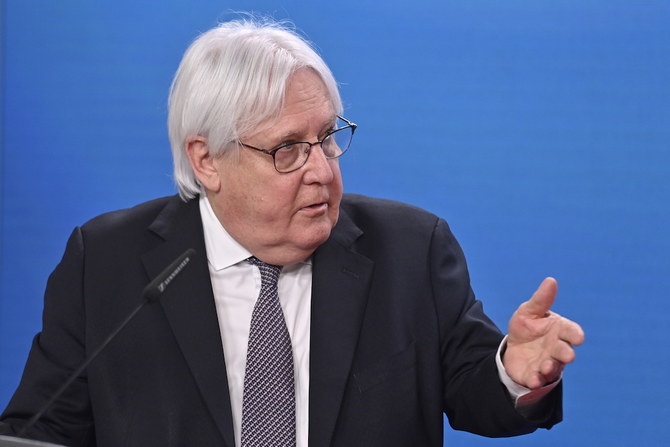

NEW YORK: The UN on Friday warned that the situation in Darfur province is “rapidly spiraling into a humanitarian calamity,” with intercommunal violence that has left hundreds dead in the town of El Geneina town alone threatening to revive ethnic tensions that stoked a two-decade war.
Martin Griffiths, the under-secretary-general for humanitarian affairs and emergency relief coordinator, has urged warring parties to allow safe and voluntary passage for those who want to flee, as well as unhindered humanitarian aid delivery for the 9 million people in the area who need it.
People in Darfur are trapped “in a living nightmare,” said Griffiths.
In a statement released on Thursday, he painted a dire picture of the situation in the province, describing “babies dying in hospitals where they were being treated, children and mothers suffering from severe malnutrition, camps for displaced persons burned to the ground, girls raped, schools closed, and families eating leaves to survive.”
Griffiths added: “Hospitals and water facilities have come under attack. Humanitarian warehouses and offices have been ransacked. Aid workers have been killed.”
Darfur, one of the war’s battlegrounds, was already scarred by a two-decade conflict that left hundreds of thousands dead and more than 2 million displaced.
Reports of mass killings in the restive province “should spur the world into action,” he said, adding that “the world cannot allow this to happen. Not again.”
As Sudan’s war entered its third month, the death toll has risen close to 2,000, with the UN saying the number of dead and injured is likely to be much higher.
The World Food Program said on Friday that 2.5 more million people risk going hungry across the country in coming months. The agency is planning to reach 6 million people with food assistance by the end of the year.
Multiple ceasefire agreements, brokered by Saudi Arabia and the US, have collapsed as fighting continues between Sudan’s de facto leader Abdel Fattah Al-Burhan and the Rapid Security Forces, a paramilitary group commanded his former deputy Mohamed Hamdan Daglo, a former warlord from Darfur who is also known as Hemedti.
The paramilitaries have been blamed for the assassination and mutilation this week of Khamis Abdallah Abbakar, the governor of West Darfur, hours after he accused the RSF of carrying out a genocide in the province.
Al-Burhan accused the RSF of the “treacherous attack.” However, the paramilitary group denied responsibility and condemned the “assassination in cold blood” of Abbakar.
Abbakar’s killers must be held to account for their crime, the UN High Commissioner for Human Rights, Volker Turk, said on Friday, as he expressed concern for the rise in hate speech in West Darfur against the Massalit — to which Abbakar belonged — and Nuba ethnic groups.
The crisis has driven 2.2 million people from their homes, including 528,000 who have fled to neighboring countries, according to the International Organization for Migration.
Griffiths said that looting of medical and humanitarian supplies continues on a massive scale.
Farmers are unable to reach their land, which “further raises the risk of food insecurity.”
He also deplored “a spike in reports of gender-based violence.”
Griffiths said: “Humanitarian partners, including local organizations, have been doing their utmost to deliver aid, replenish stocks of lifesaving supplies, such as food and medicine, and provide water and nutrition services. However, the violence is hampering their efforts.
“Under the rules of war, and the Declaration of Commitments that they both signed, parties to the conflict must refrain from attacking civilians and civilian infrastructure, and they must take constant care to spare them throughout their military operations.”


