


CHICAGO: In Middle East politics, peace is made not between friends but between enemies, suggesting the harshest foes have a better chance to achieve peace than those who claim to be friends.
That pattern has shaped some of the region’s most consequential breakthroughs, from the 1979 Egypt-Israel peace treaty to the 1993 Oslo accords and Jordan’s 1994 peace agreement with Israel.
Each was incomplete, each left the core Palestinian question unresolved, but they all reflected the same hard truth: progress has usually come only when adversaries were willing to sit down across the table.

Smoke billows during an Israeli strike on an industrial area in Gaza City. (AFP)
Now Rahm Emanuel — a seasoned political operator, former White House chief of staff and Chicago mayor, and one of Israel’s most outspoken American allies — is emerging as a voice arguing that the cycle of hostility can be interrupted.
Long regarded as a fierce critic of Palestinian leadership, Emanuel is reportedly weighing a presidential run built in part on promises to restore American leverage in the region and reengage both sides in a serious peace process.
Buoyed by a career of political successes, Emanuel is contemplating a run for the presidency in 2028 on the Democratic Party ticket, positioning himself as a figure who can help bring Israelis and Palestinians back to the negotiating table.
HIGHLIGHTS
• Rahm Emanuel’s proposed ‘23-State solution’ combines elements of the Arab Peace Initiative and Abraham Accords while conditioning future US support for Israel.
• Public opinion has shifted sharply since the Gaza war, with growing criticism of Israeli policies reshaping political calculations across both major US parties.
Emanuel won the office of Chicago mayor in 2011 with 55 percent of the city’s vote — a landslide — defeating 19 candidates, including five major Democratic rivals, by addressing local, domestic issues of concern to voters.

Emanuel met with President Isaac Herzog, bottom left, during his latest visit to Israel. (Social media)
As mayor, he moved against rising crime, pushed education reform and worked to attract major corporations to Chicago, helping to generate new jobs.
Yet that record did not prevent Emanuel, whose father served in the pre-Israeli state Irgun militant group, from aligning closely with Chicago’s pro-Israel community, while often facing accusations of marginalizing Palestinian voices.
His actions were immediate; days after being sworn in as mayor, Emanuel shuttered the annual Arabesque Festival that his predecessor, Richard M. Daley, launched in 2007. Jewish groups had complained Palestinians used the festival to criticize Israel and promote Palestinian rights.

Israel’s military campaign in Gaza has transformed US public opinion, fueling growing sympathy for Palestinians and intensifying scrutiny of American policy. (AFP)
Emanuel also reorganized the city’s Commission on Human Relations and dissolved its subgroup, the Advisory Commission on Arab Affairs, which fought anti-Palestinian bigotry.
Emanuel is also accused of distancing himself from the Arab and Palestinian communities, focusing instead on non-Arab Muslims in what critics say was a subtle act of discrimination against Arabs, who represent 25 percent of more than 7 million Muslim Americans.
On June 28, 2016, Emanuel hosted a Ramadan iftar cosponsored by the American Muslim Taskforce. Nearly 275 non-Arab Muslims attended, allowing him to embrace Muslims while appearing to isolate Arabs and Palestinians.

Chicago Mayor Rahm Emanuel speaks at a ceremony for the signing of the Fairness Act in Chicago, Illinois, November 20, 2013. (Reuters)
The chairperson of the taskforce, Salman Aftab, who continued to push for inclusion of Arabs and Palestinians in the mayor’s administration, invited me and seven other Muslim Arabs to attend the Chicago-sponsored iftar.
I had covered Chicago’s City Hall and seven of Emanuel’s predecessors, beginning with Mayor Richard J. Daley in 1976, through to his son, Richard M. Daley. Aftab thought that experience might resonate with Emanuel.
Aftab arranged for Emanuel and I to talk, hoping to improve our relations. It did not. Emanuel was courteous but cold.

US President Bill Clinton (C) stands between PLO leader Yasser Arafat (R) and Israeli Prime Minister Yitzahk Rabin (L) as they shake hands for the first time, on September 13, 1993 at the White House in Washington DC, after signing the historic Israel-PLO Oslo Accords on Palestinian autonomy in the occupied territories. (AFP)
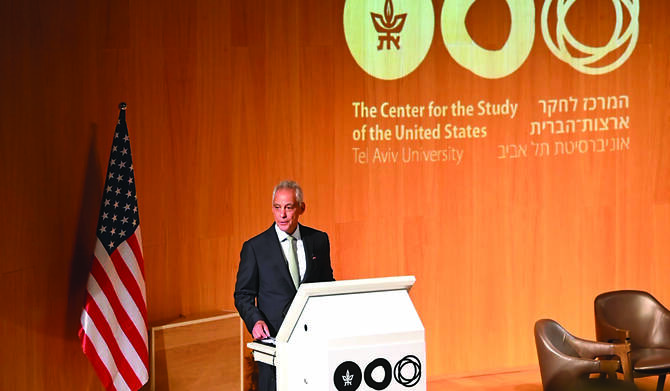
However, in an address at Tel Aviv University on July 8 this year, which many observers regarded as an early signal of a possible 2028 presidential bid, Emanuel made a sharp break from the anti-Palestinian posture he had projected in 2011.
He unveiled a three-part US approach to peace that he called the “23-State solution” for the Middle East to reconfigure “the road to peace.” Under the plan, the Arab League would establish full diplomatic recognition of Israel, set up a new Palestinian Authority that “accepts the Jewish connection” to the land, and “stop supporting violence.”
In his speech, Emanuel slammed Israeli Prime Minister Benjamin Netanyahu’s policies and said Israel can no longer expect unconditional US military aid. In light of recent conflicts, he said Israel and America “are at a crossroads.”

US President Barack Obama (C), White House Chief of Staff Rahm Emanuel (L) and Secretary of State Hillary Clinton walk from the White House across Pennsylvania Avenue to Blair House for a series of bilateral meetings on the sidelines of the Nuclear Security Summit on April 11, 2010 in Washington. (AFP)
Emanuel framed the proposal as a blend of the 2002 Arab Peace Initiative, which Netanyahu has long ignored or rejected, and the stalled Abraham Accords initiated by US President Donald Trump.
So what explains Emanuel’s shift? Before becoming mayor, Emanuel served in the Clinton White House as director of political affairs and, later, as a senior adviser.
He was also part of the political world that surrounded the Sept. 13, 1993, White House ceremony when President Bill Clinton brought together two avowed enemies, Israeli Prime Minister Yitzhak Rabin and PLO Chairman Yasser Arafat, for their now-iconic handshake on the South Lawn.

US President Bill Clinton walks through the Rose Garden at the White House before departing for Denver, Colorado 19 June as Chief of Staff Erskine Bowles (2ND R) and senior staffers Stephen Goodin (2ND L) and Rahm Emanuel (L) follow. (AFP)
That moment remains one of the most enduring symbols of the peace process — a reminder of both the possibilities and the limitations of diplomacy in the Middle East.
His esteem in the Democratic party reached new heights when President Joe Biden named him US ambassador to Japan in 2022.
The defeat of Biden’s would-be successor, Kamala Harris, in the November 2024 presidential election came as a shock to many Democrats, who seemed to have misread the public mood on Israel.
Trump defeated Harris by about 2.3 million votes, but more than 2.7 million voters, many of them Democrats, backed third-party candidates, including Dr. Jill Stein, who remained popular among Arab and Muslim voters.

U.S. President Barack Obama speaks while standing beside Chicago Mayor Rahm Emanuel as they visit a campaign office in Chicago February 19, 2015. (Reuters)
The war in Gaza has triggered a major shift in how Americans view Israel’s treatment of Palestinians. Emanuel, whose political instincts have often outpaced his earlier views on Palestinians, is likely aware of how that shift could affect any future presidential ambitions.
Several forces have driven that change, and they cannot easily be offset by traditional pro-Israel messaging or by the flow of campaign money from AIPAC, the influential pro-Israel political action committee.
For the first time in years, some Democratic and Republican candidates have declined AIPAC support, fearing it could hurt them politically.

A Palestinian man inspects the site of an Israeli strike at the Bureij refugee camp in central Gaza Strip, on July 16, 2026. (AFP)
Israel’s military campaign in Gaza, which came in retaliation for the Hamas-led attacks of Oct. 7, 2023, has fueled allegations of genocide through the killing of more than 76,000 Palestinians, including large numbers of civilians, according to Gazan health authorities.
Hundreds of journalists have been killed while reporting on the war. More than 80 percent of buildings in the territory, including homes, businesses, schools, hospitals, mosques and churches, have been destroyed or severely damaged. Nearly the entire population of 2 million people has been displaced and many face hunger, according to UN figures.
The war has also intensified the scrutiny of Israel’s conduct on the battlefield and its political leaders, including the role of the Israeli army, in which Emanuel served in 1991 as a volunteer, though he never served in the US military. The International Criminal Court has issued war crimes indictments against Netanyahu and members of his cabinet.
A recent Gallup poll also underscored the shift in sentiment since the war in Gaza. It found that 41 percent of Americans sympathized with the Palestinians while 36 percent supported Israel.
This broader shift has reshaped politics around the issue, as a result of which the kind of pro-Israel positioning that helped in 2011 is less attractive today.
Last week, 103 members of the US Congress voted to support legislation that would strip Israel’s government of US military funding.
At the same time, increasing settler violence in the occupied West Bank, reportedly carried out under the protection of the Israeli military, is also straining support among some of Israel’s Jewish-American base.
American Jews are themselves divided, with surveys showing that between 53 percent and 70 percent now express opposition to or sharp criticism of Israeli government policies.
For Emanuel, that might mean his repositioning is less about rediscovering old convictions than about reading the mood in a country where views on Israel and Palestine are changing fast.
He might not succeed in bringing about peace. But can Arabs and Palestinians afford to dismiss his shift, or refuse to engage with it, because of a political grudge that dates back 15 years?


