Iran’s president begins Latin America tour with stop in Venezuela

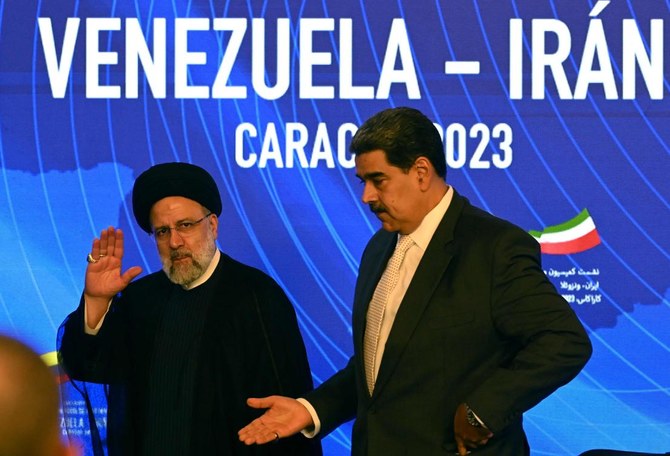
Iranian President Ebrahim Raisi arrived in Venezuela for the start of a visit to "friendly countries" that also include Cuba and Nicaragua, all under sanctions from a common adversary, the US. (AFP)
Short Url
Updated 13 June 2023
Follow

Iran’s president begins Latin America tour with stop in Venezuela

  • Both countries are under heavy US economic sanctions

CARACAS, Venezuela: In his first visit to Latin America, Iran’s hard-line president on Monday met with his Venezuelan counterpart and declared that both countries have “a common enemy,” alluding to the United States, before signing a series of cooperation agreements.
President Ebrahim Raisi’s visit to Venezuela came a year and a day after President Nicolás Maduro visited him in Iran. Both countries are under heavy US economic sanctions.
Raisi said the link between the two countries “is not normal, but rather a strategic relationship,” insisting that their nations have “common interests and we have common enemies.”
“They do not want the two countries, Iran and Venezuela, to be independent,” Raisi said referring to the US government. His tour of allied nations in Latin America, including Cuba and Nicaragua, comes amid rising tensions with the administration of US President Joe Biden.
The US has accused Iran of providing Russia with materials to build a drone manufacturing plant east of Moscow, while the Kremlin seeks to ensure a steady supply of weapons for its invasion of Ukraine. US intelligence officials believe the plant in Russia could start operations early next year, but Iran has said it supplied drones to Russia before the start of the war.
The more than dozen agreements signed by officials from the countries Monday include scholarships for Venezuelan students and the importations of cattle to Iran. Maduro’s visit last year to Iran resulted in agreements to expand ties in the oil and petrochemical industries, the military and the economy. But only a handful of the agreements have materialized.
Venezuela and Iran have maintained close relations since the government of the late President Hugo Chávez. Maduro, who became president in 2013 after Chávez death, has promoted trade relations with Iran, China, Russia and Turkiye to try to overcome the effects of the economic sanctions.
Iran, particularly since 2020, has helped alleviate part of a fuel shortage in Venezuela.
“We are on the right side of history and together we will be invincible,” Maduro said.


Halt to MSF work will be ‘catastrophic’ for people of Gaza: MSF chief

Updated 36 sec ago
Follow

Halt to MSF work will be ‘catastrophic’ for people of Gaza: MSF chief

GENEVA: Israel’s ban on Doctors Without Borders’ humanitarian operation in Gaza spells deeper catastrophe for the Palestinian territory’s people, the head of the medical charity told AFP on Monday.
Israel announced on Sunday that it was terminating all the activities in Gaza and the West Bank by the organization, known by its French acronym MSF, after it failed to provide a list of its Palestinian staff.
MSF slammed the move, which takes effect on March 1, as a “pretext” to obstruct aid.
“This is a decision that was made by the Israeli government to restrict humanitarian assistance into Gaza and the West Bank at the most critical time for Palestinians,” MSF secretary-general Christopher Lockyear warned in an interview with AFP at the charity’s Geneva headquarters.
“We are at a moment where Palestinian people need more humanitarian assistance, not less,” he said. “Ceasing MSF activities is going to be catastrophic for the people of the Gaza Strip and the West Bank.”
MSF has been a key provider of medical and humanitarian aid in Gaza, particularly since war broke out after Hamas’s October 7, 2023 attack on Israel.
The charity says it currently provides at least 20 percent of hospital beds in the territory and operates around 20 health centers.
In 2025 alone, it carried out more than 800,000 medical consultations, treated more than 100,000 trauma cases and assisted more than 10,000 infant deliveries.
It also provided more than 700 million liters of water, Lockyear pointed out.
’Impossible choice’
Israel announced in December that it planned to prevent 37 aid organizations, including MSF, from working in Gaza for failing to submit detailed information about their Palestinian employees. The move drew widespread condemnation from NGOs and the United Nations.
It had alleged that two MSF employees had links with Palestinian militant groups Hamas and Islamic Jihad, which the medical charity vehemently denies.
“If Israel has any evidence of such things, then they should share that evidence,” Lockyear said, insisting that “there’s been no proof given to us.”
He decried “an orchestrated campaign to delegitimize us,” calling on other countries to defend efforts to bring desperately-needed humanitarian aid into Gaza.
“They should be speaking to Israel, pressuring Israel to ensure that there is a reverse of any banning of humanitarian organizations.”
Lockyear said MSF, which counts around 1,100 staff inside Gaza, had been trying to engage with Israeli authorities for nearly a year over the requested lists.
But it had been left with “an impossible choice,” he said.
“We’ve been forced to choose between the safety and security of our staff and being able to reach patients.”
’Can only get worse’
The organization said it decided not to hand over staff names “because Israeli authorities failed to provide the concrete assurances required to guarantee our staff’s safety, protect their personal data, and uphold the independence of our medical operation.”
Lockyear insisted that was a “very rational” decision, pointing out that 15 MSF staff had been killed in Gaza during the war, out of more than 500 humanitarian workers and more than 1,700 medical workers killed in the Strip.
Lockyear highlighted that without independent humanitarian organizations in Gaza, an already “catastrophic” situation “can only get worse.”
“We need to increase massively the humanitarian assistance that’s going into Gaza,” he said, “not restrict it, not block it.”