Day after budget, Pakistan PM says charter of economy ‘only way forward’ to achieve prosperity 

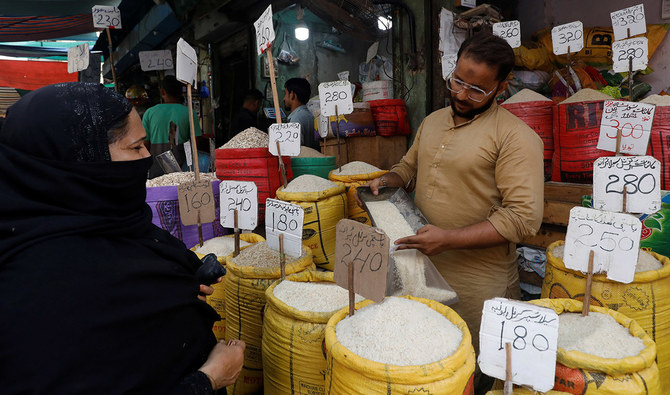
A shopkeeper fills a bag of rice for a customer, at a shop along a market in Karachi, Pakistan June 9, 2023. (REUTERS)
Short Url
Updated 10 June 2023
Follow

Day after budget, Pakistan PM says charter of economy ‘only way forward’ to achieve prosperity 

  • Shehbaz Sharif’s government has struggled with an unprecedented economic downturn since taking over last year 
  • The country is currently facing record inflation, fiscal imbalances and critically low levels of foreign exchange reserves 

ISLAMABAD: Pakistan Prime Minister Shehbaz Sharif said on Saturday that a charter of economy was the “only way forward” for the political leadership to achieve prosperity for the Pakistani people, a day after the cash-strapped government presented budget for the next fiscal year. 

PM Sharif’s government, which succeeded that of former premier Imran Khan, has struggled with an unprecedented economic downturn since taking over last year, with talks with the International Monetary Fund (IMF) for the revival of the $6 billion bailout package yielding no result since December. 

The draft budget envisaged $50.4 billion for the next fiscal year, starting July 1, a significant increase from last year’s budget, aiming for a 6.5 percent deficit and allocating approximately 50 percent for interest payments. 

“The economy direly needs reforms, which, in turn, can be undertaken in a stable political environment, for economic development is intrinsically linked to political stability,” Sharif said on Twitter. 

“It is here that the Charter of Economy appears to be the only way forward for our political parties to achieve prosperity for our people.” 

Sharif said the making of Budget 2023-24 was particularly a difficult task in view of the persistent challenges arising out of the floods-related relief and rehabilitation, global supply chain disruptions and geostrategic upheavals. 

“Never-ending headwinds of political instability created by Imran Niazi damaged the economy and created uncertainty, as the country remained on the boil for well over a year,” he added. 

Khan, who was ousted in a parliamentary no-trust vote last year, has since launched a campaign against his political rivals, demanding snap nationwide polls. The ex-premier dissolved two provincial legislatures in an attempt to pressure the central government into announcing countrywide elections. 

The political upheaval has compounded the countries the economic woes, with record inflation, fiscal imbalances and critical levels of reserves that cover barely a month of imports. 

Sharif said a more balanced budget that levied no new tax could not have been possible within the existing constraints. 

“Budget (FY23-24) represents the beginning of the process to fix the economy’s long-term ailments. The coalition government has prioritized the right areas that have the potential to spur economic growth, attract investment and make the economy self-sufficient,” he said. 

“Mindful of the impact of inflation, the government has provided relief to public sector employees and pensioners in the form of pay raise of up to 35 percent and 17.5 percent respectively, and increased minimum wage to Rs. 32000.” 

Pakistan is currently in talks with bilateral creditors to restructure its debt, the cash strapped country’s finance minister said on Friday. 

Pakistan’s IMF program ends this month with about $2.5 billion in funds yet to be released as it struggles to strike an agreement with the lender. 

Bilateral creditors made up $37 billion of Pakistan’s debt in the fiscal year 2021, out of which $23 billion is owed to China, according to an IMF country report released last year. 

“We are in the process of engaging bilateral lenders to restructure debt,” Finance Minister Ishaq Dar said in televised comments after the budget on Friday. 

“No haircuts will be made... Interest will be serviced, and principal payments will be staggered.” 


Pakistan, China to sign multiple MoUs at major agriculture investment conference today

Updated 18 January 2026
Follow

Pakistan, China to sign multiple MoUs at major agriculture investment conference today

  • Hundreds of Chinese and Pakistani firms to attend Islamabad event
  • Conference seen as part of expanding CPEC ties into agriculture, trade

KARACHI: Islamabad and Beijing are set to sign multiple memorandums of understanding (MoUs) to boost agricultural investment and cooperation at a major conference taking place in the capital today, Monday, with hundreds of Chinese and Pakistani companies expected to participate.

The conference is being billed by Pakistan’s Ministry of National Food Security and Research as a platform for deepening bilateral agricultural ties and supporting broader economic engagement between the two countries.

“Multiple memorandums of understanding will be signed at the Pakistan–China Agricultural Conference,” the Ministry of National Food Security said in a statement. “115 Chinese and 165 Pakistani companies will participate.”

The conference reflects a growing emphasis on expanding Pakistan-China economic cooperation beyond the transport and energy foundations of the flagship China-Pakistan Economic Corridor (CPEC) into agriculture, industry and technology.

Under its first phase launched in 2015, CPEC, a core component of China’s Belt and Road Initiative, focused primarily on transportation infrastructure, energy generation and connectivity projects linking western China to the Arabian Sea via Pakistan. That phase included motorways, power plants and the development of the Gwadar Port in the country's southwest, aimed at helping Pakistan address chronic power shortages and enhance transport connectivity.

In recent years, both governments have formally moved toward a “CPEC 2.0” phase aimed at diversifying the corridor’s impact into areas such as special economic zones, innovation, digital cooperation and agriculture. Second-phase discussions have highlighted Pakistan’s goal of modernizing its agricultural sector, attracting Chinese technology and investment, and boosting export potential, with high-level talks taking place between planning officials and investors in Beijing.

Agri-sector cooperation has also seen practical collaboration, with joint initiatives examining technology transfer, export protocols and value-chain development, including partnerships in livestock, mechanization and horticulture.

Organizers say the Islamabad conference will bring together government policymakers, private sector investors, industry associations and multinational agribusiness firms from both nations. Discussions will center on investment opportunities, technology adoption, export expansion and building linkages with global buyers within the framework of Pakistan-China economic cooperation.