

Day after budget, Pakistan PM says charter of economy ‘only way forward’ to achieve prosperity 

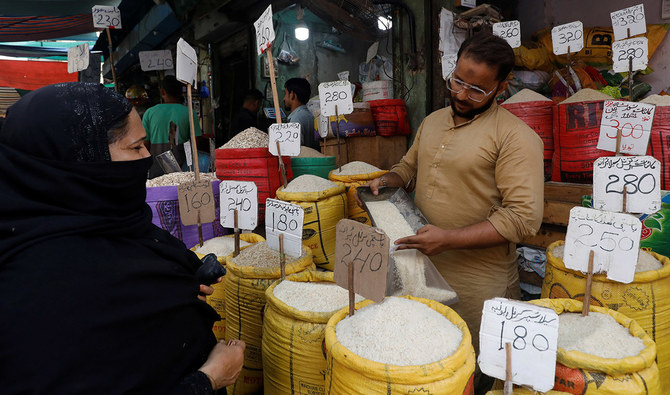
A shopkeeper fills a bag of rice for a customer, at a shop along a market in Karachi, Pakistan June 9, 2023. (REUTERS)
Short Url
Updated 10 June 2023
Follow

Day after budget, Pakistan PM says charter of economy ‘only way forward’ to achieve prosperity 

  • Shehbaz Sharif’s government has struggled with an unprecedented economic downturn since taking over last year 
  • The country is currently facing record inflation, fiscal imbalances and critically low levels of foreign exchange reserves 

ISLAMABAD: Pakistan Prime Minister Shehbaz Sharif said on Saturday that a charter of economy was the “only way forward” for the political leadership to achieve prosperity for the Pakistani people, a day after the cash-strapped government presented budget for the next fiscal year. 

PM Sharif’s government, which succeeded that of former premier Imran Khan, has struggled with an unprecedented economic downturn since taking over last year, with talks with the International Monetary Fund (IMF) for the revival of the $6 billion bailout package yielding no result since December. 

The draft budget envisaged $50.4 billion for the next fiscal year, starting July 1, a significant increase from last year’s budget, aiming for a 6.5 percent deficit and allocating approximately 50 percent for interest payments. 

“The economy direly needs reforms, which, in turn, can be undertaken in a stable political environment, for economic development is intrinsically linked to political stability,” Sharif said on Twitter. 

“It is here that the Charter of Economy appears to be the only way forward for our political parties to achieve prosperity for our people.” 

Sharif said the making of Budget 2023-24 was particularly a difficult task in view of the persistent challenges arising out of the floods-related relief and rehabilitation, global supply chain disruptions and geostrategic upheavals. 

“Never-ending headwinds of political instability created by Imran Niazi damaged the economy and created uncertainty, as the country remained on the boil for well over a year,” he added. 

Khan, who was ousted in a parliamentary no-trust vote last year, has since launched a campaign against his political rivals, demanding snap nationwide polls. The ex-premier dissolved two provincial legislatures in an attempt to pressure the central government into announcing countrywide elections. 

The political upheaval has compounded the countries the economic woes, with record inflation, fiscal imbalances and critical levels of reserves that cover barely a month of imports. 

Sharif said a more balanced budget that levied no new tax could not have been possible within the existing constraints. 

“Budget (FY23-24) represents the beginning of the process to fix the economy’s long-term ailments. The coalition government has prioritized the right areas that have the potential to spur economic growth, attract investment and make the economy self-sufficient,” he said. 

“Mindful of the impact of inflation, the government has provided relief to public sector employees and pensioners in the form of pay raise of up to 35 percent and 17.5 percent respectively, and increased minimum wage to Rs. 32000.” 

Pakistan is currently in talks with bilateral creditors to restructure its debt, the cash strapped country’s finance minister said on Friday. 

Pakistan’s IMF program ends this month with about $2.5 billion in funds yet to be released as it struggles to strike an agreement with the lender. 

Bilateral creditors made up $37 billion of Pakistan’s debt in the fiscal year 2021, out of which $23 billion is owed to China, according to an IMF country report released last year. 

“We are in the process of engaging bilateral lenders to restructure debt,” Finance Minister Ishaq Dar said in televised comments after the budget on Friday. 

“No haircuts will be made... Interest will be serviced, and principal payments will be staggered.” 


Pakistan minister calls for integrating ocean awareness into education to preserve ecosystems

Updated 14 min 43 sec ago
Follow

Pakistan minister calls for integrating ocean awareness into education to preserve ecosystems

  • Pakistan’s maritime sector posted a record $360 million profit in 2025 following a year of sweeping reforms
  • Junaid Anwar Chaudhry says education equips youth to make informed decisions, contribute to blue economy

KARACHI: Pakistan’s Maritime Affairs Minister Junaid Anwar Chaudhry has urged integrating ocean awareness into formal education systems and empowering youth as active partners in order to preserve marine ecosystems, his ministry said on Saturday.

Chaudhry said this at a meeting with Minister of State for Education and Professional Training, Wajiha Qamar, who called on him and discussed strategies for enhancing marine education, literacy, and youth engagement in sustainable ocean management.

Pakistan’s maritime sector posted a record Rs100 billion ($360 million) profit in 2025 following a year of sweeping reforms aimed at improving port efficiency, cost-cutting, and safeguarding marine ecosystems to boost the blue economy.

“Understanding our oceans is no longer optional, it is essential for climate resilience, sustainable development, and the long-term health of our maritime resources,” Chaudhry said, highlighting the critical role of marine literacy.

The minister said education equips youth to make informed decisions and actively contribute to marine conservation and the blue economy, urging inclusion of marine ecosystems, conservation and human-ocean interactions into curricula, teacher training and global citizenship programs.

“Initiatives like ‘Ocean Literacy for All’ can mainstream these elements in national policies, school programs, and community workshops to build proactive citizenship on marine challenges,” he added.

Ocean Literacy for All is a UNESCO Intergovernmental Oceanographic Commission–coordinated global initiative under the UN Ocean Decade (2021–2030) that promotes ocean awareness, education, and conservation.

Chaudhry announced reforms in maritime education, including granting degree-awarding status to the Pakistan Marine Academy, and the establishment of the Maritime Educational Endowment Fund (MEEF) to provide scholarships for deserving children from coastal communities.

“The scholarship program promotes inclusive development by enabling access to quality education for youth from over 70 coastal and fishing communities, particularly in Sindh and Balochistan,” he said.

The discussions underscored raising awareness about oceans, coastal ecosystems and marine resources, according to the Pakistani maritime affairs ministry. Both ministers stressed the need to integrate climate and marine education from classrooms

to community programs, addressing risks like rising sea temperatures, coastal erosion, biodiversity loss and pollution.

“Incorporating marine science and ocean literacy into curricula can help students connect local challenges with global trends,” Qamar said, underscoring education’s transformative power in building social resilience.

The meeting explored translating complex marine science into accessible public knowledge through sustained, solution-oriented awareness campaigns, according to the maritime affairs ministry.

With coastline facing pressures from climate change, pollution, and overexploitation, the ministers called for a coordinated approach blending formal education, informal learning and youth-led advocacy.

“A joint effort by the Ministries of Maritime Affairs and Education can cultivate an ocean-literate generation, transforming vulnerability into resilience and ensuring the long-term sustainability of coastal and marine ecosystems,” Chaudhry said.