

Pakistan’s donkey population continues to steadily rise, reaches 5.8 million 

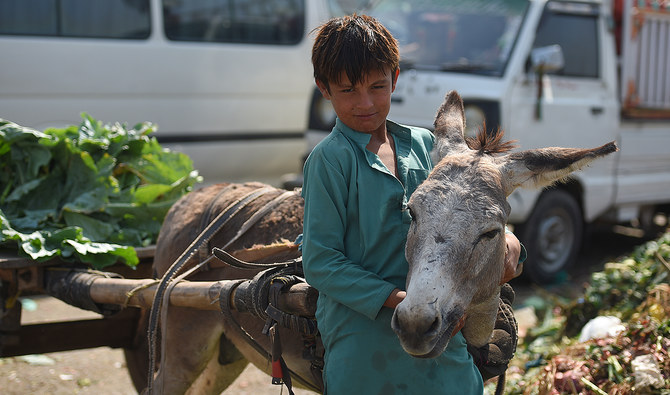
In this photograph, taken on October 8, 2019, a young boy turns his donkey cart in a vegetable and fruit market in Islamabad. (Photo courtesy: AFP/File)
Short Url
Updated 09 June 2023
Follow

Pakistan’s donkey population continues to steadily rise, reaches 5.8 million 

  • Pakistan's economic survey reveals there has been no change in number of camels, horses and mules for four years 
  • Livestock contribution to foreign exchange earnings was recorded at around 2.1 percent of Pakistan's total exports 

ISLAMABAD: The population of donkeys in Pakistan has increased by around 100,000 to 5.8 million as compared to the previous year, the country's economic survey revealed on Thursday, also showing a significant jump in the population of other animals including cattle, buffalo and sheep.

The fresh data shows that the population of donkeys has steadily increased over the past few years from 5.5 million in 2019-2020 to 5.6 million in 2020-21 and 5.7 million in 2021-22. This year it reached 5.8 million.

Unlike donkeys, there has been no change in the number of camels, horses and mules during the same period, which remains at 1.1 million, 0.4 million and 0.2 million, respectively. 

The cattle population in the country has increased to 55.5 million, buffalo to 45 million, sheep to 32.3 million and goats to 84.7 million, according to Pakistan Economic Survey 2022-23, which shows the trend of macro-economic indicators, development policies and strategies as well as sectoral achievements of the economy.

“The livestock sector has emerged as the largest contributor to agriculture, accounting for approximately 62.68 percent of the agriculture value-added and 14.36 percent of the national GDP (Gross Domestic Product) during FY2023,” the latest survey reads. 

The survey says that animal husbandry is a critical economic activity for rural dwellers in Pakistan, with over 8 million rural families engaged in livestock production and deriving up to 40 percent of their income from this sector. 

The gross value addition of livestock has increased to Rs5,593 billion ($19.8 billion) in FY2023 from Rs5,390 billion in FY2022, indicating a growth of 3.8 percent.  

“The net foreign exchange earnings of the livestock sector contribute around 2.1 percent of the total exports in the country,” it said. 

The government has recognized the potential of this sector for economic growth, food security, and poverty alleviation in the country, and has accordingly focused on its development, it stated. 

The overall strategy for livestock development revolves around promoting “private sector-led development with public sector providing enabling environment through various policy interventions,” according to the survey.

The government said it has implemented regulatory measures to enhance per unit animal productivity by improving veterinary health coverage, husbandry practices, animal breeding practices, artificial insemination services, use of balanced ration for animal feeding, and controlling livestock diseases of trade and economic importance.


Pakistan PM orders safeguards for legitimate travelers amid airport off-loading complaints

Updated 9 sec ago
Follow

Pakistan PM orders safeguards for legitimate travelers amid airport off-loading complaints

  • Over 66,000 passengers were off-loaded this year by Pakistani authorities as part of a crackdown on illegal migration
  • Instruction comes a day after Greece rescued about 540 illegal migrants at sea, including several Pakistani nationals

ISLAMABAD: Prime Minister Shehbaz Sharif on Saturday acknowledged complaints over passenger off-loading at airports and ordered safeguards for legitimate travelers, as he chaired a meeting on human smuggling a day after Greece rescued hundreds of migrants, including Pakistanis, at sea.

Earlier this week, the Federal Investigation Agency (FIA) said in a briefing to a parliamentary committee that more than 66,000 passengers had been off-loaded from Pakistani airports this year over suspected irregular travel, while tens of thousands were deported from Gulf states and other countries amid a broader crackdown on illegal migration.

The meeting chaired by Sharif reviewed enforcement measures aimed at curbing human smuggling and illegal immigration, with officials highlighting a 47 percent decline in illegal migration to Europe from the country following intensified screening at departure points.

“In taking action against those traveling illegally or holding suspicious travel documents, special care must be taken to ensure that passengers with valid documents are not affected,” the prime minister said, according to a statement issued by his office.

Sharif also ordered improvements in coordination between the FIA, the Protectorate of Emigrants and other agencies to facilitate Pakistanis traveling abroad legally for employment, while calling for stricter action against corrupt officials.

The meeting was also briefed about a growing reliance on technology by the immigration authorities to address weaknesses in the existing system. Authorities said work was under way to expand the use of electronic gates at airports, allowing automated identity verification to reduce discretionary checks.

Officials also said Pakistan was developing a mobile application to access passenger data and integrating advance passenger information and passenger name record (API-PNR) systems, enabling authorities to flag potentially fraudulent travel documents before departure.

Artificial intelligence tools are being introduced to support risk assessment and targeted screening, the statement added.

Pakistan intensified action against illegal migration in 2023 after hundreds of people, including its own nationals, died while attempting to cross the Mediterranean in an overcrowded fishing vessel that sank off the Greek coast, prompting widespread outrage and scrutiny of smuggling networks.

The meeting followed a Greek coast guard statement on Friday saying it rescued about 540 migrants from a fishing boat south of the island of Gavdos, transferring them to temporary facilities on Crete. Greek authorities said the group included nationals of Pakistan, Bangladesh and Egypt.

The latest rescue highlights how, despite tighter controls and airport screening at home, migrants continue to seek dangerous routes to Europe, largely driven by economic hardship and the promise of work in richer countries.