

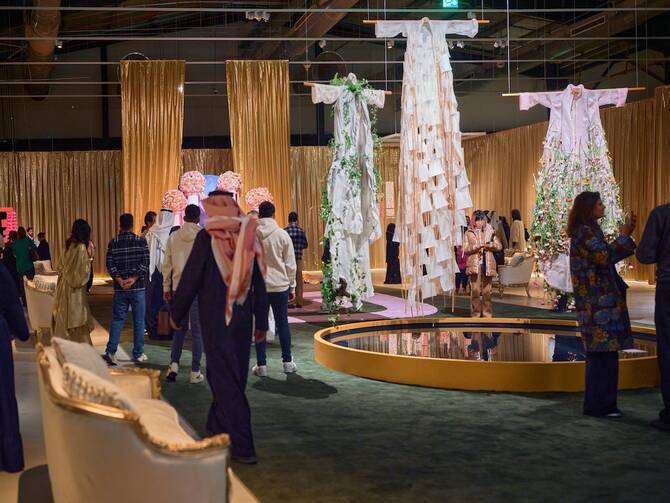

RIYADH: The Saudi Arabian Museum of Contemporary Art’s latest exhibition, “A Night of a Lifetime” explores weddings as acts of love and celebration. It runs until April 18.
The exhibition is curated by Alaa Tarabzouni and Philippe Castro and brings together works from more than 30 local, regional, and international artists, that reimagine cultural, ceremonial, and emotional aspects of weddings through the lens of contemporary art.
Noura Al-Maashoug, director of SAMoCA, told Arab News: “All of these artists are exploring both familial practices, their societal practices, what is carried on from earlier traditions, and what traditions we let go of as we move towards the future.

Nicolas Henry's 'Yasmine and Khalil, The Story of a Love Encounter.' (Courtesy of SAMoCA)
“It’s a very intimate show. A lot of the artists have explored very personal stories, either related to themselves or people from their family. And there’s also a lot of — especially from the Arab world — themes of the public and private celebrations and how weddings really reveal those disparities.”
Entering the first hall of the exhibition, that showcases the more ceremonial aspects of marriage, we are met with floating fabrics, shimmering dance installations, woven chandeliers, a wedding fountain, and children’s festive clothing.
Further in is Lebanese artist Milia Maroun’s “A Love-Living Story,” which is composed of three suspended garments draped in plants, floating between ground and ceiling. The pieces are “kimabayas,” a hybrid garment imagined by Maroun that blends the fluid grace of the kimono with the spiritual symbolism of the abaya. Maroun sees it is a symbol of marriage.

Saudi artist Sultan bin Fahad's work in 'A Night of a Lifetime.' (Supplied)
“The kimabayas are not still-life memories, but living symbols — sanctuaries that breathe, grow, and evolve alongside the couple. They tell of a marriage where body and spirit rise together, between Earth and sky, held in a luminous, living promise,” the artist wrote.
Next, visitors are led down a bright pink aisle to the kosha, an elevated seating area for the bride and groom, typical of Middle Eastern weddings, which becomes a focal point of the ceremony. Visitors to the exhibition are invited to interact with the space by sitting for pictures with loved ones or friends, as wedding guests often do.
“I really want people to just have a lot of fun with this. It’s a sumptuous, beautiful show,” Al-Maashoug said. “The scenography was designed very deliberately for people to enjoy themselves. But at the same time, all of the works are incredibly rich with nuance.”
Ultimately, the show is less about weddings than about what they reveal: our longing to be seen, chosen, and remembered. Love, in all its imperfect forms, emerges as a profound act of optimism; a decision to trust the unknown, and to embrace belief.

Amani Al-Thuwaini’s 'He Is Not Your Choice.' (Courtesy of SAMoCA)
Moroccan artist Sara Benabdallah’s “Dry Land” series and French artist Valerie Belin’s “Moroccan Brides” series both showcase grand, theatrical traditional clothing through still-life portraits. In a sense, the brides are merely models for the decorative motifs of the costumes, perhaps signifying an unexpected, heavier role at play.
French artist Nicolas Henry’s “Yasmine and Khalil, the Story of a Love Encounter” catches the eye in the neighboring hall, which showcases slightly darker themes of personal experiences with marriage. His work comes across as an ambiguous story of a love that has not been lived.
Nearby is Saudi artist Sultan bin Fahad’s sparkling mountain of collected chandeliers and ornaments, symbolizing what’s disposed of after the ceremony ends. His compatriot Batool Alshomrani’s “A Risky Game” frames book pages that title what the union could mean: “The Passionate Friends,” “Alone,” or “The Veil of Money.” Amani Al-Thuwaini’s “He Is Not Your Choice” tackles the taboo thoughts about arranged marriage of a bride-to-be, whose words are embroidered on a cascading veil.
The exhibition is a grand display of wedding culture across Arab countries and the diaspora in which the artists walk the line between how desire and doubt, and modernity and tradition, can coexist and sustain each other.
Through humor, exaggeration, and sincerity, they explore and invent the language of celebration. Ornaments become symbols of emotions.
There’s also an emphasis on marriage as labor, honing in on the daily choreography of care, endurance, and compromise. Beyond the sparkle and costume lies the quiet work of maintaining a union in gestures that are too small to be photographed and moments that endure once the lights fade out.
“We have a lot of young artists, but we also have quite established artists as well,” Al-Maashoug said. “What’s beautiful about weddings is, no matter what generation you are, you engage with it. Whether you’re looking forward to attending your first wedding, or you’re looking forward to falling in love, or you’re a little bit older and reminiscing about your experiences or those of your loved ones, there’s really something for everyone.”


