

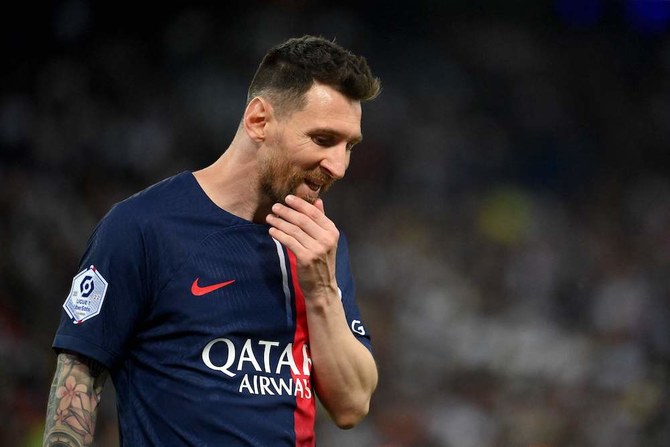

As rumors swirl linking a host of footballing superstars with a move to the Saudi professional league, including arguably the greatest player of all time, Lionel Messi, fans of Asian football would be forgiven for feeling a sense of deja vu.
While the names are different, the sudden splurge from a nation looking to develop both its football, and standing within it, is eerily similar to what we saw from China less than a decade ago as it tried to upend the sport’s established order.
And for a period it did; the likes of Oscar, Jackson Martinez, Hulk, Paulinho, Renato Augusto, not to mention coaches including Marcello Lippi, Fabio Capelli and Manuel Pellegrini, were all tempted east as the Chinese Super League threatened to take over Asian football and become a big player on the global stage.
Guangzhou Evergrande led the charge, twice winning the AFC Champions League, while upstarts such as Shanghai SIPG, now Shanghai Port, Hebei CFFC, Tianjin Quanjian and Jiangsu Suning took the league by storm.
With China’s President Xi Jinping making it a national priority for the country to become a force in world football, countless businesses, mostly real estate developers, took the opportunity to invest in football, not just at home but around the world, in an attempt to curry favor with the ruling Chinese Communist Party.
By this time in their revolution, China was expected to be a powerhouse within Asia, but their reality serves as a warning for Saudi Arabian football as it embarks on its own journey for international prominence.
Less than a decade after China really started its extravagance, local football is arguably in a worse position than before it all started. The CSL has mostly been shed of all its star names, while the national team will likely struggle to qualify for the World Cup despite Asia’s allocation doubling from four to eight.
That is to say nothing of the country’s top football officials being detained on suspicion of fraud and bribery.
This is not how it was meant to be.
The once-mighty Guangzhou Evergrande, more recently renamed Guangzhou FC, has been relegated to China League One and are winless after eight games, placing them at risk of a second consecutive relegation. This is a long way from when they dominated the ACL with titles in 2013 and 2015.
Meanwhile, once-burgeoning outfits like Jiangsu, Hebei and Tianjin have all gone bust and no longer exist – standing as monuments of failure and a permanent reminder of just how quickly things can change.
“You need a vision, and then you need a strategy, and then you need to be able to put that strategy into action,” Prof. Simon Chadwick, an expert in sport and geopolitics, told Arab News.
“You need to have checks and balances within the system, that if the strategy is not working in the most appropriate way, then those checks and balances can be enacted, to keep you on the right path towards your vision.
“These are things that I sense a little more in Saudi Arabia that didn’t necessarily exist in China.”
With further details emerging this week of Saudi Arabia’s roadmap toward success, including the privatization of the country’s four biggest clubs – Al-Hilal, Al-Ittihad, Al-Nassr and Al-Ahli – and a forecasted quadrupling of annual revenues, the Saudi experiment is already looking vastly different to that of China’s.
Whereas the largesse in China had the support of the ruling CCP party, it was more often than not financed by private individuals, albeit ones with links to the ruling communist party, using their own wealth accumulated through years of unsustainable growth in the real estate sector. By the time the heat came out of the real estate market, and the CCP tinkered to try and save clubs from themselves, it was too late.
In the case of Saudi Arabia, the investment is coming directly from the state via its sovereign wealth fund, known as the Public Investment Fund, the same source of funding for LIV Golf and Newcastle United. That alone makes this feel more secure and less at risk of an embarrassing collapse as was witnessed in China.
Chadwick also explained that the Kingdom needs to find its own uniqueness and not simply try to copy what is successful in Europe.
“One of the interesting things about both Saudi Arabia and China, I think, is a lot of people from outside the country advise and give guidance,” he said.
“(But) they don’t necessarily give the best advice or the best guidance, because what might work in Europe, for example, doesn’t necessarily work in Asia.
“So I think it’s really important, and I don’t think China did this, that Saudi Arabia needs to develop its own identity and its own system of governance, its own culture and its own way of working and not be overly preoccupied by replicating the experiences of what has happened in Europe.”


