PARIS: French union activists marched on the headquarters of the Paris Olympics and slowed traffic at the capital’s Orly Airport with strikes Tuesday as they sought to reignite resistance to a higher retirement age.
But the last-ditch effort drew fewer followers than at the height of the movement earlier this year, and even some union leaders seemed ready to move on.
President Emmanuel Macron’s move to raise the retirement age from 62 to 64 — and force the measure through parliament without a vote — inflamed public emotions and triggered some of France’s biggest demonstrations in years. But the intensity of anger over the pension reform has ebbed since the last big protests on May 1, which more than 500,000 people attended in Paris alone, and since the measure became law in April.
As part of Tuesday’s actions, a third of flights were canceled at Paris’ Orly Airport because of strikes, and about 10 percent of trains around France were disrupted. Around 250 marches, rallies and other actions were planned around the country to mark the 14th day of national protest since January over the pension reform.
A small group of activists with the hard-left CGT union pushed their way into the headquarters of the 2024 Olympics in the Paris suburb of Saint-Denis, chanting anti-Macron slogans.
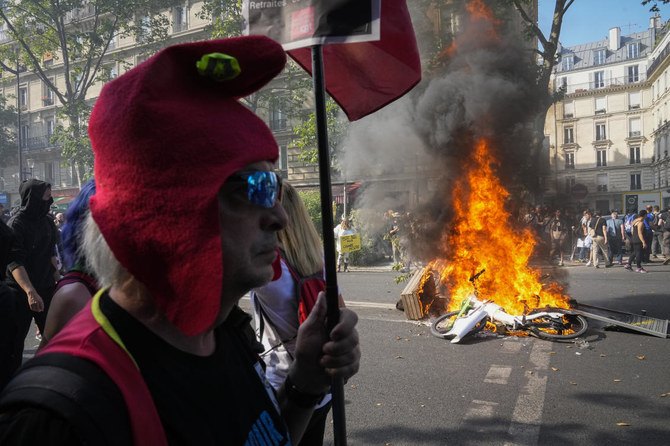
In Paris, mild tensions flared near a restaurant in the Left Bank as individuals engaged in minor vandalism of bus shelters and threw objects at police. Police quickly dispersed the crowds.
Thousands gathered along the embankments of the Seine River near the gold-domed Invalides monument before setting off on their march to southeast Paris. The peaceful crowd waved union flags, banged drums and chanted to demand the withdrawal of the pension law and a lower retirement age.
In the western city of Rennes, union activists marched on train tracks before being turned back by police, according to local public broadcaster France Bleu.
Macron says the pension reform was needed to finance the pension system as the population ages. Unions and left-wing opponents say the changes hurt poorer workers and have argued for higher taxes on the wealthy and employers instead.
The outgoing head of the moderate CFDT union, Laurent Berger, said that after Tuesday’s actions, “we will continue to contest the retirement reform, but it will take on a different form.”
CGT chief Sophie Binet told reporters at the Paris march that other protests are ‘’probable,” but she too said it was time to talk about other issues such as working conditions or tax fraud by companies.
Organizers of Tuesday’s protests hope to rally support before a possible parliamentary debate on Thursday on a bill that is seeking to repeal the new retirement age.
Legislators from centrist opposition group LIOT proposed the bill to put back the retirement age to 62. But it has already met challenges before it reaches the parliamentary floor. While Macron’s centrist party doesn’t have a majority in the National Assembly, it has allied with the conservative Republicans party to push back the opposition’s efforts.

Protests in France as unions make last-ditch bid to resist higher retirement age
Short Url
https://arab.news/gw3sx
Protests in France as unions make last-ditch bid to resist higher retirement age
- French union activists seek to reignite resistance to a higher retirement age
- President Emmanuel Macron says pension reform needed to finance the pension system as the population ages
US judge orders curbs on immigration agents’ tactics toward Minnesota protesters
- Arrests and tear-gassing of peaceful demonstrators prohibited
- Observers also protected from arrests, crowd-control munitions
MINNEAPOLIS: A federal judge in Minnesota on Friday ordered that US immigration agents deployed en masse to Minneapolis be restricted in some of the tactics they have taken against peaceful demonstrators and observers, including arrests and tear-gassing.
Handing a victory to local activists in Minnesota’s most populous city, US District Judge Kate Menendez issued an injunction barring federal agents from retaliating against individuals engaged in non-violent, unobstructive protest activity.
The ruling was in response to a lawsuit filed against the US Department of Homeland Security and other federal agencies on December 17, three weeks before an immigration agent fatally shot Renee Good, a 37-year-old woman in Minneapolis, spawning waves of protests and putting the city on edge.
The court case was brought on behalf of six protesters and observers who claimed their constitutional rights had been infringed by the actions of ICE agents.
The 83-page order explicitly prohibits federal officers from detaining people who are peacefully protesting or merely observing the officers, unless there is reasonable suspicion that they are interfering with law enforcement or have committed a crime.
Federal agents also are banned from using pepper spray, tear gas or other crowd-control munitions against peaceful demonstrators or bystanders observing and recording the immigration enforcement operations, the judge ruled.
Menendez wrote that the government, in defending the street tactics of its immigration officers, had failed to “explain why it is necessary for them to arrest and use force against peaceful observers.”
Stopping or detaining drivers and passengers in vehicles when there is no reason to believe they are forcibly obstructing or interfering with federal agents is likewise prohibited, according to the court order.
Order comes amid heightened tensions
“There may be ample suspicion to stop cars, and even arrest drivers, engaged in dangerous conduct while following immigration enforcement officers, but that does not justify stops of cars not breaking the law,” Menendez wrote.
The DHS did not immediately respond to a Reuters request for comment.
The ruling comes nearly two weeks after the Trump administration announced it was sending 2,000 immigration agents to the Minneapolis area, bolstering an earlier deployment in what the DHS called its largest such operation in history.
The surge in heavily armed officers from the Immigration and Customs Enforcement agency and Border Patrol has since grown to nearly 3,000, dwarfing the ranks of local police officers in the Twin Cities metropolitan area of Minneapolis and St. Paul.
Tensions over the deployment have mounted considerably since an ICE agent fatally shot Good, a mother of three, behind the wheel of her car on January 7.
At the time, Good was taking part in one of numerous neighborhood patrols organized by local activists to track and monitor ICE activities.
Homeland Security Secretary Kristi Noem, one of the federal officials named in the lawsuit, said after the shooting that Good had been “stalking and impeding” ICE agents all day and had committed an act of “domestic terrorism” by trying to run over federal officers.
Minneapolis Mayor Jacob Frey and local activists disputed Noem’s account, saying Good posed no physical threat to ICE agents. They pointed to video clips of the incident they said showed that Good was trying to drive her car away from officers and that the use of lethal force against her was unjustified.
Frey and Minnesota Governor Tim Walz have repeatedly demanded that the Trump administration withdraw the immigration agents, asserting that the operation is being conducted in a reckless manner endangering the public.
While largely siding with the plaintiffs in the case, the judge did not grant all their requests, declining to ban the federal government from actions not specifically taken against those who filed suit. She also limited the injunction to officers deployed in the Twin Cities, rather than extending it statewide.
Handing a victory to local activists in Minnesota’s most populous city, US District Judge Kate Menendez issued an injunction barring federal agents from retaliating against individuals engaged in non-violent, unobstructive protest activity.
The ruling was in response to a lawsuit filed against the US Department of Homeland Security and other federal agencies on December 17, three weeks before an immigration agent fatally shot Renee Good, a 37-year-old woman in Minneapolis, spawning waves of protests and putting the city on edge.
The court case was brought on behalf of six protesters and observers who claimed their constitutional rights had been infringed by the actions of ICE agents.
The 83-page order explicitly prohibits federal officers from detaining people who are peacefully protesting or merely observing the officers, unless there is reasonable suspicion that they are interfering with law enforcement or have committed a crime.
Federal agents also are banned from using pepper spray, tear gas or other crowd-control munitions against peaceful demonstrators or bystanders observing and recording the immigration enforcement operations, the judge ruled.
Menendez wrote that the government, in defending the street tactics of its immigration officers, had failed to “explain why it is necessary for them to arrest and use force against peaceful observers.”
Stopping or detaining drivers and passengers in vehicles when there is no reason to believe they are forcibly obstructing or interfering with federal agents is likewise prohibited, according to the court order.
Order comes amid heightened tensions
“There may be ample suspicion to stop cars, and even arrest drivers, engaged in dangerous conduct while following immigration enforcement officers, but that does not justify stops of cars not breaking the law,” Menendez wrote.
The DHS did not immediately respond to a Reuters request for comment.
The ruling comes nearly two weeks after the Trump administration announced it was sending 2,000 immigration agents to the Minneapolis area, bolstering an earlier deployment in what the DHS called its largest such operation in history.
The surge in heavily armed officers from the Immigration and Customs Enforcement agency and Border Patrol has since grown to nearly 3,000, dwarfing the ranks of local police officers in the Twin Cities metropolitan area of Minneapolis and St. Paul.
Tensions over the deployment have mounted considerably since an ICE agent fatally shot Good, a mother of three, behind the wheel of her car on January 7.
At the time, Good was taking part in one of numerous neighborhood patrols organized by local activists to track and monitor ICE activities.
Homeland Security Secretary Kristi Noem, one of the federal officials named in the lawsuit, said after the shooting that Good had been “stalking and impeding” ICE agents all day and had committed an act of “domestic terrorism” by trying to run over federal officers.
Minneapolis Mayor Jacob Frey and local activists disputed Noem’s account, saying Good posed no physical threat to ICE agents. They pointed to video clips of the incident they said showed that Good was trying to drive her car away from officers and that the use of lethal force against her was unjustified.
Frey and Minnesota Governor Tim Walz have repeatedly demanded that the Trump administration withdraw the immigration agents, asserting that the operation is being conducted in a reckless manner endangering the public.
While largely siding with the plaintiffs in the case, the judge did not grant all their requests, declining to ban the federal government from actions not specifically taken against those who filed suit. She also limited the injunction to officers deployed in the Twin Cities, rather than extending it statewide.
© 2026 SAUDI RESEARCH & PUBLISHING COMPANY, All Rights Reserved And subject to Terms of Use Agreement.


