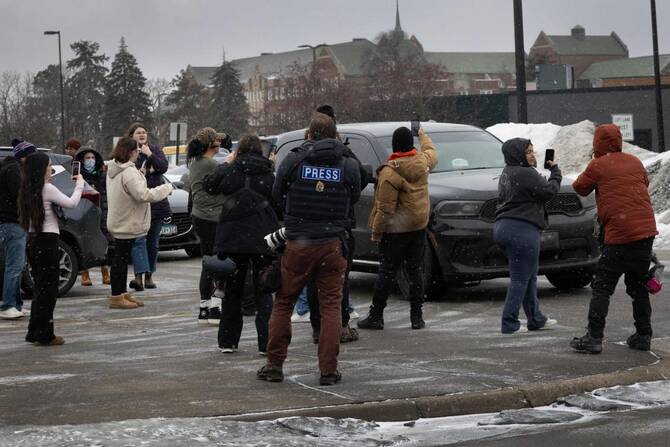
MINNEAPOLIS: A federal judge in Minnesota on Friday ordered that US immigration agents deployed en masse to Minneapolis be restricted in some of the tactics they have taken against peaceful demonstrators and observers, including arrests and tear-gassing.
Handing a victory to local activists in Minnesota’s most populous city, US District Judge Kate Menendez issued an injunction barring federal agents from retaliating against individuals engaged in non-violent, unobstructive protest activity.
The ruling was in response to a lawsuit filed against the US Department of Homeland Security and other federal agencies on December 17, three weeks before an immigration agent fatally shot Renee Good, a 37-year-old woman in Minneapolis, spawning waves of protests and putting the city on edge.
The court case was brought on behalf of six protesters and observers who claimed their constitutional rights had been infringed by the actions of ICE agents.
The 83-page order explicitly prohibits federal officers from detaining people who are peacefully protesting or merely observing the officers, unless there is reasonable suspicion that they are interfering with law enforcement or have committed a crime.
Federal agents also are banned from using pepper spray, tear gas or other crowd-control munitions against peaceful demonstrators or bystanders observing and recording the immigration enforcement operations, the judge ruled.
Menendez wrote that the government, in defending the street tactics of its immigration officers, had failed to “explain why it is necessary for them to arrest and use force against peaceful observers.”
Stopping or detaining drivers and passengers in vehicles when there is no reason to believe they are forcibly obstructing or interfering with federal agents is likewise prohibited, according to the court order.
Order comes amid heightened tensions
“There may be ample suspicion to stop cars, and even arrest drivers, engaged in dangerous conduct while following immigration enforcement officers, but that does not justify stops of cars not breaking the law,” Menendez wrote.
The DHS did not immediately respond to a Reuters request for comment.
The ruling comes nearly two weeks after the Trump administration announced it was sending 2,000 immigration agents to the Minneapolis area, bolstering an earlier deployment in what the DHS called its largest such operation in history.
The surge in heavily armed officers from the Immigration and Customs Enforcement agency and Border Patrol has since grown to nearly 3,000, dwarfing the ranks of local police officers in the Twin Cities metropolitan area of Minneapolis and St. Paul.
Tensions over the deployment have mounted considerably since an ICE agent fatally shot Good, a mother of three, behind the wheel of her car on January 7.
At the time, Good was taking part in one of numerous neighborhood patrols organized by local activists to track and monitor ICE activities.
Homeland Security Secretary Kristi Noem, one of the federal officials named in the lawsuit, said after the shooting that Good had been “stalking and impeding” ICE agents all day and had committed an act of “domestic terrorism” by trying to run over federal officers.
Minneapolis Mayor Jacob Frey and local activists disputed Noem’s account, saying Good posed no physical threat to ICE agents. They pointed to video clips of the incident they said showed that Good was trying to drive her car away from officers and that the use of lethal force against her was unjustified.
Frey and Minnesota Governor Tim Walz have repeatedly demanded that the Trump administration withdraw the immigration agents, asserting that the operation is being conducted in a reckless manner endangering the public.
While largely siding with the plaintiffs in the case, the judge did not grant all their requests, declining to ban the federal government from actions not specifically taken against those who filed suit. She also limited the injunction to officers deployed in the Twin Cities, rather than extending it statewide.


![]()

US judge orders curbs on immigration agents’ tactics toward Minnesota protesters
Short Url
https://arab.news/myaa3
US judge orders curbs on immigration agents’ tactics toward Minnesota protesters
- Arrests and tear-gassing of peaceful demonstrators prohibited
- Observers also protected from arrests, crowd-control munitions


Latest updates



Recommended


© 2026 SAUDI RESEARCH & PUBLISHING COMPANY, All Rights Reserved And subject to Terms of Use Agreement.