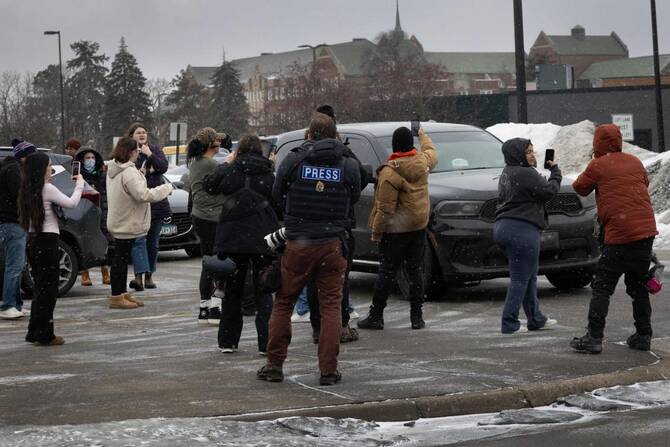
US judge orders curbs on immigration agents’ tactics toward Minnesota protesters

US District Judge Kate Menendez issued an injunction barring federal agents from retaliating against individuals engaged in non-violent, unobstructive protest activity. (Getty Images via AFP)
Short Url
Updated 17 January 2026
Follow

US judge orders curbs on immigration agents’ tactics toward Minnesota protesters

  • Arrests and tear-gassing of peaceful demonstrators prohibited
  • Observers also protected from arrests, crowd-control munitions

MINNEAPOLIS: A federal judge in Minnesota on Friday ordered that US immigration agents deployed en masse to Minneapolis be restricted in some of the tactics they have taken against peaceful demonstrators and observers, including arrests and tear-gassing.
Handing a victory to local activists in Minnesota’s most populous city, US District Judge Kate Menendez issued an injunction barring federal agents from retaliating against individuals engaged in non-violent, unobstructive protest activity.
The ruling was in response to a lawsuit filed against the US Department of Homeland Security and other federal agencies on December 17, three weeks before an immigration agent fatally shot Renee Good, a 37-year-old woman in Minneapolis, spawning waves of protests and putting the city on edge.
The court case was brought on behalf of six protesters and observers who claimed their constitutional rights had been infringed by the actions of ICE agents.
The ‌83-page order explicitly ‌prohibits federal officers from detaining people who are peacefully protesting or merely observing the ‌officers, ⁠unless there is ‌reasonable suspicion that they are interfering with law enforcement or have committed a crime.
Federal agents also are banned from using pepper spray, tear gas or other crowd-control munitions against peaceful demonstrators or bystanders observing and recording the immigration enforcement operations, the judge ruled.
Menendez wrote that the government, in defending the street tactics of its immigration officers, had failed to “explain why it is necessary for them to arrest and use force against peaceful observers.”
Stopping or detaining drivers and passengers in vehicles when there is no reason to believe they are forcibly obstructing or interfering with federal agents is likewise prohibited, according to the court ⁠order.
Order comes amid heightened tensions
“There may be ample suspicion to stop cars, and even arrest drivers, engaged in dangerous conduct while following immigration enforcement officers, but ‌that does not justify stops of cars not breaking the law,” Menendez ‍wrote.
The DHS did not immediately respond to a ‍Reuters request for comment.
The ruling comes nearly two weeks after the Trump administration announced it was sending 2,000 immigration ‍agents to the Minneapolis area, bolstering an earlier deployment in what the DHS called its largest such operation in history.
The surge in heavily armed officers from the Immigration and Customs Enforcement agency and Border Patrol has since grown to nearly 3,000, dwarfing the ranks of local police officers in the Twin Cities metropolitan area of Minneapolis and St. Paul.
Tensions over the deployment have mounted considerably since an ICE agent fatally shot Good, a mother of three, behind the wheel of her car on January 7.
At the time, Good was taking part in one of numerous neighborhood ⁠patrols organized by local activists to track and monitor ICE activities.
Homeland Security Secretary Kristi Noem, one of the federal officials named in the lawsuit, said after the shooting that Good had been “stalking and impeding” ICE agents all day and had committed an act of “domestic terrorism” by trying to run over federal officers.
Minneapolis Mayor Jacob Frey and local activists disputed Noem’s account, saying Good posed no physical threat to ICE agents. They pointed to video clips of the incident they said showed that Good was trying to drive her car away from officers and that the use of lethal force against her was unjustified.
Frey and Minnesota Governor Tim Walz have repeatedly demanded that the Trump administration withdraw the immigration agents, asserting that the operation is being conducted in a reckless manner endangering the public.
While largely siding with the plaintiffs in the case, the judge did not grant all their requests, declining to ban the federal government from actions not specifically taken against those who ‌filed suit. She also limited the injunction to officers deployed in the Twin Cities, rather than extending it statewide.


Troops guard Bangladesh depots as fuel crunch hits Asia

Updated 2 sec ago
Follow

Troops guard Bangladesh depots as fuel crunch hits Asia

  • The oil price spike caused by the war in the Middle East has sparked unrest in Bangladesh and exasperation at petrol pumps around Asia
DHAKA: The oil price spike caused by the war in the Middle East has sparked unrest in Bangladesh and exasperation at petrol pumps around Asia, where many economies are heavily dependent on fossil fuel imports.
Even as governments move to limit the impact on fuel prices, lines have formed at petrol stations in countries including Vietnam, Pakistan and the Philippines, although the situation remains stable elsewhere.
In Bangladesh — which imports 95 percent of its oil and gas needs — the military has been deployed at major oil depots, as police patrol in and around filling stations.
“We haven’t received supply from the depot, but the bike riders weren’t convinced and vandalized the station,” said petrol station worker Ashrafuzzaman Dulal told AFP, describing violence on Sunday.
On Tuesday his station Shahjahan Traders, one of the oldest in the capital Dhaka, had hung a banner apologizing because its stock had run out.
The South Asian nation of 170 million people has started fuel rationing, sent students home and scrapped celebratory light displays over the energy crunch.
One man was killed on Saturday night in the southern Bangladeshi district of Jhenaidah after an altercation over refueling with staff.
Following the 25-year-old’s death, angry crowds torched three buses and vandalized a filling station, police said.
- ‘So, so angry’ -
On Tuesday, queues stretched for 1.5 kilometers (nearly one mile) through Dhaka’s city center.
“My boss left the car here and took a rickshaw to reach his destination,” Kamrul Hasan, who was waiting in a vehicle almost at the end of the queue, told AFP.
Filling station worker Akhtar Hossain said he had not stopped for hours.
“Even during the Gulf War, we didn’t experience this sort of rush,” Hossain told AFP.
Oil prices fell Tuesday after US President Donald Trump said the US-Israel war on Iran could end “very soon.”
The previous day, the price of benchmark crude had rocketed past $100 a barrel — its highest level since Russia’s invasion of Ukraine in 2022.
The market instability came as Iran targeted the crude-rich Gulf with missile and drone barrages.
Maritime traffic in the Strait of Hormuz — a key Gulf waterway through which a fifth of global crude passes — has also all but halted since the war broke out.
Thousands of motorbike riders queued for fuel Tuesday in Vietnam, where prices for unleaded gasoline have surged more than 20 percent.
Vietnam has so far avoided mass shortages, with the government scraping duties on many imported petroleum products.
A 57-year-old who gave his name as Tuan told AFP at a Hanoi petrol station that he was “so, so angry.”
“I have been waiting in line for almost one hour. Then my turn came, and they said their system is down,” he said as dozens of drivers waited but others gave up.
- Myanmar price spike -
Vehicles also lined up in scorching heat at Philippine petrol stations this week, as officials warned against hoarding fuel, with similar scenes unfolding in Pakistan and Sri Lanka.
Enrico Guda, a gas station attendant in Metro Manila, said the station had double its usual daily workload as people rushed to fuel up before prices jumped.
In Myanmar, which imports 90 percent of its fuel oil and has long suffered from a fragile energy supply chain owing to the civil war consuming the country, traffic curbs are in place.
From Saturday, half of private vehicles have been ordered off the roads each day to preserve oil stocks.
“Some drivers depend on their vehicles for work and survival... the new system has made it harder for them to run their businesses,” said Hla Htay, 56, a car rental business owner.
In the Myanmar frontier town of Tachileik, an AFP reporter saw signs cross-border supplies from Thailand had been cut — with some petrol stations shut last week after an up-to threefold price spike the day before.
In several other Asian countries, from Japan to Indonesia, as well as China, India and Afghanistan, panic appears not yet to have hit, apart from a few sporadic queues for petrol.
“I used to fill up regularly once a week, but now I try to fill up whenever I find a cheaper gas station,” South Korean businessman Lee In-tae, 42, told AFP in Seoul.