

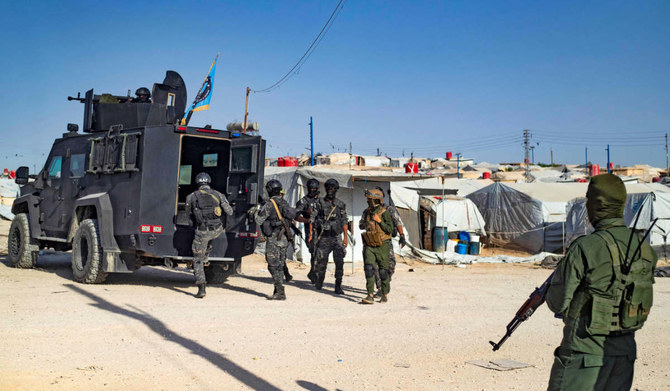

BAGHDAD: Fifty Daesh terrorists and 168 Iraqi members of terrorist families were repatriated from Syria to Iraq on Saturday, an Iraqi official said.
Iraqi authorities “received 50 members of the Daesh from the Syrian Democratic Forces (SDF),” said the source who spoke on condition of anonymity.
The SDF are the Kurds’ de facto army in the area, and led the battle that dislodged Daesh group fighters from the last scraps of their Syrian territory in 2019.
They will “be the subject of investigations and will face Iraqi justice,” they added.
According to conflict monitor the Syrian Observatory for Human Rights they were detained in Hasakah, northeast Syria.
Additionally, 168 relatives of Daesh-group members were repatriated from Syria’s Al-Hol camp to be relocated to Al-Jadaa camp south of Mosul, the Iraqi official added, where they will undergo psychiatric treatment.
“Once we receive the assurances of their tribal leaders that they will not face reprisals, they will be sent home.”
Al-Hol camp, in Kurdish-controlled northeast Syria, is home to about 50,000 people including family members of suspected terrorists.
Among them are displaced Syrians, Iraqi refugees as well as more than 10,000 foreigners originally from some 60 countries.
In March, UN Secretary-General Antonio Guterres called for the swift repatriation of foreigners held in Al-Hol.
Nearly half of the camp’s population is under the age of 12 and residents are “deprived of their rights, vulnerable, and marginalized,” Guterres said in a statement during a visit to Iraq.
“I have no doubt to say that the worst camp that exists in today’s world is Al-Hol, with the worst possible conditions for people and with enormous suffering for the people that have been stranded there for years,” Guterres said.
Since May 2021, hundreds of families have been transferred from Al-Hol to Al-Jadaa in Iraq, with a number of those going on to flee.
The repatriation to Iraq of relatives of fighters who joined the ultra-radical group that controlled one-third of Iraq between 2014 and 2017 has sparked opposition.
In December 2021, Iraqi authorities announced plans to close Al-Jadaa.
But little progress has been made and the relocation of displaced people to their home regions has proven challenging and prompted opposition from local people.


