

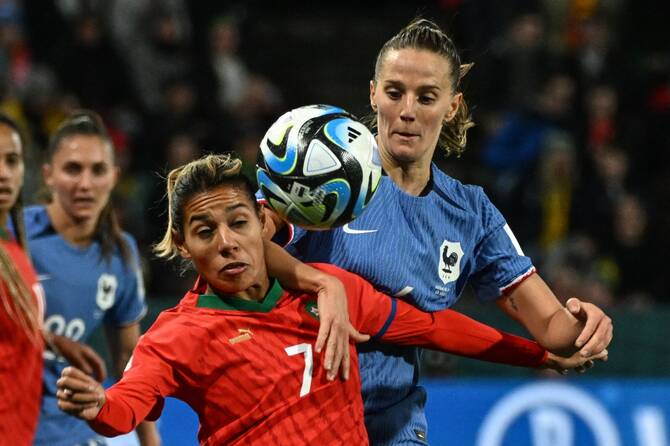

CAIRO: Ghizlane Chebbak does not remember a time without a ball at her feet.
Her late father, Larbi Chebbak, who helped guide Morocco to the Africa Cup of Nations title back in 1976, gave her a football when she was a little girl — and it was love at first sight.
She would play in the streets of her neighborhood in Casablanca with her brothers and other boys and has memories of herself as an eight-year-old already playing football at a club.
“In my neighborhood, I was the only girl playing football,” Chebbak told Arab News. “My family helped me continue in the sport. My father loved football. My brothers love football. My mother encouraged me to play football. I didn’t have a problem with my family. Girls who stop playing usually have problems with their families.
“Alhamdulillah, I had a lot of support from my family. They were happy when they saw me playing football. That made me happy and made me more comfortable playing the game. I always say this, to this day, I am lucky that I have a family who loves sports and loves football in particular.”
Buoyed by that support, Chebbak has gone on to become arguably the greatest and most influential player in the history of Moroccan women’s football. Now 35, she is ready to lead the Atlas Lionesses in a third consecutive Women’s AFCON.
Winner of the Golden Boot in the previous two WAFCON competitions, netting five goals last year and three in the one before that, Chebbak is determined to secure the title with Morocco — starting with a match against Kenya at Moulay El Hassan Stadium in Rabat on Sunday.
Morocco finished runners-up in the last two WAFCONs and are keen to emulate their male counterparts by triumphing on home soil.
“One of my biggest dreams is to win a title with the national team,” said the veteran forward. “For me, all the titles I won at club level or all the individual awards I have won wouldn’t amount to 1 percent of a title I would win with the national team.
“God willing, we are ready and our spirits are high, and Inshallah we have a better tournament than the ones we had before. We have all the capabilities to perform at a high level. We have many talented players, disciplined players. So we hope that this year we will win the title.”
Just as Morocco’s men have reached unprecedented heights on football’s global stage in recent years, the country’s women have also been writing history for their country as they make rapid progress.
The Atlas Lionesses played in their first WAFCON since 2000 when they hosted the tournament in 2022. They made the final, with Chebbak earning Player of the Tournament as well as the Golden Boot.
As one of the four teams to reach the semifinals at that tournament, the Moroccans sealed qualification for the 2023 FIFA Women’s World Cup — the first Arab side to do so.
Their exploits didn’t stop there.
At the World Cup, they rebounded from a brutal 6-0 opening defeat by Germany by advancing to the knockout stage, where they ended up falling to France.
Chebbak recalls how hard it was to deal the loss to Germany and how they won fans’ hearts by turning things around with victories over Colombia and South Korea.
“We knew that it was our first experience at that stage. It was a dream for each of us to play in the World Cup. It is no mean feat, it’s not something that everyone can achieve,” she reflected.
“The idea was not to just go and participate and be the weak team in the group, the team that everyone would beat. Our mentality was that we wanted to surprise everyone. We had a difficult group. But we were thinking that, since we reached this point too, then we, also, are not an easy team to beat. We felt like we had the same goal and same spirit. We all wanted to represent our country in the best way possible in the World Cup.”
The reaction from people back home following the Germany game was ruthless.
“It was difficult because everyone was sending us sarcastic messages and comments and making fun of us. They thought they would break us or defeat us,” Chebbak said.
“But these messages were a great source of motivation for us to change the people’s mentality. To tell everyone who was making fun of us that we did not just come to participate. But that we wanted to do something exceptional. We wanted to do something that no Arab team had done before.”
She added: “It was a motivation for us. I remember that there were messages that made us cry. But after that, we did a remontada that forced everyone to talk about us. And everyone who was badmouthing us ended up telling us how proud they were of us. I always say that results can change people’s mentality. Thank God, we were able to surprise everyone.”
With a professional career spanning 20 years, Chebbak has experienced firsthand the evolution of football in Morocco.
She credits the King of Morocco, Mohammed VI, for the vision that led to a complete overhaul of the football system within the country. A regime change within the Royal Moroccan Football Federation combined with investments in infrastructure and the game in general has led to significant evolution as well as financial stability.
“There are a lot of people who see the results that Morocco has achieved now, they think it’s by coincidence, and they are surprised by the results. No, this is the result of years and years of hard work,” she said.
“It took years to get here; it’s not by chance. I lived in a time when there was nothing (dedicated to women’s football), and now there is everything, thank God. But there are still things we have to do.”
On a personal level, there is very little Chebbak has not achieved.
During her two-decade career, she enjoyed a 12-year spell with Moroccan giants ASFAR, with whom she won the Moroccan Women’s Championship 10 times and the Moroccan Women Throne Cup nine times.
She had a stint playing club football in Egypt, and in 2024, she signed with Spanish club Levante Badalona, becoming the first Moroccan to move from a domestic club to a European side.
This past season, Chebbak has played at Al-Hilal in Saudi Arabia, helping them reach the final of the Saudi Women’s Cup.
At the CAF Awards last November, she became the first Moroccan to be named African Women’s Footballer of the Year and shared the stage with Achraf Hakimi, who won the men’s award.
“It was a great feeling. An indescribable feeling. It is also a great honor,” said Chebbak, who is also the first Moroccan and the second African player to win a FIFPRO Best XI award.
“It is the fruit of years and years of labor and hard work, years of effort, and sacrifices, that in the end, earns you something like this. But it also gives you greater responsibility.
“It gives you the power to continue. So you don’t get tired of training or underperform in any game. You have more responsibility. Because once you win an award like this, all eyes are on you and people will judge if you deserve it or not.”
She added: “Winning an award like this also helps you build a good image and become a good role model for others. I’m talking about the Moroccan players and our national team. This is a way to show them that nothing is impossible. One of you has won this award, you can do it too. You can work hard, you can believe in yourself so that one day, you will be in my position too.”
Chebbak enjoyed playing with Al-Hilal — she signed a one-year contract — and said the standard of women’s football in the Kingdom had surprised her.
“The league is very competitive. The level is quite close among the teams, there are four or five teams that are on the same level,” she said. “So there is a fierce competition, and the level of the players continues to improve. This, of course, develops the level of the league as a whole.”
At 35, Chebbak insists that “age is just a number” and she is not placing any limitations on herself. She draws inspiration from Cristiano Ronaldo, who continues to compete at 41.
Her next club destination has yet to be revealed. For now, she is fully focused on Morocco’s WAFCON campaign which sees the hosts headline Group A alongside Algeria, Senegal and Kenya.
A maiden continental title and qualification for the 2027 FIFA Women’s World Cup is on the line.
“My biggest ambition will always be to win a title with the national team,” Chebbak said.
“I don’t have any bigger ambitions than winning a title with the national team. Individual awards, yes, I like them, but it’s not my first interest.”


