

After Daesh and bombs, refugee sisters sing of Kurdish sorrow

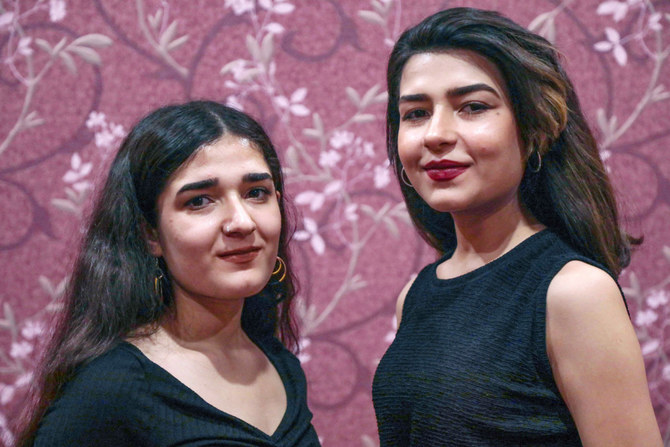
Syrian-Kurdish refugees and musicians Norshean Salih, 23, right, and her sister Perwin Salih, 20, in Irbil, the capital of the autonomous Kurdish region of northern Iraq. (AFP)
Short Url
Updated 03 June 2023
Follow

After Daesh and bombs, refugee sisters sing of Kurdish sorrow

  • They have twice been driven from their family home in northern Syrian town of Kobani
  • Kurdish folk songs are our favorite type of music. They tell the plight of the Kurds, the wars, the tragedy of displacement and the killings

IRBIL: When the Syrian Kurdish sisters Perwin and Norshean Salih sing about loss, it comes from the heart.

Aged in their early 20s, they have twice been driven from their family home in the northern Syrian town of Kobani — once by the Daesh group, and again by the threat of Turkish bombs.
Now they have found a safe haven in northern Iraq’s Kurdish region, where they carve out a living by performing the often melancholy music of their people in a restaurant.
“Kurdish folk songs are our favorite type of music,” said Perwin Salih, 20, who plays the santoor, tambourine and Armenian flute. “They tell the plight of the Kurds, the wars, the tragedy of displacement and the killings.” The Kurds, a non-Arab ethnic group of between 25 million and 35 million people, are spread mainly across Turkiye, Syria, Iraq and Iran, with no state of their own.
They have long complained of oppression but endured special horrors during Syria’s 12-year civil war, especially the Daesh onslaught.
When the jihadists attacked Kobani in late 2014, and heavy fighting turned the town into a symbol of Kurdish resistance, the sisters fled across the border to Turkiye.
After several unhappy months in Istanbul, they moved to the mainly Kurdish city of Diyarbakir in Turkiye’s southeast where they continued their music studies.
They moved back home in 2019, after Syrian Kurdish-led forces drove Daesh out of their last territorial stronghold, with US backing. Turkiye has kept targeting parts of northern Syria in what Ankara says is a fight against Kurdish militants.
Once, the sisters say, mortar shells hit their family home, thankfully without exploding.
Late last year, when Turkiye launched major air and artillery strikes, the Salih sisters fled once more, this time to Iraq, where they and two more siblings now rent a modest two-room house in Irbil.
The two women said they grew up in a household of music lovers, with their mother singing to them before bedtime while their father played the tambourine.
But the trauma they have endured since has left deep scars.
“A vision of Daesh still haunts me,” said Perwin. “Men in black clothes, holding black flags, on a quest to turn life itself black.”
At a recent concert, Perwin played the flute while Norshean, 23, captivated the audience with a Kurdish folk tune about displacement.
“I am a stranger,” she sang softly. “Without you, mother, my wings are broken. I am a stranger, and life abroad is like a prison.”
Norshean, a classical music afficionado, also plays the piano, guitar and kamanja, an ancient Persian string instrument, and dreams of making it as a violinist.
But for now she has recurring nightmares of the jihadists.
“The Daesh still haunts my dreams,” she said. On their latest escape from Kobani, the sisters faced another nightmare.
At the border, Syrian soldiers demanded that they play, warning that they would confiscate the instruments if they didn’t like the music. “We cried while we played, and when we were done they smiled and said: now you can pass,” recounted Norshean.
The sisters now mainly perform at a restaurant called Beroea, an ancient name for the once-vibrant Syrian city of Aleppo.
Co-owner Riyad Othman said he was not surprised by the dangers the women have had to face.
A Syrian Kurd himself, he said his people “spend their entire life fleeing, estranged and suffering.”


Gaza access: Foreign press group welcomes Israel court deadline

Updated 5 sec ago
Follow

Gaza access: Foreign press group welcomes Israel court deadline

  • The Foreign Press Association, which represents hundreds of foreign journalists in Israel and the Palestinian territories, filed a petition to the Supreme Court last year, seeking immediate access for international journalists to the Gaza Strip

JERUSALEM: The Foreign Press Association in Jerusalem on Sunday welcomed the Israeli Supreme Court’s decision to set Jan. 4 as the deadline for Israel to respond to its petition seeking media access to Gaza.
Since the start of the Gaza war in October 2023, sparked by the attack on Israel, Israeli authorities have prevented foreign journalists from independently entering the devastated territory.
Israel has instead allowed, on a case-by-case basis, a handful of reporters to accompany its troops into the blockaded Palestinian territory.
The Foreign Press Association, which represents hundreds of foreign journalists in Israel and the Palestinian territories, filed a petition to the Supreme Court last year, seeking immediate access for international journalists to the Gaza Strip.
On Oct. 23, the court held its first hearing in the case and gave Israeli authorities one month to develop a plan to grant access.
Since then, the court has granted several extensions to the Israeli authorities to develop their plan, but on Saturday, it set Jan. 4 as the final deadline.
“If the respondents (Israeli authorities) do not inform us of their position by that date, a decision on the request for a conditional order will be made on the basis of the material in the case file,” the court said.
The FPA welcomed the court’s latest directive.
“After two years of the state’s delay tactics, we are pleased that the court’s patience has finally run out,” the association said in a statement.
“We renew our call for the state of Israel to immediately grant journalists free and unfettered access to the Gaza Strip.
“And should the government continue to obstruct press freedoms, we hope that the Supreme Court will recognize and uphold those freedoms,” it added.
An AFP journalist serves on the FPA board.
Meanwhile, US Senator Lindsey Graham accused Hamas of rearming during a visit to Israel on Sunday, and charged that the Palestinian group was also consolidating power in Gaza.
“My impression is that Hamas is not disarming, they are rearming,” Graham said in a video statement issued by Prime Minister Benjamin Netanyahu’s office.
“It’s my impression that they are trying to consolidate power (and) not give it up in Gaza.”
Graham’s remarks came a day after mediators the US, Qatar, Egypt, and Turkiye urged both sides in the Gaza war to uphold the ceasefire.
Hamas has called on the mediators and Washington to stop Israeli “violations” of the ceasefire.
On Friday, six people, including two children, were killed in an Israeli bombing of a school serving as a shelter for displaced people, according to the civil defense agency in Gaza.