Record inflation in Pakistan creating ‘unprecedented hardships’ for country’s poor — experts

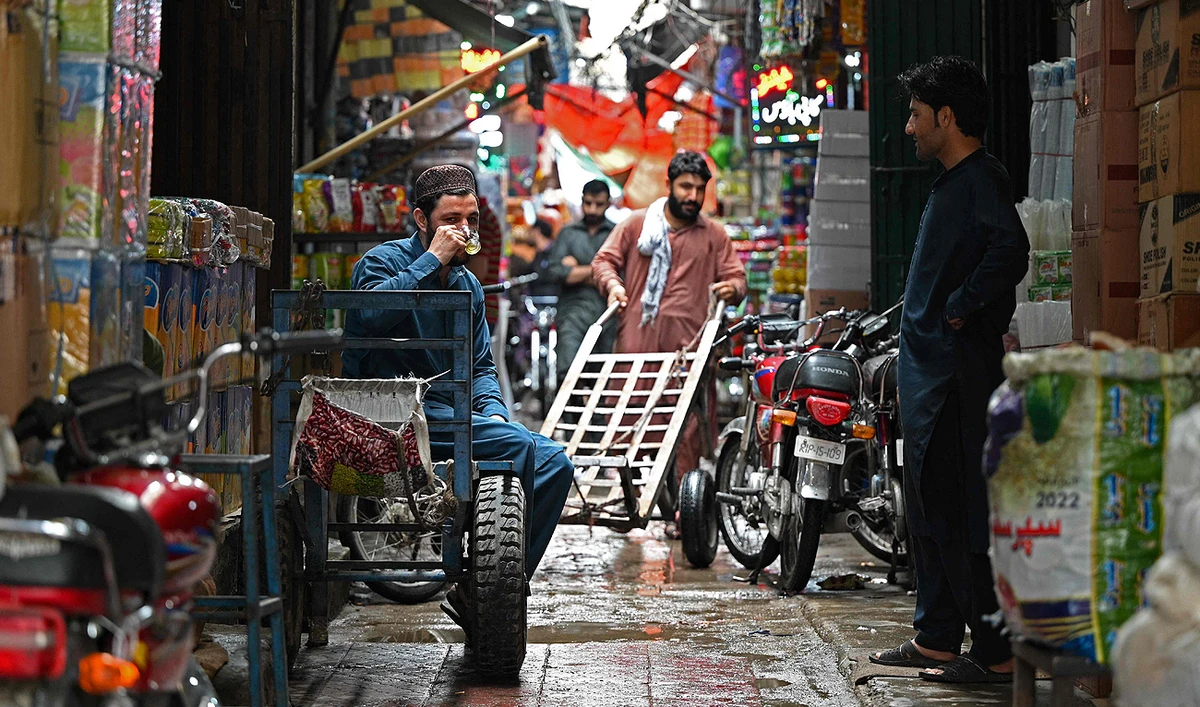
A trader drinks tea along an alley in a market in Rawalpindi on June 1, 2023. (Photo courtesy: AFP)
Short Url
Updated 05 June 2023
Follow

Record inflation in Pakistan creating ‘unprecedented hardships’ for country’s poor — experts

  • Supply constraints, currency devaluation, hoarding are some of the key elements that continue to push inflation up in Pakistan
  • Financial experts call for increase in income-support program, minimum wage in public and private sector to mitigate the impact

KARACHI: The historic high inflation in Pakistan is hitting the poor and creating “unprecedented” hardships for the low-income groups, financial experts said on Friday, adding the situation has forced masses to spend much of their income on food.

The South Asian nation has been witnessing an increase in the inflation rate since late last year when the government took prior actions to comply with the conditions set by the International Monetary Fund (IMF) to revive a stalled $7 billion bailout program., stalled since November.

Pakistan reported 38 percent inflation in May as compared to 36.4 percent in April, on the back of rising food and energy prices and a massive currency devaluation. The Pakistani currency has devalued by around 30 percent since last June and played a major role in piling up the inflationary pressure. 

Food inflation in May rose by 48.65 percent on an annual basis, driven by an uptick in prices of tea that increased by 112.18 percent, potatoes 108.17 percent, wheat flour 99.02 percent and eggs by 90.27 percent, according to the Pakistan Bureau of Statistics (PBS).

“The record high inflation in Pakistan, in fact hyperinflation, in food item is affecting the financially vulnerable population creating unprecedented hardships for them, especially those living in rural and remote areas,” Dr. Ikramul Haq, a Lahore-based economist, told Arab News. 

Haq said the high cost of utilities, nearly 25 percent borrowing rate and extractive taxes were pushing businesses to raise the prices.

“Many are even closing down due to these factors pushing unemployment that is badly affecting the poor and the low-income groups,” he added. 

Haq said the stagnant economy and disrupted supply chains due to continued embargo on imports is a “sure recipe” for disaster for the vast majority of the population, especially those living below the poverty line.

Dr. Khaqan Najeeb, a former adviser to the Pakistani finance ministry, identified supply constraints, currency devaluation and hoarding as the key elements pushing the inflation rate up.

“This, of course, is unprecedented and affects the middle-, low-income and the vulnerable the most as more of their income is spent on food items,” Najeeb said.

Families affected by the rising inflation say they have made a drastic cut in their kitchen spending and are focusing only on most essential items. 

“We have cut down on some of the kitchen items, including cheese, bakery items and cereals,” said Fatima Ali, a housewife. “We have also reduced the quantity of items to strike a balance between income and expenditures.”

As the inflationary pressure continues to build up, people falling in the low-income group say the high inflation rate has deprived them of some of the protein-rich food items.

“We can’t think of mutton now,” said Ali Raza, an office assistant. “The prices of chicken are also getting out of our purchasing power so we have reduced purchasing.”

As Pakistan’s Finance Minister Ishaq Dar prepares to present budget for the next fiscal year, financial experts expect the government to take steps to mitigate the suffering of low-income groups.

“The mitigation aspects in the budget could be three in my opinion,” Najeeb said. “Substantial increase in the income-support program, rise in minimum wage, and increase in pensions and wages of the federal and provincial government employees, with the private sector following suit.”

Analysts hope that inflation would gradually start declining this month. 

“We anticipate monthly inflation to soften from June 2023 and gradually decline over the next 12 months, majorly because of base effect along with tight monetary and fiscal policy,” Muhammad Sohail, CEO of Karachi-based Topline Securities brokerage house, told Arab News. 

“Petrol and diesel prices were reduced by 7-12 percent in May 2023. This will also ease inflation in the coming months, unless any major pressure is seen on rupee.”

Pakistan has ruled out military operation in northwestern Tirah Valley

Updated 4 sec ago
Follow

Pakistan has ruled out military operation in northwestern Tirah Valley

  • Residents in northwestern Tirah Valley fled their homes this month fearing a military operation against militants
  • Defense minister says army conducting intelligence-based operations in area, residents’ migration “routine” practice

Islamabad: Defense Minister Khawaja Asif on Tuesday clarified that the military was not conducting a military operation in the northwestern Tirah Valley, saying that the ongoing residents’ migration from the area was a routine practice that has been going on for several years. 

The defense minister’s clarification came as residents of Tirah Valley in Pakistan’s northwestern Khyber Pakhtunkhwa (KP) province bordering Afghanistan fled their homes this month, fearing a planned military operation by the army against militants, particularly the Tehreek-e-Taliban Pakistan (TTP) group. 

Pakistan’s information ministry on Sunday issued a clarification that the armed forces were not involved in the “depopulation” of the valley. It pointed to a notification from the provincial Khyber Pakhtunkhwa Relief, Rehabilitation and Resettlement Department in December which demanded the release of funds, reportedly Rs4 billion [$14.24 million], for the voluntary movement of people from Tirah Valley. 

Speaking to reporters at a news conference alongside Information Minister Attaullah Tarar and Special Assistant to the PM for Information and KP Affairs Ikhtiar Wali Khan, Asif said the last military operation in the area was conducted several years ago. He said the military had decided that intelligence-based operations (IBOs) were more effective than military operations as they resulted in lower civilian casualties. 

“So over a long period of time, the army gave up [military] operation in favor of IBOs,” Asif said. “For many years this practice has been continuing. Hence, there is no question of an operation there.”

The defense minister described the migration of residents from Tirah Valley as a “routine” practice due to the harsh cold. 

He criticized the provincial government, led by the Pakistan Tehreek-e-Insaf (PTI) party for not serving the people of the area, accusing it of not building any schools, hospitals, or police stations in Tirah Valley.

Asif said around 400-500 TTP members lived in the valley with their families, alleging that hemp was being harvested there on over 12,000 acres of land. He said that while hemp is also used for medicinal and construction purposes, its dividends were going to militants and politicians. 

“All of this hemp is harvested there and the dividends from it either go to the people associated with politics or the TTP,” the minister said.

“We have initiated the process to stop this so that the people benefit from this harvest and so that schools and hospitals are constructed there.”

The minister said that a district-level jirga or tribal council met representatives of the KP government on Dec. 11, 24 and 31 to decide matters related to the residents’ migration in the area. 

Holding up the KP Relief, Rehabilitation and Resettlement Department notification, Asif said:

“In the presence of this notification, in the presence of this tribal council and in the presence of all of these things, where do you see the army?“

The minister accused the provincial government of deflecting its “failures” in the province to the armed forces or to a military operation that did not exist. 

The migration has exposed tensions between the provincial government and the military establishment over the use of force in the region.

KP Law Minister Aftab Alam Afridi said earlier this month that the provincial government will not allow a military operation to take place in the area, arguing that past military campaigns had failed to deliver lasting stability.