Pakistan’s national currency makes historic recovery against USD in open market — currency dealers

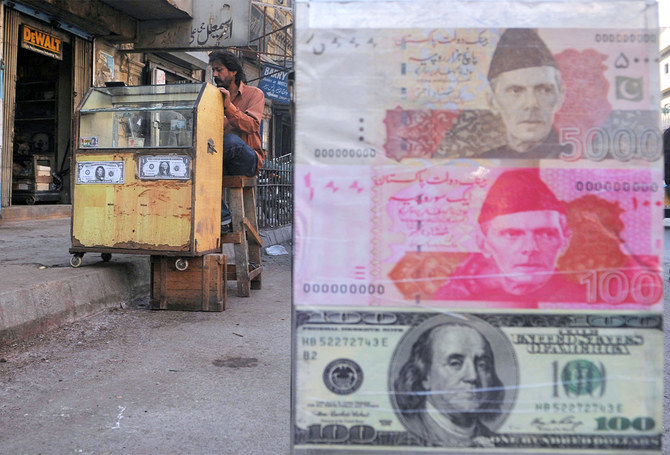
A hoarding display (R) showing currency notes are pictured as a money exchange vendor waits for customers at a local and foreign currency market in Karachi, Pakistan, on December 14, 2011. (AFP/File)
Short Url
Updated 01 June 2023
Follow

Pakistan’s national currency makes historic recovery against USD in open market — currency dealers

  • Appreciation follows central bank’s decision to allow banks to buy dollars from interbank market for credit and debit card payment settlements
  • Rupee was trading at Rs290 in open market during afternoon trading session as compared to Rs315 in the previous day’s trading

KARACHI: Pakistan’s national currency posted historic gains against the United State dollar in the open market on Thursday, following the central bank’s decision to allow banks to buy dollars from the interbank market for credit and debit card payment settlements, currency dealers said.

The rupee was trading at Rs290 in the open market during the afternoon trading session as compared to Rs315 in the previous day’s trading, showing an appreciation of 8 percent, according to dealers. 

“The rupee has appreciated more than Rs25 in the open market and this has happened for the first time in the history of Pakistan,” Malik Bostan, chairman of the Exchange Companies Association of Pakistan (ECAP), told Arab News. 

The currency appreciated in the open market after the central bank on Wednesday allowed authorized dealers, that is banks, to “purchase dollar from the interbank for settlement of the card based cross border transactions with IPS (Instant Payment System),” a notification said.

Prior to the State Bank notification, commercial banks were buying around $15-20 million from the free market per day, putting an excessive burden on it, the key reason for the widening gap between the interbank and open market, according to Bostan. 

“The banks were buying dollars from the open market at Rs315 but they were selling to their customers for the settlement at Rs325,” Bostan said, adding that banks had been buying from the open market but selling to their credit card holders at higher rates which excessively burdened the free market.

“They, Finance Minister Ishaq Dar and Central bank, took the timely decision and allowed them to purchase from the interbank market instead of the exchange companies,” he added.

Bostan’s claims could not be independently verified.

The ECAP chief predicted that the central bank’s decision would lead to further appreciation of the rupee in the open market, to reach close to the interbank rate.

The rupee in the interbank was trading between Rs290 and Rs300 at the end of trading session on Thursday, according to Bostan.

Pakistani analysts said the central bank’s move had eased the pressure on the open market and would also narrow the gap between the open and interbank markets in line with the International Monetary Fund’s conditions.

“The demand for credit and debit card settlement is around $2 billion to $2.5 billion per annum and the central bank’s decision has eased off the pressure from the open market,” Tahir Abbas, Head of the research at Arif Habib Limited, said. “The IMF also wanted to reduce the gap between the exchange rates prevailing in the interbank and open markets.” 

The rupee in the interbank market closed at Rs285.47 against the greenback on Wednesday.


Post-break return of students drives surge in education spending, SAMA data shows

Updated 10 sec ago
Follow

Post-break return of students drives surge in education spending, SAMA data shows

RIYADH: Spending on education in Saudi Arabia increased by 141.1 percent for the week ending Jan. 24, as students returned to the classroom after the mid-year break.

This was accompanied by a 7 percent increase in spending on books and stationery, which reached SR146.17 million ($38.9 million).

According to the latest data from the Saudi Central Bank, the over POS value dropped 10.6 percent to SR12.52 billion, with transactions representing a 9.7 percent week-on-week decrease to 213.62 million.

This week saw negative changes across all the remaining sectors. Spending on bakeries and pastries saw an 18.4 percent decline to SR229.71 million, while gas stations saw an 11 percent drop. Professional and business services decreased by 11.6 percent.

Expenditure on apparel and clothing fell by 19.7 percent to SR985.94 million, followed by a 2.8 percent drop in spending on jewelry.

Spending on car rentals in the Kingdom fell by 14.7 percent, while airlines saw a 9.3 percent decrease to SR38.16 million.

Expenditure on food and beverages saw a 7.9 percent decline to SR1.88 billion, claiming the largest share of the POS. Restaurants and cafes retained the second position despite an 18.5 percent decrease to SR1.50 billion.

Geographically, Riyadh accounted for the largest share of total POS spending, but still saw a 6 percent dip to SR4.46 billion, down from SR4.74 billion the previous week. The number of transactions in the capital settled at 69.07 million, down 6.8 percent week on week.

In Jeddah, transaction values decreased by 13.6 percent to SR1.75 billion, while Dammam reported a 4.8 percent decrease to SR640.59 million.

POS data, tracked weekly by SAMA, provides an indicator of consumer spending trends and the ongoing growth of digital payments in Saudi Arabia. 

The data also highlights the expanding reach of POS infrastructure, extending beyond major retail hubs to smaller cities and service sectors, supporting broader digital inclusion initiatives. 

The growth of digital payment technologies aligns with the Kingdom’s Vision 2030 objectives, promoting electronic transactions and contributing to the Kingdom’s broader digital economy.