


They’re back! Saudi astronauts return safely to Earth after mission to International Space Station

1 / 3
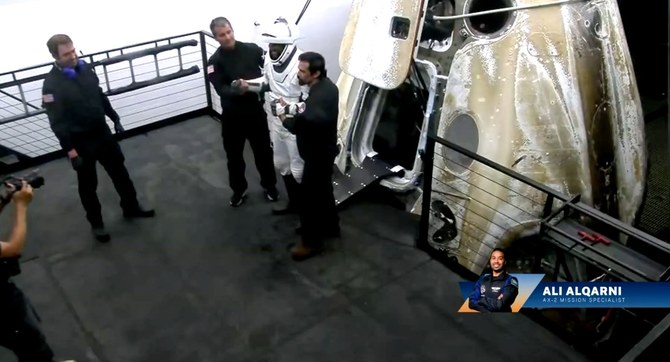
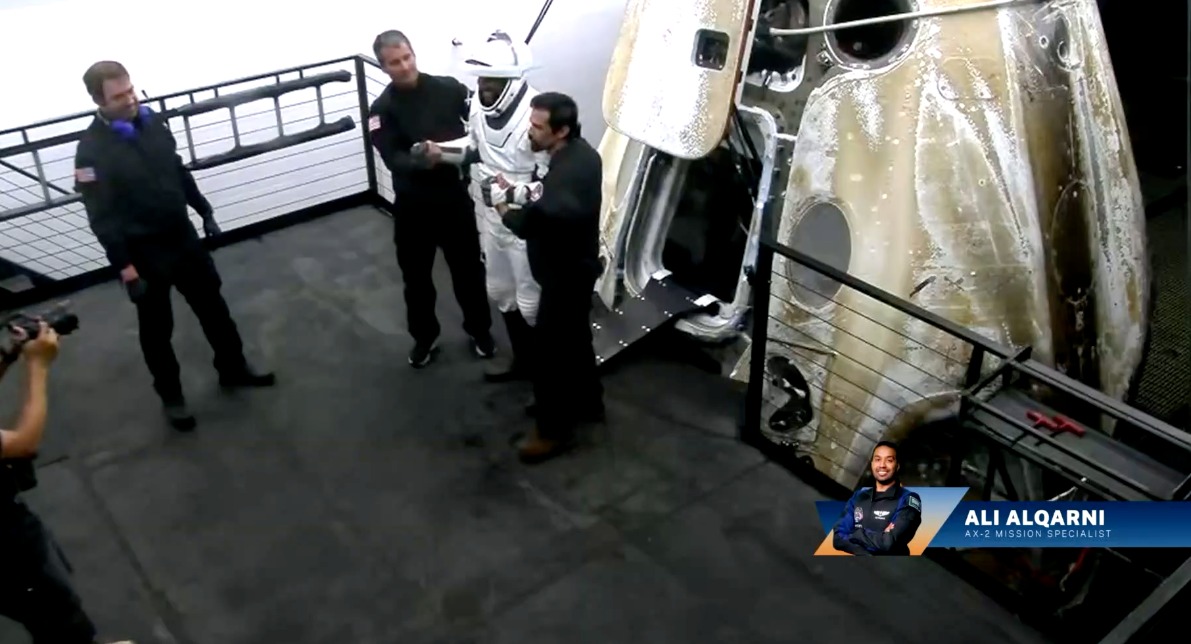
The first view of the four after the safely landed back on Earth. (AXIOM Space screengrab)
2 / 3
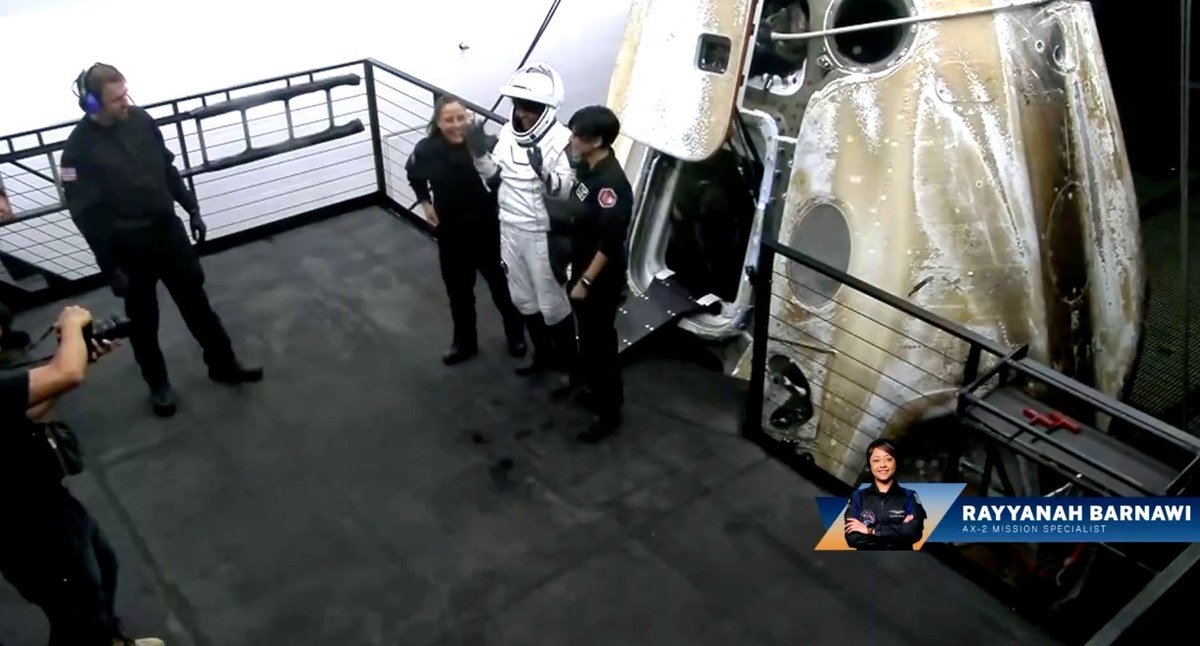
The crew includes commander, former NASA astronaut Peggy Whitson, and pilot John Shoffner, flanked by Saudis Ali Al-Qarni and Rayyanah Barnawi. (AXIOM Space)
3 / 3
Short Url
Updated 31 May 2023
Follow

They’re back! Saudi astronauts return safely to Earth after mission to International Space Station

  • Rayyanah Barnawi first Saudi Arabian and Arab woman to go into space
  • Two Saudi astronauts carried out 8 days of significant research aboard the ISS

JEDDAH: The second all-private mission to fly to the International Space Station returned to Earth off the coast of Florida on Wednesday, carrying two Saudi astronauts following eight days of scientific research aboard the ISS.

The SpaceX Crew Dragon capsule carrying them parachuted down onto the Gulf of Mexico off the coast of Panama City, Florida, after a 12-hour return flight and blazing re-entry plunge through Earth's atmosphere.
The splashdown was carried live by a joint webcast presented by SpaceX and the company behind the mission, Axiom Space.

Mission Specialists Ali Alqarni and Rayyanah Barnawi participated in experiments with Saudi school children as part of their eight-day stay on ISS.

When the door of the capsule opened Rayyanah Barnawi, the first Arab woman to orbit Earth, gave a thumbs up to the camera.

The four astronauts were helped out of the capsule by crew before boarding a helicopter to land where they are due to be flown to Cape Canaveral by plane, where they will meet their families.
 

The touchdown concluded the second space station mission organized, equipped and trained entirely at private expense by Axiom, a 7-year-old Houston-based venture headed by NASA's former ISS program manager.

The Saudi government picked up the multimillion-dollar tab for its two astronauts: Rayyanah Barnawi, a stem cell researcher who became the first Saudi woman in space; and fighter pilot Ali al-Qarni.
The Axiom 2 crew was led by retired NASA astronaut Peggy Whitson, 63, who holds the US record for most time spent in orbit with 665 days in space over three long-duration missions to the ISS, including 10 spacewalks.

During the mission tasks involved working with cutting-edge technologies, while the two Saudis acted as global ambassadors in the fields of science, technology, engineering, arts, and mathematics.


TIMELINE: AX-2 mission’s return to Earth

Some do argue that strictly speaking Barnawi was not the first Arab woman to enter space.

Indeed, in August 2022, Sara Sabry became the first Arab woman and the first Egyptian to fly to space on a brief suborbital ride operated by the Blue Origin astro-tourist venture of Jeff Bezos.

But Barnawi was the first to enter space and orbit Earth.
The ISS stay of Alqarni and Barnawi was also notable for overlapping with that of Sultan Alneyadi, an ISS Expedition-69 crew member from the United Arab Emirates, marking the first time three astronauts from the Arab world were aboard the space station together.
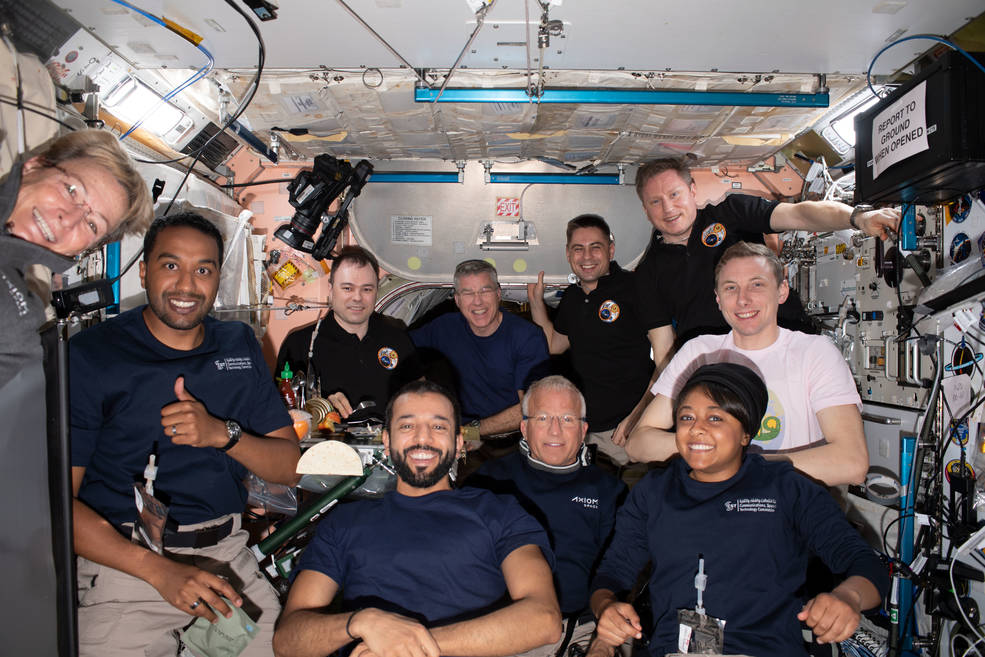


The Axiom Mission-2 and Expedition 69 crew members pose for a portrait together during dinner time aboard the International Space Station. (NASA)

In an emotional farewell ceremony at the end of the mission on Monday, the Axiom-2 crew members reflected on their time in space.

Barnawi said: “Every story comes to an end, and this is only the beginning of a new era for our country and our region.”

Al-Qarni, who with Barnawi became the first Saudi to visit the space station, said: “This is our last day in our great mission. We have achieved all our tasks and it will benefit our country and people in the future.”

Both the astronauts completed 14 pioneering experiments in microgravity, three of which were dedicated to educational and motivational purposes with the participation of 12,000 Saudi students in 47 different locations across the Kingdom.

With them, the craft returned to Earth with a cargo including NASA hardware and data from over 20 different experiments.
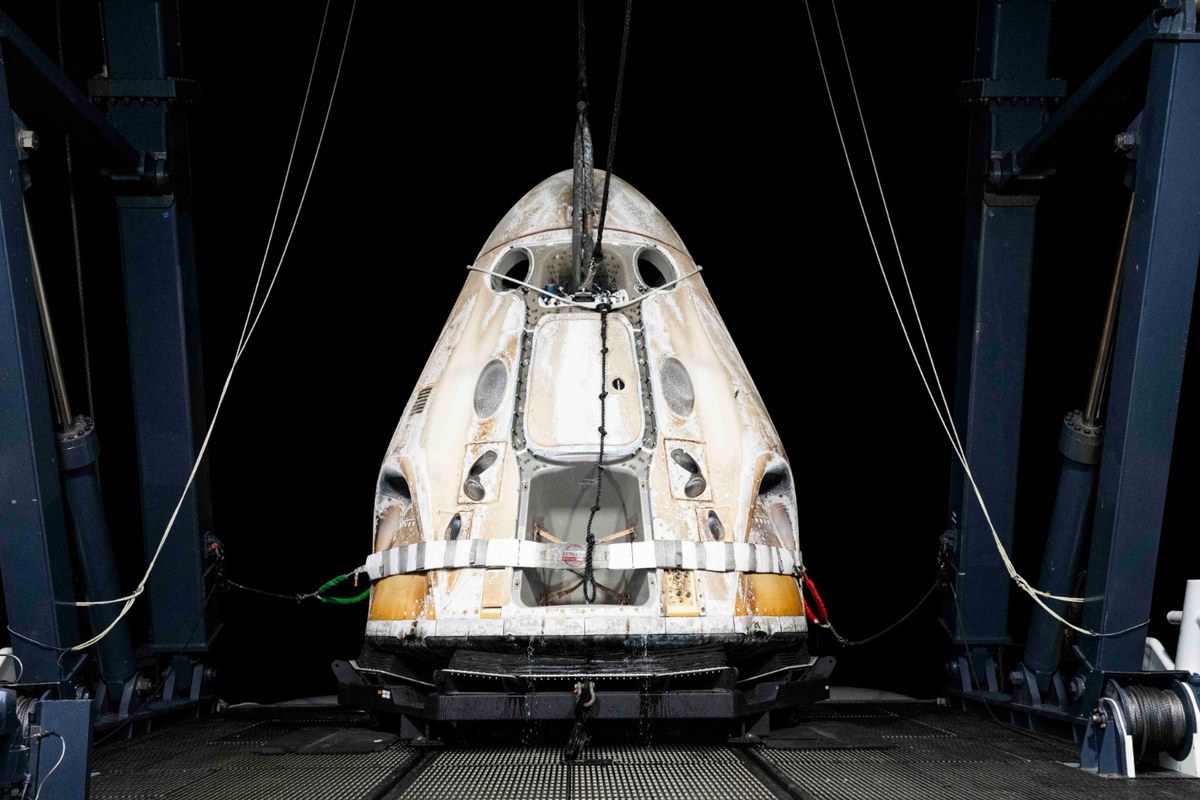


The capsule retrieve from the sea. (SpaceX)

The flight launched on May 21 from NASA’s Kennedy Space Center and docked with the station on May 22.

The Axiom 2 mission, which launched on May 21, was the latest in a series of space expeditions bankrolled by private investment capital and wealthy passengers rather than by taxpayer dollars as NASA seeks to expand commercial access to low-Earth orbit.
Axiom, which sent its first four-member astronaut team to ISS in April 2022, also has signed a contract with the U.S. space agency to build the first commercial addition to the orbiting laboratory.
California-based SpaceX, founded by Twitter owner and Tesla Inc electric carmaker CEO Elon Musk, supplied the Falcon 9 rocket and crew capsule that ferried Axiom’s team to and from orbit and controlled the flight.
NASA furnished the launch site at its Kennedy Space Center in Cape Canaveral, Florida, and assumed responsibility for the Axiom crew during their stay aboard the space station, orbiting some 250 miles (400 km) above Earth. 

(With agencies)


Local ZUMI thermos bottle has heritage-inspired design

Updated 30 January 2026
Follow

Local ZUMI thermos bottle has heritage-inspired design

  • References Zamzam and Hajar’s search for water
  • Helps to tell Kingdom’s story, says firm Teeb Made

ZUMI, a thermos bottle unveiled this month by Saudi Arabia brand Teeb Made, has a design referencing local memory, ritual and place, according to its producers.

“We believe meaningful design can influence how people live, feel, and connect,” said Abeer Alessa, CEO of The Bold Group and co-founder of Teeb Made.

“ZUMI draws from our heritage yet speaks to a global audience seeking intention and authenticity in the objects they choose.”

Developed under The Bold Group, ZUMI reflects a growing movement within Saudi Arabia’s creative sector to translate cultural narratives into tangible products.

Rather than following global design trends, the team focused on grounding the product in a story that resonates locally while remaining accessible internationally.

Above, the team behind Zumi.

The name ZUMI is inspired by Hajar’s call, “Zummi, zummi,” meaning “gather, gather,” during her search for water for her son Ismail between the hills of Safa and Marwah.

That moment led to the emergence of Zamzam water, a source revered for centuries and deeply embedded in Islamic and Saudi identity. For the creators, this origin story became the philosophical core of the product.

“Culture starts with a story,” Alessa explained. “With Teeb Made, we wanted to tell our story not only through communication, but through a product you can touch, live with, and keep close to you.”

Visually, ZUMI draws inspiration from the dorag, the historical vessel used by the Zamazmah men of Makkah to serve Zamzam water to pilgrims for more than 1,400 years.

Traditionally utilitarian, the dorag carried spiritual weight through its purpose rather than ornamentation. Teeb Made reinterpreted this form into a minimal, contemporary silhouette suited for modern lifestyles.

“We wanted ZUMI to be a vessel of meaning, not just water,” said Mohamad Baalbaki, executive creative director of The Bold Group and co-founder of Teeb Made.

“Its form, its patented base, and its simplicity all serve one purpose: to create something that feels familiar, timeless, and deeply personal.”

“We believe meaningful design can influence how people live, feel, and connect,” said Abeer Alessa, CEO of The Bold Group and co-founder of Teeb Made. (Supplied)

The design process was extensive. Translating a historical silhouette into a thermos bottle required more than 18 months of research and development.

The final product received a patented design certification from the Saudi Ministry of Culture, marking a milestone in original Saudi intellectual property within product design.

One of ZUMI’s most talked-about features is that it does not stand upright. This decision was entirely intentional.

“We wanted people to carry it, not leave it on a table,” Baalbaki said. “It’s a statement piece, but more importantly, it’s a personal object that invites interaction and conversation.”

Color selection further reinforces the connection to place. The launch collection features hues inspired by Saudi landscapes, including tin (mud), forest, and matar (rain), reflecting the Kingdom’s environmental diversity and grounding the product visually in its origins.

“ZUMI is a product with a Saudi story that is scalable and built to last,” said Souad Merheb, general manager of Teeb Made. “Our vision is to create intellectual property that can live long, grow as a brand, and carry these stories to new generations without losing their meaning.”

“Teeb Made is, at its core, a product design company,” Merheb added. “Our expertise lies in design and creativity, and ZUMI is a reflection of that focus, a piece of IP developed with intention, patience, and depth.”

“There are many rich and insightful stories in Saudi Arabia that remain untapped,” Alessa said. “With ZUMI, this is just the beginning.”

Beyond the product itself, ZUMI aligns with broader national efforts to elevate Saudi culture through the creative economy.

Teeb Made has engaged with several government entities and cultural platforms that recognize the value of culturally rooted products in shaping global perceptions of the Kingdom.

“Today, every Saudi has a role in telling our story to the world,” Alessa said. “For us, it is an honor to contribute to that narrative through design.”

ZUMI also signals the beginning of a wider design ecosystem under Teeb Made, with future editions and complementary accessories already in development.

According to the team, this is only the first chapter in a larger effort to revive untapped cultural stories through modern design.

ZUMI is available at www.zumibottle.com and on Instagram @zumibottle.