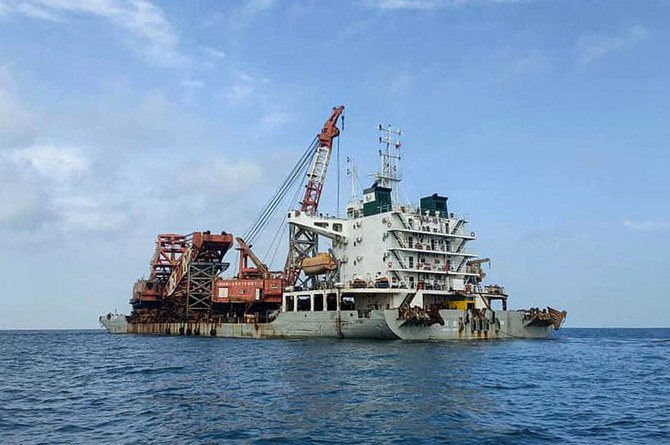
KUALA LUMPUR: Malaysia’s coast guard said on Tuesday authorities were questioning the crew of a Chinese vessel detained on suspicion of looting two British World War II shipwrecks.
Officers discovered unexploded shells upon boarding the Chinese-registered vessel, which was detained for illegal anchorage at the weekend, said Nurul Hizam Zakaria, Malaysian Maritime Enforcement Agency chief in Johor state.
“Our investigation is now directed to where these cannon shells originated from. Right now, we have officers from multi-agencies searching the big ship,” he said.
Nurul Hizam said the vessel from the city of Fuzhou had a crew of 32 comprising 21 Chinese nationals, 10 Bangladeshis and one Malaysian, some of whom were in coast guard custody for questioning.
“This case also involves the discovery of explosives,” he said.
China’s foreign affairs ministry said the Chinese embassy in Malaysia was in close communication with local authorities “to understand the situation.”
It asked Malaysia to handle the case “fairly and in accordance with the law.” Beijing also asked Malaysia to protect the rights and safety of Chinese citizens.
A senior Malaysian maritime official said on condition of anonymity that the pieces of metal and shells could have originated from two sunken British warships.
More than 800 British sailors were killed when the HMS Prince of Wales and HMS Repulse were torpedoed by Japanese aircraft in the South China Sea.
The attack on December 10, 1941, happened three days after Japan attacked the US fleet in Pearl Harbor, Hawaii.
Photos and a video shared by the Malaysian coast guard showed large pieces of corroded metal and shells, as well as a large crane and gas torches used to cut metal on board the ship.
The shells could also be linked to the discovery of unexploded World War II-era ordnance at a jetty in Johor on May 19, the maritime agency said in a statement Monday.
Nurul Hizam said the maritime agency would not tolerate any form of illegal salvage activities in Malaysian waters.
“Our national treasure must be protected and preserved,” he said, describing looting as “an uncivilized act.”
Britain’s Ministry of Defense condemned the “desecration” of maritime military graves after reports that scavengers had targeted two WWII wrecks, the BBC said Saturday.
Malaysia’s New Straits Times newspaper reported in recent weeks that illegal salvage operators had targeted high-grade aluminum and brass fixtures from the two British warships.


![]()


Malaysia searches Chinese ship suspected of looting WWII wrecks
Short Url
https://arab.news/4ebk6
Malaysia searches Chinese ship suspected of looting WWII wrecks
- Officers discover unexploded shells upon boarding the Chinese-registered vessel
- Vessel from the city of Fuzhou had a crew of 32 comprising mostly Chinese nationals


AI reshaping the battle over the narrative of Maduro’s US capture
- Since the US captured Venezuelan leader Nicolas Maduro in early January, pictures and videos chronicling the events have been crowded out by those generated with artificial intelligence
CARACAS: Since the US captured Venezuelan leader Nicolas Maduro in early January, pictures and videos chronicling the events have been crowded out by those generated with artificial intelligence, blurring the lines between fiction and reality.
The endless stream of content ranges from comedic memes to dramatic retellings.
In one, a courtroom illustration of Maduro in a New York courthouse springs to life and announces: “I consider myself a prisoner of war.”
In another, an AI-generated Maduro attempts to escape a US prison through an air duct, only to find himself in a courtroom with US President Donald Trump, where they dance with a judge and an FBI agent to a song by American rapper Ice Spice.
Maduro was captured alongside his wife Cilia Flores during US strikes in the Venezuelan capital of Caracas on January 3.
They have since been taken to a prison in New York where they are being held on drug trafficking charges.
While some have celebrated Maduro’s ouster, the “Chavismo” movement he leads — named after his predecessor Hugo Chavez — has worked to reframe what his fall means for Venezuela’s future.
- ‘ Confuse, combat, and silence’ -
Leon Hernandez, a researcher at Andres Bello Catholic University, told AFP that with AI’s rapid creation of content, we see development of “disinformation labs” that flood social media platforms.
“There were things that circulated that were not real during the capture (of Maduro), and things that circulated which were real that generated doubt,” Hernandez said.
“That was the idea: to create confusion and generate skepticism at the base level by distorting certain elements of real things.”
The goal, he added, is for the content to overwhelm audiences so they cannot follow it.
Even legacy media such as the Venezuelan VTV television channel are in on it, with the broadcaster playing an AI-animated video narrated by a child recounting Maduro’s capture.
“AI has become the new instrument of power for autocrats to confuse, combat, and silence dissent,” said Elena Block, a professor of political communication and strategy at the University of Queensland in Australia.
- ‘Greatest threat to democracy’ -
Block pointed out the use of cartoons, specifically, had been a medium of propaganda used in both authoritarian and democratic states.
Long before his arrest, Maduro was depicted as the illustrated superhero “Super Bigote” or “Super Mustache,” donning a Superman-like suit and fighting monsters like “extremists” and the “North American empire.”
The cartoon’s popularity spawned toys that have been carried by Maduro’s supporters during rallies advocating for his return.
And much like his predecessor, Maduro continued a practice of “media domination” to stave off traditional media outlets from airing criticism of Chavismo.
“With censorship and the disappearance or weakening of news media, social media has emerged as one of the only spaces for information,” Block said.
Maduro is not the only leader to use AI propaganda — Trump has frequently posted AI-generated pictures and videos of himself with “antagonistic, aggressive, and divisive language.”
“These digital and AI tools end up trivializing politics: you don’t explain it, you diminish it,” Block said. “AI today is the greatest threat to democracy.”
The endless stream of content ranges from comedic memes to dramatic retellings.
In one, a courtroom illustration of Maduro in a New York courthouse springs to life and announces: “I consider myself a prisoner of war.”
In another, an AI-generated Maduro attempts to escape a US prison through an air duct, only to find himself in a courtroom with US President Donald Trump, where they dance with a judge and an FBI agent to a song by American rapper Ice Spice.
Maduro was captured alongside his wife Cilia Flores during US strikes in the Venezuelan capital of Caracas on January 3.
They have since been taken to a prison in New York where they are being held on drug trafficking charges.
While some have celebrated Maduro’s ouster, the “Chavismo” movement he leads — named after his predecessor Hugo Chavez — has worked to reframe what his fall means for Venezuela’s future.
- ‘ Confuse, combat, and silence’ -
Leon Hernandez, a researcher at Andres Bello Catholic University, told AFP that with AI’s rapid creation of content, we see development of “disinformation labs” that flood social media platforms.
“There were things that circulated that were not real during the capture (of Maduro), and things that circulated which were real that generated doubt,” Hernandez said.
“That was the idea: to create confusion and generate skepticism at the base level by distorting certain elements of real things.”
The goal, he added, is for the content to overwhelm audiences so they cannot follow it.
Even legacy media such as the Venezuelan VTV television channel are in on it, with the broadcaster playing an AI-animated video narrated by a child recounting Maduro’s capture.
“AI has become the new instrument of power for autocrats to confuse, combat, and silence dissent,” said Elena Block, a professor of political communication and strategy at the University of Queensland in Australia.
- ‘Greatest threat to democracy’ -
Block pointed out the use of cartoons, specifically, had been a medium of propaganda used in both authoritarian and democratic states.
Long before his arrest, Maduro was depicted as the illustrated superhero “Super Bigote” or “Super Mustache,” donning a Superman-like suit and fighting monsters like “extremists” and the “North American empire.”
The cartoon’s popularity spawned toys that have been carried by Maduro’s supporters during rallies advocating for his return.
And much like his predecessor, Maduro continued a practice of “media domination” to stave off traditional media outlets from airing criticism of Chavismo.
“With censorship and the disappearance or weakening of news media, social media has emerged as one of the only spaces for information,” Block said.
Maduro is not the only leader to use AI propaganda — Trump has frequently posted AI-generated pictures and videos of himself with “antagonistic, aggressive, and divisive language.”
“These digital and AI tools end up trivializing politics: you don’t explain it, you diminish it,” Block said. “AI today is the greatest threat to democracy.”
Latest updates


© 2026 SAUDI RESEARCH & PUBLISHING COMPANY, All Rights Reserved And subject to Terms of Use Agreement.