DUBAI: Iran’s supreme leader said Monday he’d “welcome” the restoration of full diplomatic ties between Egypt and the Islamic Republic, raising the prospect of Cairo and Tehran normalizing relations after decades of strain.
The comments by Ayatollah Ali Khamenei came as a series of websites linked to Iran’s presidency bore the images of two leaders of an exiled opposition group Monday, with others showing the pictures of Khamenei and President Ebrahim Raisi crossed out.
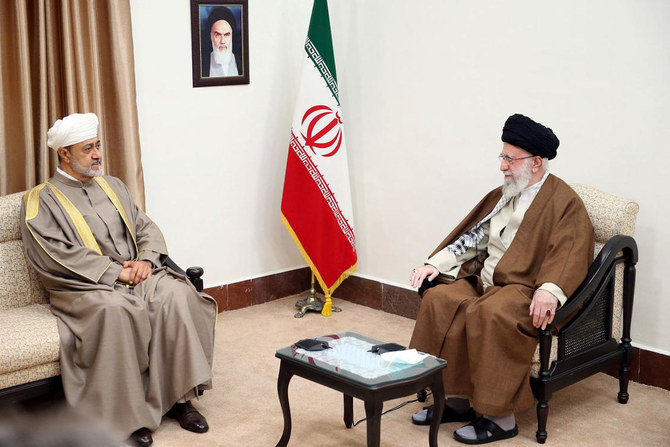
Iranian state television quoted Khamenei’s comments as coming from a meeting he held with the visiting sultan of Oman, Haitham bin Tariq. Sultan Haitham’s trip to Tehran, his first since assuming power in 2020, comes as Muscat long has served as an interlocutor between Tehran and the West.
There have been growing signs of Egypt and Iran potentially restoring ties, particularly as Saudi Arabia and Iran reached a détente in March with Chinese mediation after years of tensions. Cairo relies on Saudi Arabia and other oil-rich Gulf Arab states for economic support.
“We welcome this issue and have no problem in this regard,” Khamenei reportedly said.
There was no immediate reaction from Egypt to Khamenei’s comments. Officials in Cairo did not respond to a request for comment.
Egypt under Anwar Sadat cut ties to Iran after the 1979 Islamic Revolution. Sadat had been a close friend to the deposed Shah Mohammad Reza Pahlavi, welcomed him to Egypt just before his death and hosted his state funeral in 1980. The shah’s remains are entombed at Cairo’s Al-Rifai Mosque. Egypt’s peace deal with Israel also angered Iran’s theocratic government, which views Israel as its top regional enemy.
Meanwhile Monday, an Internet account describing itself as a group of hackers claimed responsibility for defacing websites associated with Iran’s presidency. The account GhyamSarnegouni, whose name in Farsi means “Rise to Overthrow,” previously claimed hacking websites associated with Iran’s Foreign Ministry earlier this month.
Iranian state media and officials did not immediately acknowledge the apparent hack. However, Associated Press journalists accessing the sites found them defaced with images of Massoud Rajavi, the long-missing leader of the Iranian exile group Mujahedeen-e-Khalq, and his wife Maryam, who is now the public face of the group.
One site bore the slogan: “Death to Khamenei Raisi- Hail to Rajavi.” Iran’s Supreme Leader Ayatollah Ali Khamenei and Iran’s president Ebrahim Raisi both were targeted similarly in the previously claimed hacked in May.
Iran has been targeted by a series of embarrassing hacks amid the rising tensions over its rapidly advancing nuclear program. That’s included the signal of Iranian state television being targeted, gasoline pumps that provide subsidized fuel being targeted in a cyberattack and government surveillance camera imagery being released, including from a notorious prison.
The Mujahedeen-e-Khalq, known by the acronym MEK, called the hack “very extensive” when reached, but did not claim credit for it. The MEK had angrily condemned a prisoner swap Belgium conducted with Iran on Friday to free an aid worker that saw an Iranian diplomat convicted of being behind a bomb plot targeting the group released.
The MEK began as a Marxist group opposing the shah’s rule. It claimed and was suspected in a series of attacks against US officials in Iran in the 1970s, something the group now denies.
It supported the 1979 Islamic Revolution, but soon had a falling out with Ayatollah Ruhollah Khomeini and turned against the cleric. It carried out a series of assassinations and bombings targeting the young Islamic Republic.
The MEK later fled into Iraq and backed dictator Saddam Hussein during his bloody eight-year war against Iran in the 1980s. That saw many oppose the group in Iran. Although largely based in Albania, the group claims to operate a network inside Iran.


![]()

Iran’s Khamenei welcomes better ties with Egypt
Short Url
https://arab.news/2j2n3
Iran’s Khamenei welcomes better ties with Egypt
- Relations between Egypt and Iran have often been fraught in recent decades
- Group of hackers claimed responsibility for defacing websites associated with Iran’s presidency


Latest updates


© 2026 SAUDI RESEARCH & PUBLISHING COMPANY, All Rights Reserved And subject to Terms of Use Agreement.