Lebanese army says it arrests prominent Al Qaeda leader in Deir Ammar town

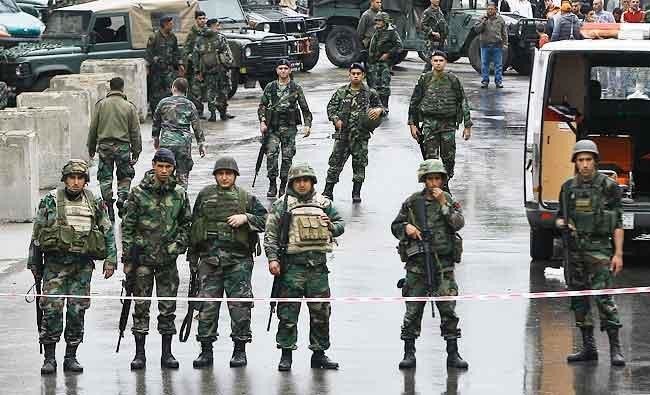
The Lebanese army said on Saturday it had arrested a prominent Al Qaeda leader in Deir Ammar town, northeast of the city of Tripoli. (AP/File)
Short Url
Updated 20 May 2023
Follow

Lebanese army says it arrests prominent Al Qaeda leader in Deir Ammar town

  • It identified the arrested man only as "T.M." and said in a statement that the arrest took place on Friday
  • "He has also played a key role in establishing the terrorist Fatah al-Islam organisation," the statement added

BEIRUT: The Lebanese army said on Saturday it had arrested a prominent Al Qaeda leader in Deir Ammar town, northeast of the city of Tripoli.
It identified the arrested man only as “T.M.” and said in a statement that the arrest took place on Friday.
“T.M. is one of the most prominent leaders of Al Qaeda and the founder of its cells in Lebanon,” it added.
“He has also played a key role in establishing the terrorist Fatah Al-Islam organization,” the statement added, referring to an Al Qaeda-inspired militant group that used to be active in Lebanon over a decade ago.
The Lebanese army said T.M. withdrew from the spotlight in late 2007 following a fierce battle between the military and Fatah Al-Islam at a refugee camp in northern Lebanon.
He then returned to prominence after the rise of Daesh and Syrian militant group the Nusra Front, the army added.


Iraq executes a former senior officer under Saddam for the 1980 killing of a Shiite cleric

Updated 12 sec ago
Follow

Iraq executes a former senior officer under Saddam for the 1980 killing of a Shiite cleric

  • Al-Sadr was a leading critic of Saddam’s secular Baathist government whose dissent intensified after the 1979 Islamic Revolution in Iran
  • The cleric’s execution in 1980 became a symbol of oppression under Saddam
BAGHDAD: Iraq announced on Monday that a high-level security officer during the rule of Saddam Hussein has been hanged for his involvement in the 1980 killing of a prominent Shiite cleric.
The National Security Service said that Saadoun Sabri Al-Qaisi, who held the rank of major general under Saddam and was arrested last year, was convicted of “grave crimes against humanity,” including the killing of prominent Iraqi Shiite cleric Mohammed Baqir Al-Sadr, members of the Al-Hakim family, and other civilians.
The agency did not say when Al-Qaisi was executed.
Al-Sadr was a leading critic of Iraq’s secular Baathist government and Saddam, his opposition intensifying following the 1979 Islamic Revolution in Iran, which heightened Saddam’s fears of a Shiite-led uprising in Iraq.
In 1980, as the government moved against Shiite activists, Al-Sadr and his sister Bint Al-Huda — a religious scholar and activist who spoke out against government oppression — were arrested. Reports indicate they were tortured before being executed by hanging on April 8, 1980.
The execution sparked widespread outrage at the time and remains a symbol of repression under Saddam’s rule. Saddam was from Iraq’s Sunni minority.
Since the 2003 US-led invasion of Iraq, authorities have pursued former officials accused of crimes against humanity and abuses against political and religious opponents. Iraq has faced criticism from human rights groups over its application of the death penalty.