

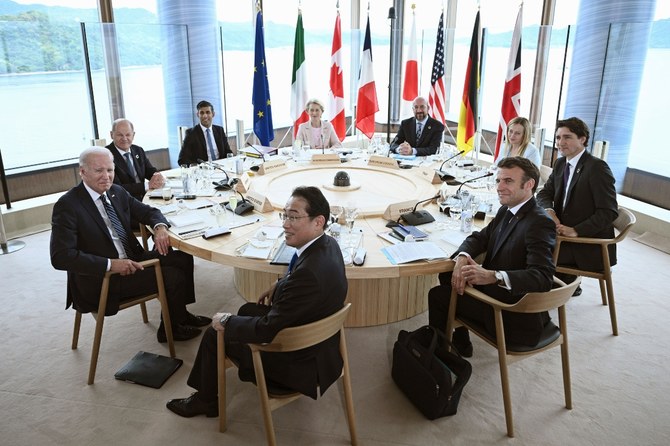

HIROSHIMA: Ukrainian President Volodymyr Zelensky will attend the G7 summit in Japan in person, officials familiar with his plans revealed Friday, as the bloc announced new sanctions targeting Russia’s “war machine”.
The surprise trip will be his first to Asia since the war began and would allow him to meet key allies like US President Joe Biden and the leaders of powerful unaligned nations who have been invited, including Brazil and India.
Zelensky had been expected to address the grouping by videolink on Sunday.
“Very important things will be decided there, and therefore the presence, the physical presence of our president is absolutely essential to defend our interests,” Secretary of the National Security Council of Ukraine Oleksii Danilov said confirming the trip.
An informed source in Hiroshima told AFP that Zelensky was now expected to appear, though the timing of his trip remained unclear.
Zelensky recently embarked on a European tour, pleading for military support ahead of a long-anticipated spring offensive.
The Hiroshima summit would offer a chance to again push Kyiv’s demand for modern US-made fighter jets, as well as tougher sanctions on Russia.
Earlier Friday, the United States and its G7 allies announced new measures targeting Moscow’s lucrative diamond trade and more entities linked to the invasion of Ukraine.
Vladimir Putin’s invasion of Ukraine 15 months ago has prompted waves of sanctions that have helped plunge his country into recession and drained the Kremlin’s war chest.
The G7 wants to tighten the screws further, strengthening existing sanctions, closing loopholes, and subjecting more Russian firms and their international partners to punitive restrictions.
A senior US administration official said another 70 entities from Russia and “other countries” would be placed on a US blacklist.
“And there will be upwards of 300 new sanctions against individuals, entities, vessels and aircraft,” the official said.
As the G7 weighs how to collectively choke off Russia’s $4-5 billion annual trade in diamonds -- including through high-tech methods of tracing -- Britain announced its own “ban on Russian diamonds”.
London said it was also targeting imports of aluminium, copper and nickel.
“As today’s sanctions announcements demonstrate, the G7 remains unified in the face of the threat from Russia and steadfast in our support for Ukraine,” said Prime Minister Rishi Sunak.
The G7 is likely to stop short of an outright ban on Russian diamonds, at least for now. But according to officials, the summit will signal a determination to act.
“Russian diamonds are not forever,” said EU Council President Charles Michel. “We will restrict trade.”
EU member state Belgium is among the largest wholesale buyers of Russian diamonds, along with India and the United Arab Emirates.
The United States is a major end-market for the finished product.
Economists are divided about just how much G7 and other sanctions have hurt the Russian war effort.
The Russian economy contracted 2.1 percent in 2022, a trend that continued early this year.
But Moscow has adapted quickly, introducing strict capital controls, diverting trade to allies like China, and reportedly borrowing evasion techniques from much-sanctioned countries like Cuba, Iran and North Korea.
The International Monetary Fund has projected a modest 0.7 percent economic rebound in 2023.
Michel said military support for Ukraine would also be discussed among G7 members Friday, along with training for fighter pilots.
“We will assess the level of additional support that will be needed. It’s very clear that Ukraine needs more military equipment,” he added.
Apart from Ukraine, China will also dominate the three days of meetings.
The focus will be on diversifying crucial supply chains away from China and insulating sectors from “economic coercion”.
But European countries insist that doesn’t mean breaking ties with China, one of the world's largest markets.
“Not a single country” is pursuing “decoupling”, German Chancellor Olaf Scholz told reporters in Hiroshima.
“However, we want to organise global supply relations, trade and investment relations, in such a way that the risks are not increased by dependence on individual countries,” he said.
Earlier Friday, the leaders visited Hiroshima’s peace park memorials and museum, where they saw evidence of the suffering and devastation caused by the 1945 atomic bombing of the city.
In a moment heavy with symbolism, they laid wreaths at the Hiroshima cenotaph, which commemorates the estimated 140,000 people killed in the attack and its aftermath.
Kishida, who comes from Hiroshima, has tried to move nuclear disarmament up the agenda, but there appears to be little appetite to reduce stockpiles at a time when Russia is issuing thinly veiled threats to use the weapons and China is building up its arsenal.


