

G7 finance chiefs to warn of global uncertainty as US debt crisis looms

1 / 3
G7 finance ministers and central bank governors attend a group photo session ahead of their meeting in Niigata, Japan, on May 12, 2023. (AP)
2 / 3
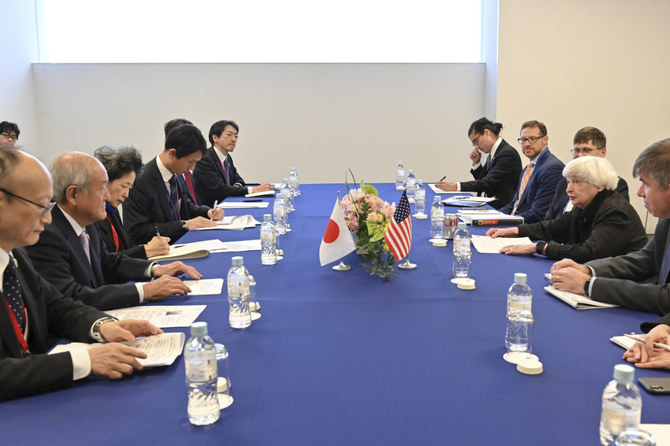
US Treasury Secretary Janet Yellen, second right, and Japan's Finance Minister Shunichi Suzuki, second left, hold their meeting at the Toki Messe convention center in Niigata, Japan, on May 13, 2023. (Pool Photo via AP)
3 / 3
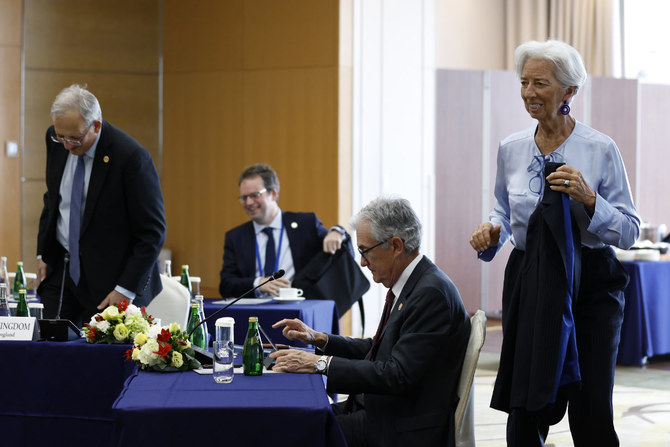
European Central Bank President Christine Lagarde, arrives for the central bank session of the G-7 finance ministers and central bank governors meeting in Niigata, Japan, on May 13, 2023. (Pool Photo via AP)
Short Url
Updated 13 May 2023
Follow

G7 finance chiefs to warn of global uncertainty as US debt crisis looms

  • World Bank President David Malpass: Dstress in the world’s biggest economy would be negative for everyone
  • Group finance leaders are expected to set a year-end deadline for launching a new scheme to diversify global supply chains

NIIGATA, Japan: Finance leaders of the Group of Seven (G7) rich nations are expected to warn of more global economic uncertainty as they wrap up a three-day meet on Saturday overshadowed by a US debt ceiling stalemate and fallout from Russia’s invasion of Ukraine.

The gathering in the Japanese city of Niigata came as worries over a US default fueled uncertainty over the global outlook, already clouded by stubbornly high inflation and US bank failures.
“The global economy has shown resilience against multiple shocks, including the COVID-19 pandemic, Russia’s war of aggression against Ukraine, and associated inflationary pressures,” the leaders will say in a final draft of a communique seen by Reuters.
“We need to remain vigilant and stay agile and flexible in our macroeconomic policy amid heightened uncertainty about the global economic outlook.”
The communique is unlikely to mention the US debt ceiling stalemate, which hits markets at a time when borrowing costs are rising because of aggressive monetary tightening by US and European central banks.
US Treasury Secretary Janet Yellen said on Friday she would meet senior Wall Street bankers next week about the possibility that Washington could default on its debt for the first time since 1789.
“Clearly, distress in the world’s biggest economy would be negative for everyone,” World Bank President David Malpass told Reuters on the sidelines of the G7 meeting the same day. “The repercussions would be bad to not get it done.”
On the banking troubles, the draft communique said policymakers would tackle “data, supervisory, and regulatory gaps in the banking system.”
The grouping is expected to reiterate its condemnation of Russia’s invasion of Ukraine and pledge to strengthen monitoring of cross-border transactions between Russia and other countries.
China has also been much on the leaders’ minds, with this year’s chair, Japan, spearheading efforts to diversify supply chains and reduce their heavy reliance on the world’s second-biggest economy.
The G7 finance leaders are expected to set a year-end deadline for launching a new scheme to diversify global supply chains, the draft showed.
The new scheme envisages the G7 offering aid to low- and middle-income countries so that they can play a bigger role in supply chains for energy-related products, such as by refining minerals and processing manufacturing parts.


Gulf-EU value chain integration signals shift toward long-term economic partnership: GCC secretary general

Updated 03 February 2026
Follow

Gulf-EU value chain integration signals shift toward long-term economic partnership: GCC secretary general

RIYADH: Value chains between the Gulf and Europe are poised to become deeper and more resilient as economic ties shift beyond traditional trade toward long-term industrial and investment integration, according to the secretary general of the Gulf Cooperation Council.

Speaking on the sidelines of the World Governments Summit 2026 in Dubai, Jasem Al-Budaiwi said Gulf-European economic relations are shifting from simple commodity trade toward the joint development of sustainable value chains, reflecting a more strategic and lasting partnership.

His remarks were made during a dialogue session titled “The next investment and trade race,” held with Luigi Di Maio, the EU’s special representative for external affairs.

Al-Budaiwi said relations between the GCC and the EU are among the bloc’s most established partnerships, built on decades of institutional collaboration that began with the signing of the 1988 cooperation agreement.

He noted that the deal laid a solid foundation for political and economic dialogue and opened broad avenues for collaboration in trade, investment, and energy, as well as development and education.

The secretary general added that the partnership has undergone a qualitative shift in recent years, particularly following the adoption of the joint action program for the 2022–2027 period and the convening of the Gulf–European summit in Brussels.

Subsequent ministerial meetings, he said, have focused on implementing agreed outcomes, enhancing trade and investment cooperation, improving market access, and supporting supply chains and sustainable development.

According to Al-Budaiwi, merchandise trade between the two sides has reached around $197 billion, positioning the EU as one of the GCC’s most important trading partners.

He also pointed to the continued growth of European foreign direct investment into Gulf countries, which he said reflects the depth of economic interdependence and rising confidence in the Gulf business environment.

Looking ahead, Al-Budaiwi emphasized that the economic transformation across GCC states, driven by ambitious national visions, is creating broad opportunities for expanded cooperation with Europe. 

He highlighted clean energy, green hydrogen, and digital transformation, as well as artificial intelligence, smart infrastructure, and cybersecurity, as priority areas for future partnership.

He added that the success of Gulf-European cooperation should not be measured solely by trade volumes or investment flows, but by its ability to evolve into an integrated model based on trust, risk-sharing, and the joint creation of economic value, contributing to stability and growth in the global economy.

GCC–EU plans to build shared value chains look well-timed as trade policy volatility rises.

In recent weeks, Washington’s renewed push over Greenland has been tied to tariff threats against European countries, prompting the EU to keep a €93 billion ($109.7 billion) retaliation package on standby. 

At the same time, tighter US sanctions on Iran are increasing compliance risks for energy and shipping-related finance. Meanwhile, the World Trade Organization and UNCTAD warn that higher tariffs and ongoing uncertainty could weaken trade and investment across both regions in 2026.