

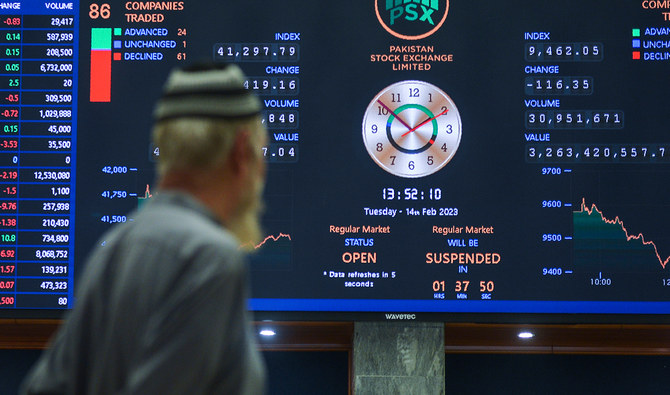
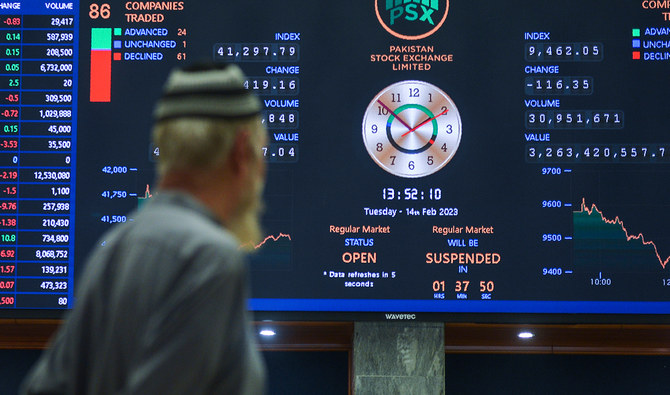
KARACHI: The Pakistan Stock Exchange (PSX) has lost market capitalization by $77.7 billion or 78 percent in the past six years, according to official data, making experts attribute the decline to political instability that led weakened the country’s economic fundamentals.
Pakistan’s equity market made history in May 2017 when benchmark KSE100 index crossed 52,000 points, raising the market capitalization – or the cumulative value of the shares of companies listed on the bourse – to an all-time high of $99.52 billion.
However, this number dropped to $76.30 billion in May 2018 due to the deterioration of political and economic situation ahead of the general elections, with further decline in subsequent years.
“The fall in market capitalization is mainly because of the political instability that badly affected the economic fundamentals of the country because political managers, in order to consolidate their own power in the country, borrowed money,” Muhammad Sohail, the chief executive officer of Topline Securities, said on Tuesday. “Because of this excessive borrowing, Pakistan is now facing a debt repayment crisis.”
The market cap declined further to $47.52 billion in 2019, $40.23 billion in 2020 but jumped to $52.05 billion in 2021 against the backdrop of improving liquidity and macroeconomic indicators.
After the ouster of former prime minister Imran Khan in April 2022, however, the political and economic conditions started deteriorating again, resulting in a decline that took it down to $21.83 billion in the ongoing month.
Samiullah Tariq, research director at the Pakistan-Kuwait Investment Company, said the KSE100 index, which stood at 53,000 in 2017, was now trading around 40,000. He noted the market value determined by PSX capitalization had also lowered in rupee terms since 2017.
“In terms of dollars, the exchange rate was Rs105 [in 2017] and it is now trading at Rs285,” he said. “In terms of dollars, the decline was even more pronounced. Interest rate was around 7.5 percent at that time but now it is about 21 percent.”
Analysts said former prime minister Imran Khan’s Pakistan Tehreek-e-Insaf (PTI) administration could not bring stability to the market in the wake of the 2018 elections, adding the situation exacerbated further due to the delayed International Monetary Fund (IMF) bailout program and the COVID-19 pandemic.
“The change of government in 2018 did not bring any good news to the stock market because the PTI government took more than a year to enter the IMF program and then there was COVID-19 which badly affected the market,” Sohail said.
He maintained the market gradually started improving, but faced another crisis last year when Khan’s administration was brought down in a vote of no-confidence.
“Initially, there were a few problems with the previous government,” he added. “But when things started to stabilize, we had another change of government.”
He noted the political upheavals were followed by a surge in international oil prices.
“The Ukraine war had its own impact on Pakistan economy,” he continued. “That is why the valuation at Pakistan Stock Exchange is now at an all-time low.”
As stocks trade at low multiples, Sohail said Pakistan faced an uncertain political future and external account imbalance which could lead to a situation where the country might find it difficult to repay its debts and default.


