

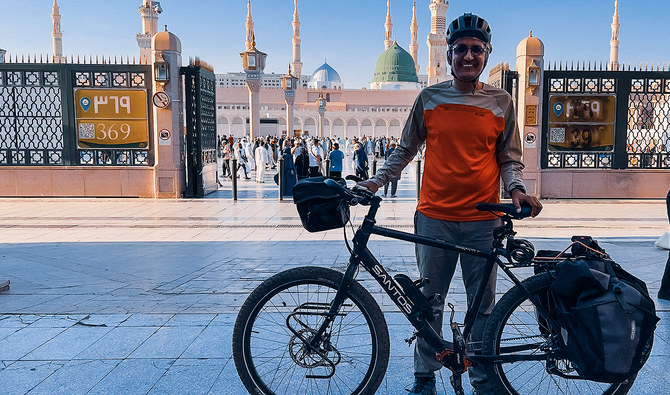

ISLAMABAD: Like most Pakistanis who haven’t traveled frequently to Saudi Arabia, Kamran Ali only knew the Middle Eastern country as the home of Islam’s holiest sites in Makkah and Madinah.
But when he pedaled his way into the Kingdom in February this year, Ali, 45, was blown away by Saudi Arabia’s cultural richness and its historical castles, fiery volcanoes and ancient rock formations and art.
In 2019, Saudi Arabia threw open its doors to foreign tourists, launching a new visa regime and appealing to foreign companies to invest in a sector it hopes will contribute 10 percent of gross domestic product by 2030.
The move was part of Crown Prince Mohammed bin Salman’s ambitious plans to develop new industries to wean the world’s top oil exporter off crude. Many of his reforms have received international praise.
“I came to Saudi Arabia without much knowledge because the books we studied only provided information about religious places,” Ali, who in the last eight years has cycled through 46 countries across four continents and covered a remarkable 56,000 kilometers, told Arab News over the phone from Makkah.
“However, when I saw the rock formations in the deserts, the intricate inscriptions, and Islamic rock art and historical castles and volcanoes, it was a mind-blowing and unforgettable experience.”
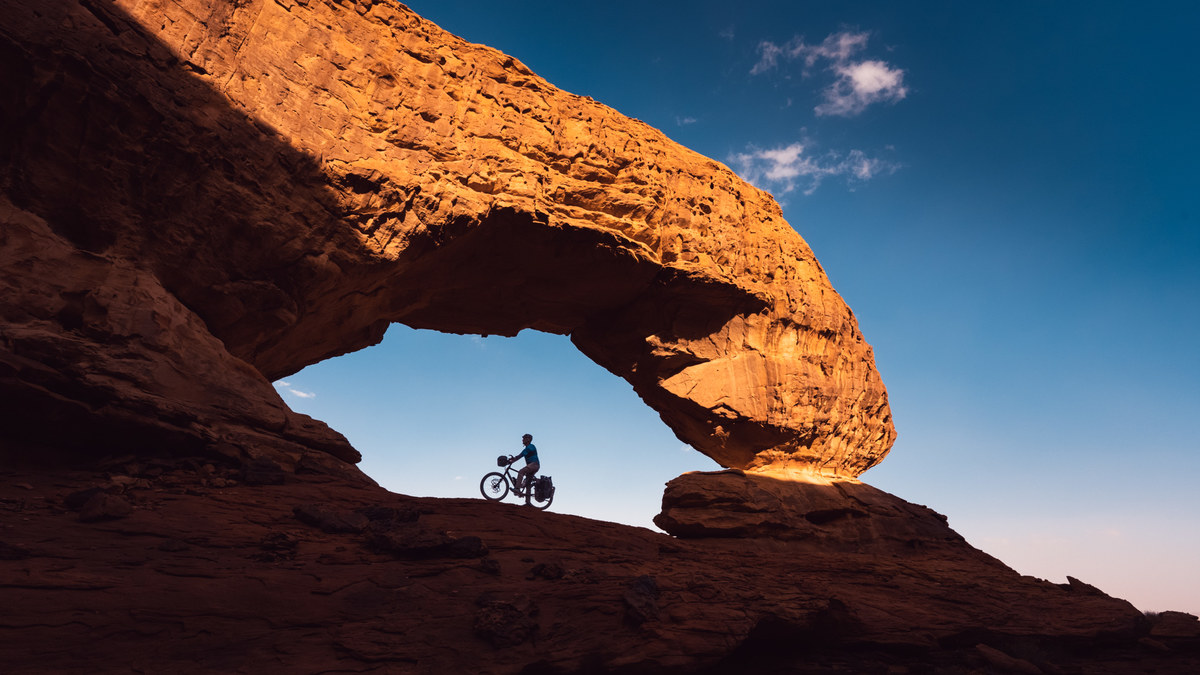
Kamran Ali, a Pakistani adventurer who travels internationally on his bicycle explores different tourist destinations in Saudi Arabia during the last three months. (Photo courtesy: Kamran Ali)
Among major restoration projects that have taken place in Saudi Arabia in recent years and attracted foreign tourists is Dariyah, the ancestral home of the Al-Saud family and the capital of the First Saudi State. Other projects include the ancient sites of Fau, Madain Saleh, Tayma, Duma and along the Darb Zubaydah, the pilgrimage road to Makkah. There is also the flagship $20 billion tourism project of Al-Ula, the site of an ancient civilization in a remote northwestern corner of the country.
Ali is well on his way to cycling through them all.
Born in Layyah, a small city in Pakistan’s eastern Punjab province, Ali has a PhD in Computer Science and made the life-changing decision in 2015 to quit his job in Germany and follow his passion for cycling. He has since biked through cities in Europe, Asia, South America, Central America, and North America.
His latest excursion, which began in December 2022, will end in South Africa and includes an over three-month-long detour in Saudi Arabia, which Ali is currently exploring.
Due to visa issues from Iranian authorities, Ali had to begin his tour of the Middle East from Muscat, Oman, and onwards to the UAE, from where he entered Saudi Arabia on February 9 through the Al-Batha land border.
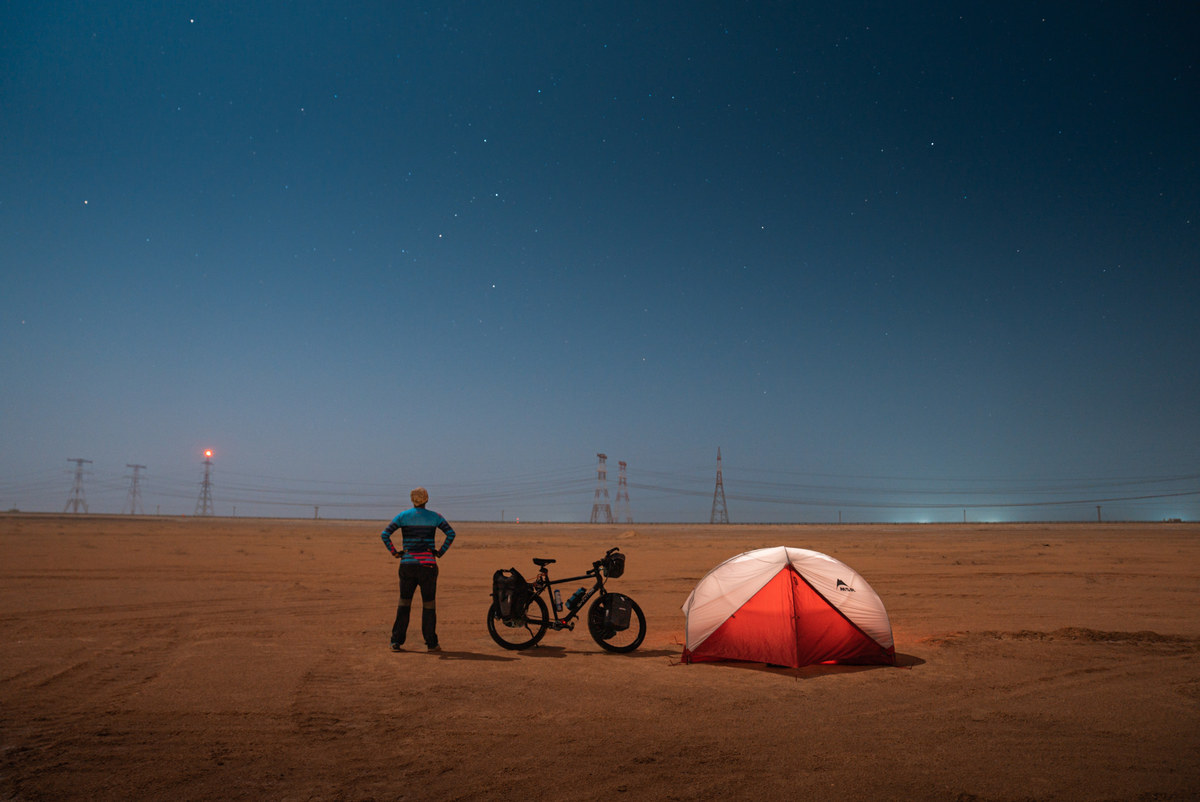
Kamran Ali, a Pakistani adventurer who travels internationally on his bicycle, Is camping on roadside near Abu Dhabi, UAE enroute to Saudi Arabia on February 5, 2023. (Photo courtesy: Kamran Ali)
In the last three months, he has explored the Rub’ al Khali, Al-Kharj, Hail, Al-Ula and Madinah cities of Saudi Arabia before arriving in Makkah 12 days ago, having cycled some 3,500 kilometers since he left Muscat.
The Pakistani adventurer lavished praise on Madinah, calling the province and its regional capital city “remarkable” for its historical inscriptions, Islamic rock art, castles and volcanoes.
“The [Madinah] province is a treasure trove of Islamic and pre-Islamic history, boasting breathtaking landscapes,” he said, adding that the Kingdom’s Hail region was also captivating for both its landscape and history.
The Ikmah mountain in Saudi Arabia’s Al-Ula city, with over 500 inscriptions from the Dadan and Lihyan civilizations, have also captured the Pakistani cyclist’s imagination.
“Notably, the Lihyanite inscriptions, which are 4,000 to 5,000 years old, narrate the history of ancient Arabia,” Ali explained.
He also spoke of the extensive stone structures that stretch for miles in Saudi Arabia’s Khaybar city, located around 150 kilometers to the north of Madinah, and are replete with Islamic rock art and calligraphic inscriptions that date back 1,300 years.
Impressed by the country’s rock art, Ali has vowed to raise awareness about them.
“I will write about the rock art in Saudi Arabia to promote the country’s tourist destinations beyond the Two Holy Mosques,” Ali said.
But more than the majestic mountains, old rock formations and centuries-old castles, the Pakistani traveler said Saudi Arabia’s “incredible” hospitality, generosity and kindness was what would remain most memorable for him.
He recalled one incident when he was traveling under the harsh sun through the Rub’ al Khali desert, which includes parts of Saudi Arabia, Oman, the UAE and Yemen, and was unable to carry much food or water, with no facilities or shade in sight for several kilometers.
“However, the local people checked on me, provided me with food and water, and even invited me to their homes if they were nearby,” Ali said.
He recounted another example of Saudi generosity in the city of Al-Kharj in central Saudi Arabia, where he tried to help a disabled boy while eating at a roadside restaurant.
But a local intervened and not only paid for the boy’s food but also for Ali’s meal.
Despite traveling through 46 countries, Ali said he had never seen “such examples of generosity” anywhere else in the world.
“I was astonished because such acts of kindness are often only read about in books,” he said, “but this actually happened in Saudi Arabia.”


