

Erdogan ascendant as Turkiye heads for historic runoff

1 / 3
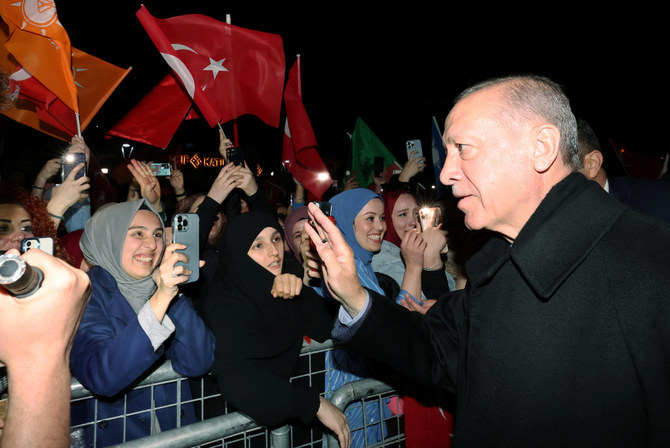
Turkish President Tayyip Erdogan greets his supporters as he leaves his residence in Istanbul on May 14, 2023. (Presidential Press Office/Handout via REUTERS)
2 / 3
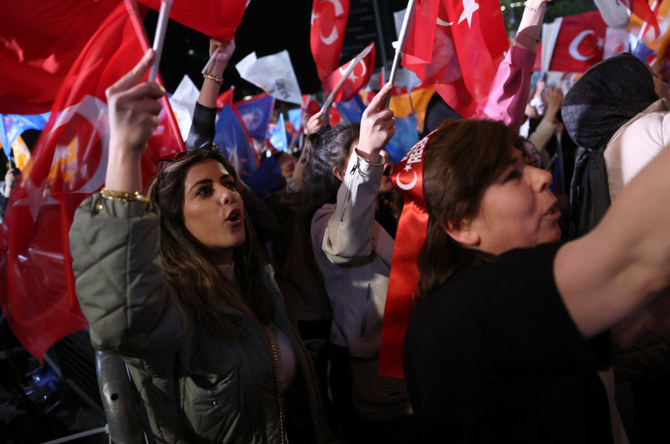
Supporters of Turkish President Recep Tayyip Erdogan and AK Party (AKP) wave flags at the AK Party headquarters in Ankara on Sunday. (Reuters)
3 / 3
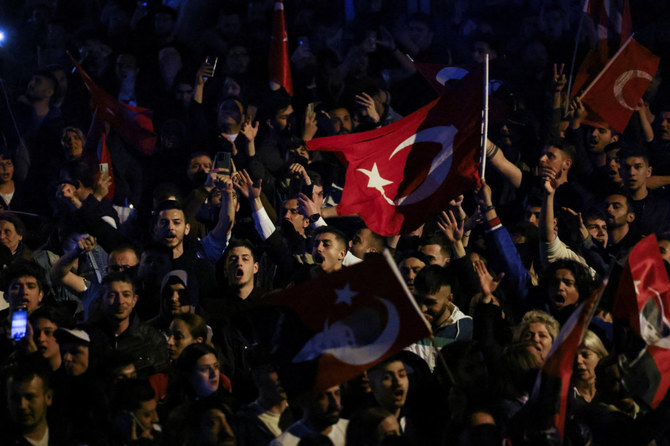
Supporters of Kemal Kilicdaroglu, presidential candidate of Turkey's main opposition alliance, rally outside the Republican People's Party (CHP) headquarters on election night in Ankara on Sunday. (Reuters)
Short Url
Updated 15 May 2023
Follow

Erdogan ascendant as Turkiye heads for historic runoff

  • Erdogan led with 49.42 percent of the vote to Kilicdaroglu’s 44.95 percent
  • Neither Erdogan nor Kemal Kilicdaroglu reached the 50-percent threshold for a first-round victory

ANKARA: Turkiye on Monday woke up to the prospect of its first presidential runoff vote after conservative President Recep Tayyip Erdogan confounded pollsters and his secular rival to win the first round of the country’s pivotal election.
Pre-election opinion polls had suggested Erdogan risked a first national election defeat to his main challenger’s disparate six-party alliance, in a vote seen as the most important in the Muslim-majority nation’s post-Ottoman history.
But the 69-year-old defied expectations in Sunday’s ballot and could extend his two-decade grip on power on May 28, after neither he nor Kemal Kilicdaroglu reached the 50-percent threshold for a first-round victory.
With almost all ballots counted on Monday morning, Erdogan led with 49.42 percent of the vote to Kilicdaroglu’s 44.95 percent, according to official figures provided by state news agency Anadolu.
A nationalist third candidate, Sinan Ogan, emerged as the kingmaker after picking up five percent, but has yet to come out for either frontrunner.
Erdogan’s Islamic-rooted Justice and Development Party (AKP) and its far-right allies were also close to an outright majority in Sunday’s parliamentary elections.
The lira fell against the euro as traders digested with apprehension the increased likelihood of Erdogan’s unconventional economic policies continuing.
The Borsa Istanbul index opened sharply in the red on Monday and was down by almost 4.5 percent at around 11:00 am (0800 GMT).
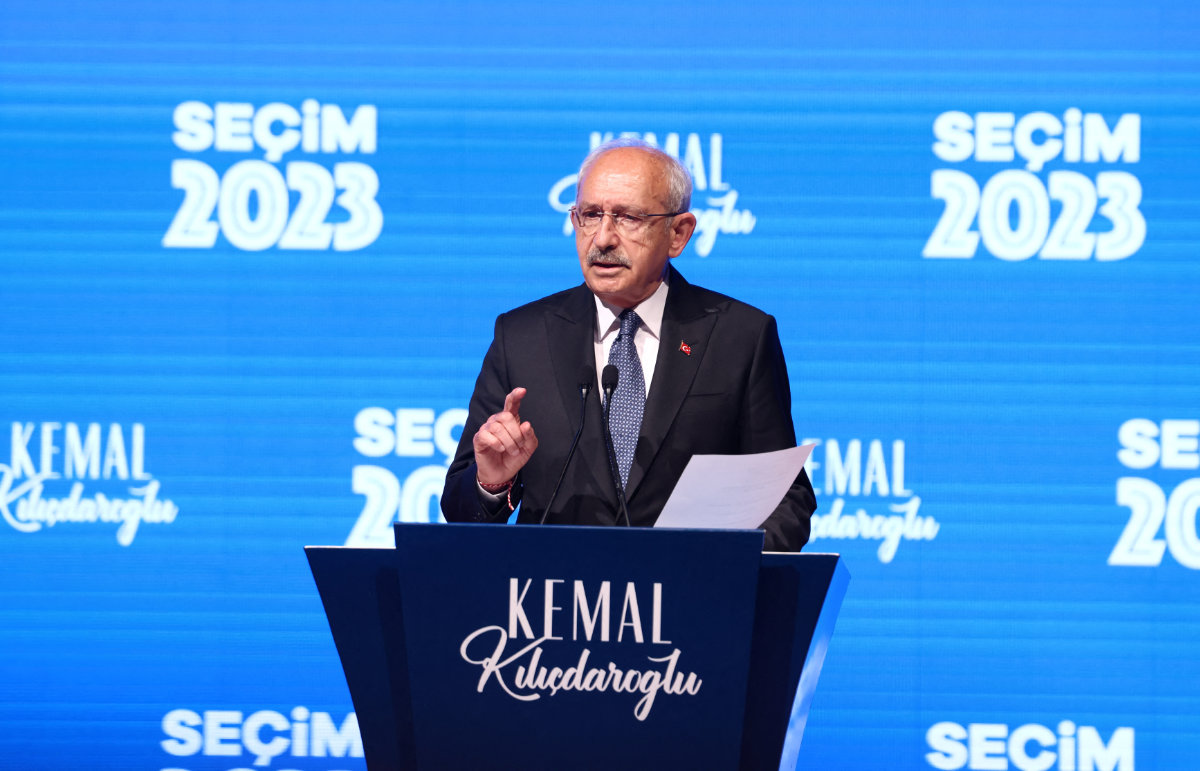


Kemal Kilicdaroglu, presidential candidate of Turkey's main opposition alliance, speaks at the Republican People's Party headquarters in Ankara on May 14, 2023. (REUTERS)

The result was a crushing disappointment for Kilicdaroglu and his Republican People’s Party (CHP) supporters.
An overcast dawn greeted Istanbul residents on Monday, a symbolic reflection of the opposition’s gloomier outlook but opinions were divided as to the outcome of Turkiye’s unprecedented runoff.
“Erdogan is going to win. He’s a real leader. The Turkish people trust him and he has a vision for Turkiye,” Hamdi Kurumahmut told AFP in Istanbul.
“Of course there are things that need to be improved, on the economy, education or the refugee policy. But we know he’s the one who can sort all that out,” added the 40-year-old tourism sector worker.
Betul Yilmaz, 26, wanted to keep the faith in a Kilicdaroglu victory if he sealed an alliance with Ogan. “But it’s going to be close,” the young woman said.
“If Kilicdaroglu wins... a beautiful time awaits us. I don’t want to even think about a scenario in which Erdogan wins,” Emin Serbest, 33, an employee of Istanbul’s municipal authority, told AFP as the count continued.
Pro-government daily Sabah called Erdogan’s unexpectedly strong performance a “superb success.”
Kilicdaroglu, who has a history of defeats to pro-Erdogan candidates, only emerged as the opposition’s candidate after a year of bitter debate between the alliance’s disparate members, who span Turkiye’s cultural and religious divides.
The unwieldy coalition now faces a challenging task to regroup for the runoff, with Erdogan seemingly possessing the momentum.
“The president is likely to ride his strong approval rating, surprise win in parliament, and incumbency advantages to secure re-election,” said Emre Peker of the Eurasia Group consultancy.
The strong performance of the AKP and its allies in the legislative ballot suggests “identity, terrorism and security issues played well with Erdogan’s broader conservative base and helped the president make up for his economic shortcomings,” he added.
Support from Kurdish voters for Kilicdaroglu’s alliance means it is “unlikely” Ogan will back it, Peker noted.


Syria moves military reinforcements east of Aleppo after telling Kurds to withdraw

Updated 3 sec ago
Follow

Syria moves military reinforcements east of Aleppo after telling Kurds to withdraw

ALEPPO: Syria’s army was moving reinforcements east of Aleppo city on Wednesday, a day after it told Kurdish forces to withdraw from the area following deadly clashes last week.
The deployment comes as Syria’s Islamist-led government seeks to extend its authority across the country, but progress has stalled on integrating the Kurds’ de facto autonomous administration and forces into the central government under a deal reached in March.
The United States, which for years has supported Kurdish fighters but also backs Syria’s new authorities, urged all parties to “avoid actions that could further escalate tensions” in a statement by the US military’s Central Command chief Admiral Brad Cooper.
On Tuesday, Syrian state television published an army statement with a map declaring a large area east of Aleppo city a “closed military zone” and said “all armed groups in this area must withdraw to east of the Euphrates” River.
The area, controlled by Kurdish forces, extends from near Deir Hafer, around 50 kilometers (30 miles) from Aleppo, to the Euphrates about 30 kilometers further east, as well as toward the south.
State news agency SANA published images on Wednesday showing military reinforcements en route from the coastal province of Latakia, while a military source on the ground, requesting anonymity, said reinforcements were arriving from both Latakia and the Damascus region.
Both sides reported limited skirmishes overnight.
An AFP correspondent on the outskirts of Deir Hafer reported hearing intermittent artillery shelling on Wednesday, which the military source said was due to government targeting of positions belonging to the US-backed, Kurdish-led Syrian Democratic Forces.

’Declaration of war’

The SDF controls swathes of the country’s oil-rich north and northeast, much of which it captured during Syria’s civil war and the fight against the Daesh group.
On Monday, Syria accused the SDF of sending reinforcements to Deir Hafer and said it would send its own personnel there in response.
Kurdish forces on Tuesday denied any build-up of their personnel and accused the government of attacking the town, while state television said SDF sniper fire there killed one person.
Cooper urged “a durable diplomatic resolution through dialogue.”
Elham Ahmad, a senior official in the Kurdish administration, said that government forces were “preparing themselves for another attack.”
“The real intention is a full-scale attack” against Kurdish-held areas, she told an online press conference, accusing the government of having made a “declaration of war” and breaking the March agreement on integrating Kurdish forces.
Syria’s government took full control of Aleppo city over the weekend after capturing its Kurdish-majority Sheikh Maqsud and Ashrafiyeh neighborhoods and evacuating fighters there to Kurdish-controlled areas in the northeast.
Both sides traded blame over who started the violence last week that killed dozens of people and displaced tens of thousands.

PKK, Turkiye

On Tuesday in Qamishli, the main Kurdish city in the country’s northeast, thousands of people demonstrated against the Aleppo violence, with some burning pictures of Syrian President Ahmed Al-Sharaa, an AFP correspondent said, while shops were shut in a general strike.
Some protesters carried Kurdish flags and banners in support of the SDF.
“Leave, Jolani!” they shouted, referring to President Sharaa by his former nom de guerre, Abu Mohammed Al-Jolani.
“This government has not honored its commitments toward any Syrians,” said cafe owner Joudi Ali.
Other protesters burned portraits of Turkish Foreign Minister Hakan Fidan, whose country has lauded the Syrian government’s Aleppo operation “against terrorist organizations.”
Turkiye has long been hostile to the SDF, seeing it as an extension of the Kurdistan Workers’ Party (PKK) and a major threat along its southern border.
Last year, the PKK announced an end to its long-running armed struggle against the Turkish state and began destroying its weapons, but Ankara has insisted that the move include armed Kurdish groups in Syria.
On Tuesday, the PKK called the “attack on the Kurdish neighborhoods in Aleppo” an attempt to sabotage peace efforts between it and Ankara.
A day earlier, Ankara’s ruling party levelled the same accusation against Kurdish fighters.
The Britain-based Syrian Observatory for Human Rights reported 45 civilians and 60 soldiers and fighters from both sides killed in the Aleppo violence.
Aleppo civil defense official Faysal Mohammad said Tuesday that 50 bodies had been recovered from the Kurdish-majority neighborhoods after the fighting.