Syria extends opening of 2 border crossings with Turkiye for quake aid

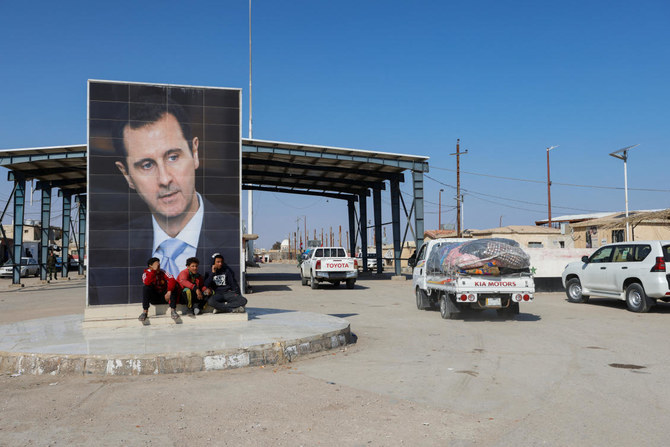
A picture of Syrian President Bashar al-Assad is seen on a road where vehicles containing aid head to Syria to support victims of the deadly earthquake. (Reuters/File)
Short Url
Updated 13 May 2023
Follow

Syria extends opening of 2 border crossings with Turkiye for quake aid

  • Syrian President Bashar Assad had agreed to open the border crossings at Bab al-Salameh and al-Rai for three months
  • Syrian Foreign Minister Faisal Mekdad conveyed to UN Under-Secretary-General Martin Griffiths the decision

DAMASCUS: The Syrian government has agreed to extend by another three months the use of two border crossings with Turkiye into the rebel-held northwest that were opened for aid delivery after a deadly earthquake in February, Syrian and UN officials said Saturday.
Syrian President Bashar Assad had agreed to open the border crossings at Bab Al-Salameh and Al-Rai for three months to allow aid to flow into Idlib province a week after the Feb. 6, earthquake that hit southern Turkiye and northern Syria.
The earthquake has killed more than 50,000 people, including over 6,000 in Syria, according to the United Nations. The quake also displaced hundreds of thousands of people.
Following a request by the UN and ensuing discussions, Syrian Foreign Minister Faisal Mekdad conveyed to UN Under-Secretary-General Martin Griffiths the decision by Syria’s government to allow the UN to continue using the two border crossing points for an additional three months, said Eri Kaneko, spokesperson for the UN office for the Coordination of Humanitarian Affairs.
Syria’s ambassador to the UN Bassam Sabbagh tweeted that the period has been extended for another three months based on Syria’s determination to enhance “stability and improve the living and humanitarian” conditions of all Syrians. He added the move also aims to facilitate the delivery of humanitarian aid to those in need in all of Syria.
Syria’s northwestern province of Idlib is home to some 4 million people, many of whom had been earlier displaced during the country’s 12-year civil war, which has killed nearly half a million people.
David Carden, the UN’s Deputy Regional Humanitarian Coordinator for the Syria crisis, said during a visit to Idlib earlier this month that since the earthquake some 2,000 trucks have crossed the border from Turkiye, providing assistance such as shelter, food, medical supplies and other services.
Carden added that the earthquake damaged or destroyed the homes of about 855,000 people.
In 2014, the Security Council authorized four border crossings to deliver aid to northwest Syria — two from Turkiye, one from Jordan and one from Iraq. In January 2020, Syria’s close ally Russia used its veto threat to reduce the number of crossing to the two from Turkiye. The following July, China and Russia used their veto power to reduce the number to just a single crossing.


Turkiye’s approval of peace roadmap is important step, PKK source says

Updated 8 sec ago
Follow

Turkiye’s approval of peace roadmap is important step, PKK source says

  • “The vote is considered an achievement and an important step toward consolidating democracy in Turkiye,” said the PKK source
  • There were foundations for resolving the Kurdish issue, but there was a lack of clarity on the issue in the report

BAGHDAD: A Turkish parliamentary commission’s approval of a report setting out a roadmap for legal reforms alongside the disbandment of the Kurdistan Workers Party (PKK) militant group is an important step and the beginning of a fundamental change in Turkish policy, a PKK source told Reuters on Thursday.
The commission voted overwhelmingly on Wednesday to approve the report, advancing a peace process designed to end decades of conflict.
“The vote is considered an achievement and an important step toward consolidating democracy in Turkiye,” said the PKK source.
The PKK — designated a terrorist ⁠organization by Turkiye, ⁠the United States and the European Union — halted attacks last year and said in May it had decided to disband and end its armed struggle.
The parliamentary vote shifts the peace process to the legislative theater, as President Tayyip Erdogan, Turkiye’s leader of more than two decades, bids to end a conflict focused on mainly Kurdish southeast Turkiye.
The insurgency began in 1984 and has killed more than 40,000 people, sowing deep discord at home and ⁠spreading violence across borders into Iraq and Syria.

IMPORTANT ISSUES OUTSTANDING
The PKK source said there were foundations for resolving the Kurdish issue, but there was a lack of clarity on the issue in the report.
“There also remain other important issues, such as initiating constitutional amendments, especially in aspects related to the Kurdish language as well as amendments to the anti-terrorism law,” the source said.
Another issue was legislation concerning the return of PKK militants to Turkiye and their integration into society, the source said.
A key element of Wednesday’s report recommended strengthening mechanisms to ensure compliance with decisions by the European Court of Human Rights (ECHR) and the Constitutional Court.
Among key ECHR decisions related to Turkiye are rulings that the rights of ⁠jailed former pro-Kurdish ⁠party leader Selahattin Demirtas had been violated and that he should be released immediately.
Ankara’s final appeal against that was rejected in November.

SIGN OF INTENT
Demirtas’ lawyer Mahsuni Karaman told Reuters the report’s comments on the ECHR were important as a sign of intent.
“We hope this will be reflected in judicial practice— that is our wish and expectation,” Karaman said.
Demirtas was detained in November 2016 on terrorism-related charges, which he denies. In May 2024, a court convicted him in connection with deadly 2014 protests and sentenced him to more than 40 years in prison.
Turkish nationalist leader Devlet Bahceli, a key Erdogan ally whose call in 2024 triggered the current PKK peace process, said in November that it “would be beneficial” to release Demirtas from prison.
The opposition pro-Kurdish DEM Party — the successor party of Demirtas’ HDP — remains parliament’s third-largest bloc and has cooperated closely with the parliamentary commission.