


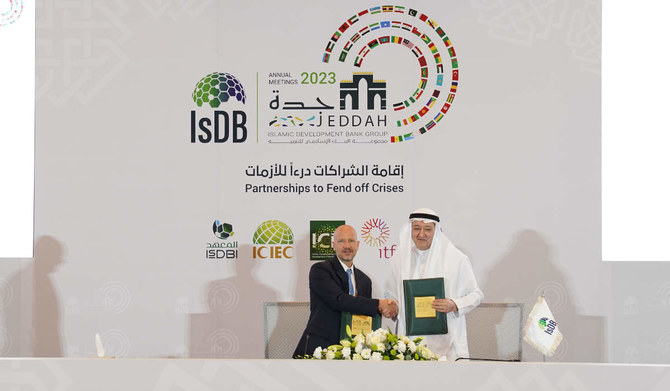


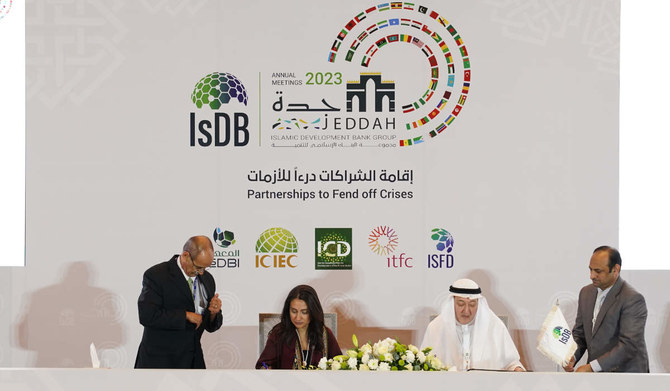


JEDDAH: The Islamic Development Bank has agreed to provide funding for seven new welfare schemes under the Afghanistan Humanitarian Trust Fund.
The decision was made on Saturday during an annual meeting in Jeddah of the bank’s governors alongside ministers and delegations from its member countries.
The projects will seek to improve nutritional and healthcare services for children and their mothers in remote rural areas of Afghanistan, as well as tackling the problem of waterborne diseases like cholera through the provision of solar-powered water systems.
HIGHLIGHT
The projects will seek to improve nutritional and healthcare services for children and their mothers in remote rural areas of Afghanistan, as well as tackling the problem of waterborne diseases like cholera through the provision of solar-powered water systems.
Two of the projects, worth $2 million apiece, were signed with UNICEF and will help to provide lifesaving nutritional services and clean water to tens of thousands of vulnerable children in Kandahar province and other rural parts of Afghanistan.
A third, also worth $2 million, was signed with the International Organization for Migration to provide safe drinking water for more than 13,000 people.
Mohammed Al-Jasser, IsDB president and group chairman, said: “The signing of these agreements is testimony to the most effective and collaborative team effort.”
He thanked Saudi Arabia for its contribution of $30 million to the fund through the King Salman Center for Relief and Humanitarian Aid, the Organization of Islamic Cooperation for mobilizing resources around the world, and the governments of Algeria Kuwait, Malaysia and Turkey for their contributions.
“We look forward to receiving more contributions to the fund from member countries and other providers.”
Al-Jasser said work had already begun on the next batch of projects which “will be funded through the generous contributions of the Saudi Fund for Development.”
Hissein Brahim Taha, secretary-general of the OIC, said: “I would like to comment on the excellent work that is being deployed under the leadership of Mohammed Al-Jasser and I would like to express my appreciation and gratitude for the contributions provided by all other countries, as well as KSrelief.”
Sultan Abdulrahman Al-Marshad, CEO of the Saudi Fund for Development, said: “These agreements are tangible contributions to strengthen the development of the framework scene in order to achieve inclusive development.”


