

Pakistani foreign minister says against banning political parties, advises PTI to forgo violence

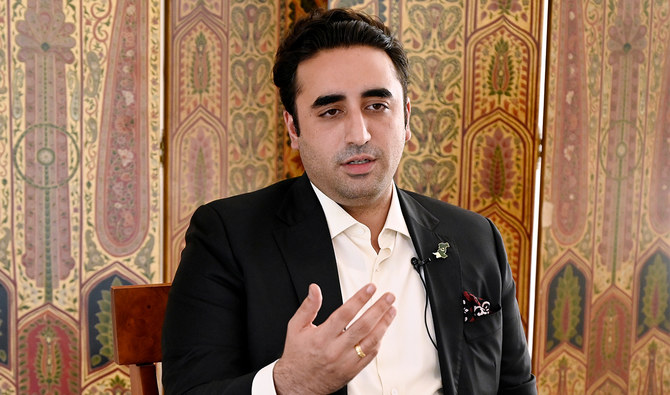
Pakistan's Foreign Minister Bilawal Bhutto Zardari, speaks during an interview at the Embassy of Pakistan in Washington, DC, September 27, 2022. (AFP/File)
Short Url
Updated 11 May 2023
Follow

Pakistani foreign minister says against banning political parties, advises PTI to forgo violence

  • Bhutto-Zardari says will be ‘last person’ to condone banning Imran Khan’s PTI party
  • Says ban, if imposed, should be done through an impartial process and as a last resort

KARACHI: Pakistani foreign minister Bilawal Bhutto-Zardari said on Thursday he was “principally” opposed to banning political parties and such a drastic step should only be used as a last resort against ex-prime minister Imran Khan’s Pakistan Tehreek-e-Insaf (PTI) party.

The minister issued the statement against the backdrop of violent demonstrations that erupted across the country following Khan’s arrest from the Islamabad High Court in a graft case on Tuesday. He is currently on physical remand of the National Accountability Bureau which is investigating him for allegedly receiving land as a bribe from a major property tycoon.

Meanwhile, Khan’s supporters have reacted to his arrest by storming sensitive army buildings and setting public property on fire, including military and government buildings, leading the army to put out a strongly worded statement on Wednesday that “facilitators, planners, and political activists” behind organized attacks on its properties and installations would be punished. Prime Minister Shehbaz Sharif also promised to punish all miscreants “as per the law and constitution.”

In the backdrop of the army and PM’s strongly-worded statements, many analysts have conjectured whether the destruction wrought by the protesters, which military and political leaders say was directly instigated by the PTI, will be used as a pretext to ban the party.

“I am principally against imposing a ban on any political party and would be the last person to condone such a move,” the foreign minister said in a news conference on Thursday.

“If another party had engaged in terrorist activities that we saw yesterday, they would have been pushed towards [a ban], but we cannot make such a decision on TV screens on the basis of the videos [of violent protests] that we saw.”

Bhutto-Zardari said if a ban had to be eventually imposed on the PTI, then it should be done as a "last resort."

“An impartial process has to be in place for such a decision [to be taken],” he said.

“The only advice I can give to the PTI is what’s done is done, and those who were involved in [violence] have to be made answerable, but the party should not make matters worse,” he added.

“Call an end to the violent protests, declare that you would abide by the rule of law and constitution, and accept that you would engage the [anti-graft] National Accountability Bureau as citizens and not as terrorists.”


Pakistan urges UN Security Council to sanction separatist BLA group after recent attacks

Updated 05 February 2026
Follow

Pakistan urges UN Security Council to sanction separatist BLA group after recent attacks

  • Separatist BLA launched attacks in multiple Balochistan cities last week, killing over 50 as per official figures
  • Pakistan envoy says since Taliban assumed control of Afghanistan, BLA, other militant groups have a “new lease of life“

ISLAMABAD: Pakistan’s UN Ambassador Iftikhar Ahmed this week urged the Security Council to impose sanctions against the separatist Baloch Liberation Army (BLA) militant group and designate it as a “terrorist” group, after its recent coordinated attacks in southwestern Balochistan province. 

Pakistan’s military said on Thursday it has concluded security operations in Balochistan against separatists that was launched since Jan. 29, killing 216 militants. The military launched counteroffensive operations in Balochistan after the BLA said it launched coordinated attacks in several parts of the province last Friday and Saturday. 

The attacks killed 36 civilians and 22 law enforcement and security forces personnel, Pakistan’s military said. Pakistan’s government has accused India of being involved in the attacks, charges that New Delhi has dismissed. 

“We hope the Council will act swiftly to designate BLA under the 1267 sanctions regime acceding to the listing request that is currently under consideration,” Iftikhar said on Wednesday during a UNSC briefing on the topic ‘Threats to International Peace and Security caused by Terrorist Acts.’

The 1267 sanctions regime is a UNSC program that seeks to impose sanctions on individuals and entities associated with “terrorism.”

The regime seeks to impose travel bans, freeze assets and impose an arms embargo on individuals and groups primarily associated with Al-Qaeda or the Taliban. 

Ahmad said that after the Taliban takeover of Afghanistan in 2021, “externally sponsored and foreign-funded proxy terrorist groups” such as the Tehreek-e-Taliban Pakistan and the BLA have got a “new lease of life.”

“Operating with virtual impunity from Afghan soil and with the active support of our eastern neighbor, these groups are responsible for heinous terrorist attacks inside Pakistan,” he said. 

The Pakistani envoy said it has become imperative to prevent billions of dollars of sophisticated weapons and equipment, which were left behind by foreign forces in Afghanistan, “from falling into the hands of terrorists.”

“There must be accountability of external destabilizing actors who support, finance and arm these groups, including their proxies in Afghanistan,” Ahmad said in a veiled reference to India. 

Pakistan’s largest and poorest province, mineral-rich Balochistan borders Iran and ‌Afghanistan and is home to China’s investment in the Gwadar deep-water ‍port and other projects.

Balochistan has been the site of a ‍decades-long insurgency led by ethnic Baloch separatists seeking greater autonomy and a larger share of its natural ‍resources. 

They accuse the state of denying locals a fair share of the province’s mineral wealth, charges that are denied by the Pakistani government.