

Israel kills senior Gaza commanders as rockets cause first death in Israel

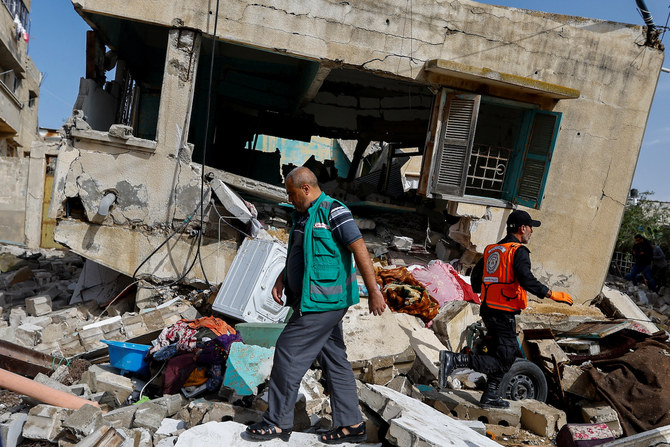
Palestinian rescue workers walk amid rubble after Islamic Jihad commander Ahmed Abu Daqqa was killed in an Israeli strike, in the southern Gaza Strip May 11, 2023. (Reuters)
Short Url
Updated 11 May 2023
Follow

Israel kills senior Gaza commanders as rockets cause first death in Israel

  • 28 Palestinians killed in blockaded enclave since Tuesday
  • ‘Occupation forces continuing to target people safe in their homes’

GAZA CITY: Israeli military aircraft on Thursday bombed an apartment building in a residential complex in the southern Gaza Strip city of Khan Yunis, killing three Palestinians and wounding seven.

Islamic Jihad announced the killing of Ali Hassan Ghali, the commander of the rockets program of Saraya Al-Quds, the body’s military wing, during the attack, along with his brother Mahmoud and his nephew.

Ghali is the fourth prominent military commander killed by Israel during the current round of fighting that started before dawn on Tuesday.

He is a member of the military council and leads the military wing of Islamic Jihad.

The Israeli warplanes also completely destroyed three homes in Khan Yunis in the south, and Beit Lahiya in the northern Gaza Strip, after warning its residents to evacuate, without causing any injuries.

“The Zionist occupation continues to target people who are safe in their homes and apartments with US-manufactured missiles, which the occupation planes struck again, targeting a residential building in Hamad Town in Khan Yunis,” the militant group said in a statement.

It said the attack led to the “martyrdom” of three people and the destruction of homes, apartments and residential buildings.

“The policy of assassination by bombing residential buildings will not give the enemy victory, and the upcoming strikes will reveal its weakness and impotence,” the statement added.

It said the “martyrdom of Commander Ali Ghali will not stop the rocket fire, and the Al-Quds Brigades are able to expand and increase the beam of fire.”

On Wednesday morning, the Palestinian Ministry of Health announced that the number of victims of the Israeli bombing had risen to 25 Palestinians, including six children and four women, and that more than 70 others were injured, with some of them in critical condition.

Palestinian militants continued to fire rockets at Israeli towns, despite the Israeli bombardment of various areas in the Gaza Strip, the largest of which was on the city of Tel Aviv on Wednesday evening.

Tariq Selmi, spokesman for the Islamic Jihad in Gaza, said: “The resistance is capable of confronting the occupation’s attacks and inflicting casualties on its ranks.”

The Israeli bombardment, and the firing of missiles from Gaza, continue amid attempts by Egypt and other parties to reach a ceasefire that will restore calm to the Gaza Strip.

Officials of Islamic Jihad had traveled to Cairo for the talks — most notably Muhammad Al-Hindi — the political official from the organization in the Gaza Strip, who is currently living in Istanbul.

“We received an invitation from our Egyptian brothers to discuss the details of the ceasefire, and a number of leaders traveled to Cairo for that,” Selmi told Arab News.

The Palestinian group requires that Israel stop the “assassination” policy against its leaders and Palestinian factions, in addition to returning the body of Khader Adnan, who died in an Israeli prison after a hunger strike.

“A ceasefire agreement will not be reached without the occupation’s pledge to completely stop the policy of assassinations,” the spokesman said.

The residents of the Gaza Strip continue to suffer as a result of the continued fighting with Israel, and the closure of the Erez and Kerem Shalom crossings.

The government’s information office stated that “the occupation prevented the supply of fuel needed for the only power plant in the Gaza Strip for the third day in a row, threatening the continuation of the work of the power plant and its ability to produce electricity.”

The statement added: “The quantities of fuel have begun to run out, and the countdown to shutting down the station has begun, which foreshadows a humanitarian, health and environmental crisis in the Gaza Strip.”

An Israeli political official, in a statement distributed to Hebrew-language media from Prime Minister Benjamin Netanyahu’s office, said: “We will not stop the policy of assassinations, and we will not return the body of Khader Adnan under any conditions.”

The official added that “there are continuous contacts, and we did not promise Egypt anything, and we will not accept any conditions.”


Lebanese finance minister denies any plans for a Kushner-run economic zone in the south

Updated 45 min 44 sec ago
Follow

Lebanese finance minister denies any plans for a Kushner-run economic zone in the south

  • Proposal was made by US Envoy Morgan Ortagus but was ‘killed on the spot’
  • Priority is to regain control of state in all aspects, Yassine Jaber tells Arab News

DAVOS: Lebanon’s finance minister dismissed any plans of turning Lebanon’s battered southern region into an economic zone, telling Arab News on the sidelines of the World Economic Forum’s meeting in Davos that the proposal had died “on the spot.”

Yassine Jaber explained that US Envoy to Lebanon Morgan Ortagus had proposed the idea last december for the region, which has faced daily airstrikes by Israel, and it was immediately dismissed.

Jaber’s comments, made to Arab News on the sidelines of the World Economic Forum in Davos, were in response to reports which appeared in Lebanese media in December which suggested that parts of southern Lebanon would be turned into an economic zone, managed by a plan proposed by Jared Kushner, US President Donald Trump’s son in law.

Meanwhile, Jaber also dismissed information which had surfaced in Davos over the past two days of a bilateral meeting between Lebanese ministers, US Middle East Envoy Steve Witkoff and Kushner.

Jaber said that the meeting on Tuesday was a gathering of “all Arab ministers of finance and foreign affairs, where they (Witkoff and Kushner) came in for a small while, and explained to the audience the idea about deciding the board of peace for Gaza.”

He stressed that it did not develop beyond that.

When asked about attracting investment and boosting the economy, Jaber said: “The reality now is that we need to reach the situation where there is stability that will allow the Lebanese army, so the (Israeli) aggression has to stop.”

Over the past few years, Lebanon has witnessed one catastrophe after another: one of the world’s worst economic meltdowns, the largest non-nuclear explosion in its capital’s port, a paralyzed parliament and a war with Israel.

A formal mechanism was put in place between Lebanon and Israel to maintain a ceasefire and the plan to disarm Hezbollah in areas below the Litani river.

But, the minister said, Israel’s next step is not always so predictable.

“They’re actually putting pressure on the whole region. So, a lot of effort is being put on that issue,” he added.

“There are still attacks in the south of the country also, so stability is a top necessity that will really succeed in pushing the economy forward and making the reforms beneficial,” he said.

Lawmakers had also enacted reforms to overhaul the banking sector, curb the cash economy and abolish bank secrecy, alongside a bank resolution framework.

Jaber also stressed that the government had recently passed a “gap law” intended to help depositors recover funds and restore the banking system’s functionality.

“One of the priorities we have is really to deal with all the losses of the war, basically reconstruction … and we have started to get loans for reconstructing the destroyed infrastructure in the attacked areas.”

As Hezbollah was battered during the war, Lebanon had a political breakthrough as the army’s general, Joseph Aoun, was inaugurated as president. His chosen prime minister was the former president of the International Court of Justice, Nawaf Salam.

This year marks the first time a solid delegation from the country makes its way to Davos, with Salam being joined by Jaber, Economy and Trade Minister Amr Bisat, and Telecoms Minister Charles Al-Hage.

“Our priority is to really regain the role of the state in all aspects, and specifically in rebuilding the institutions,” Jaber said.