

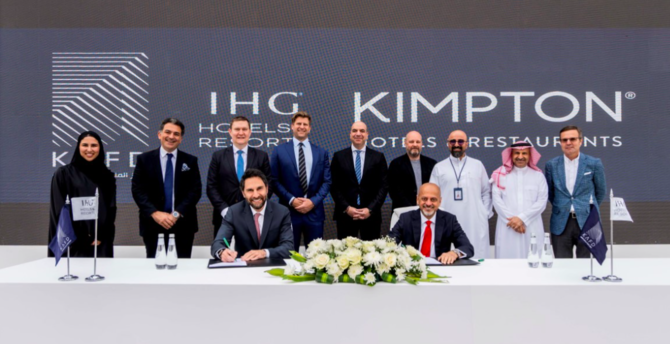
IHG to debut Kimpton hotel in Riyadh in June 2024 

This signing is in line with IHG’s commitment to bring more luxury and lifestyle brands from its global portfolio to Saudi Arabia (Supplied)
Short Url
Updated 05 May 2023
Follow

IHG to debut Kimpton hotel in Riyadh in June 2024 

RIYADH: Saudi Arabia is widening its hospitality mix by introducing the luxury boutique hotel brand Kimpton to Riyadh in June 2024. 

The confirmation came after the King Abdullah Financial District, the Public Investment Fund-owned project management company, signed a management agreement with IHG Hotels and Resorts on Thursday to launch a 200-room hotel in the capital. 

The debut comes as part of IHG’s strategy to cater to a growing number of business travelers and meet the tourism objectives of the Vision 2030 blueprint. 

The Kimpton Riyadh will be built in the heart of KAFD. It will offer five food and beverage options, including an all-day dining restaurant, a specialty restaurant, a lobby lounge, a lobby living room cafe and a pool bar.  

Kimpton Riyadh will also host an outdoor amphitheater terrace, health club and swimming pool. 

“We have identified a trend toward blended travel, with those traveling for work or business also seeking a lifestyle element to their stay,” said Haitham Mattar, managing director, IHG Hotels & Resorts for India, the Middle East and Africa. 

Kimpton Hotels & Restaurants operates over 60 hotels and 75 restaurants, bars and lounges across the US, Canada, Europe, the Caribbean and Greater China.  

“Saudi Arabia is one of the few countries worldwide that saw a rise in tourism investment and expenditure during the COVID-19 pandemic, with domestic tourism increasing by 33.6 percent and over SR80 billion ($21.33 billion) spent by tourists,” said Gautam Sashittal, CEO at KAFD Development and Management Co. 

“As we look to make KAFD an essential part of the business landscape of the Kingdom, Kimpton Riyadh at KAFD will enable us to welcome diverse visitors for work, leisure or both,” he added. 

Through this new property, IHG will focus on corporate executives and affluent Saudi families looking for a luxury lifestyle.  

IHG currently operates 37 hotels across five brands in Saudi Arabia, including InterContinental, Crowne Plaza, Holiday Inn, Staybridge Suites, and voco, with 31 hotels in the development pipeline set to open within the next three to five years. 


As world fractures, experts weigh in on the politics of AI at WGS

Updated 26 sec ago
Follow

As world fractures, experts weigh in on the politics of AI at WGS

  • e& group CEO Hatem Dowidar said there was increasing pressure to choose between the Chinese and US ecosystems

DUBAI: Across three days of rigorous debate at the World Government Summit in Dubai, experts from some of the world’s largest tech and telecommunication companies debated what the future political landscape of artificial intelligence development would be.

Speaking at the summit on Thursday, e& group CEO Hatem Dowidar said there was increasing pressure to choose between the Chinese and US ecosystems, which could have impacts on the sovereign capabilities of countries, like Gulf Cooperation Council member states, which thus far have stayed in the middle.

“I think the fracture and the pressure today is if you use this technology, you cannot use the other. You must separate them completely and this is something that never happened before,” Dowidar said.

He warned that whilst people around the world currently have access to both the leading large language models in the US and China, ChatGPT and Deepseek, this would not always be the case, and middle powers would need to develop their own capability to maintain their sovereignty.

“Europe is trying to find its own way as well, because Europe — having been caught now in the middle — they don’t have platforms, they don’t have the data center capability,” he said.

“So now, Europe is focusing a lot on building sovereign capability, sovereign data centers to run AI applications within Europe.”

Dowidar said the GCC had been ahead of the curve in this regard, having worked out early on that sovereign capability would be necessary in the new multipolar world and subsequently investing heavily in local infrastructure and capability.

“We were lucky here in the region that already — I would say a couple of years ago —we have kind of ironed out how this works,” he said.

“I think that everyone will try to see how they can either utilize the global platforms in a sovereign manner, or they end up trying to push to develop their own platforms.” 

This sentiment was echoed by Chamath Palihapitiya, the founder and managing partner of Social Capital, who said that China’s dedication to open-source models — whose code is released under a license granting users rights to view, study, modify, and redistribute it freely — could make Chinese AI more popular in the long run for nations looking to keep some level of sovereignty.

“I do think that there are a handful of American open-source models that are quite good. I think Nvidia’s models are excellent. But in fairness, the Chinese open-source models are just superb,” he told the summit on Wednesday.

“It’s going to be important for every country to make their own decisions about their own sovereignty, and in that realm, I think the open-source models provide the clearest path, because it just gives you total transparency to what’s happening underneath the hood.”

This was reiterated by Joseph Tsai, the chairman and co-founder of Alibaba Group, who said Chinese open-source systems would be favored by middle powers — but warned they had yet to find a way to be economically self-sufficient. 

“Because countries care about the sovereignty aspect and care about their data privacy, you can take an open-source model and deploy it on your own infrastructure … giving you ownership and control” he said.

“But it remains to be seen how economically all the model companies are going to make it sort of sustainable with an open-source approach … This is the biggest challenge for the Chinese firms.”