

Taliban authorities warn UN over being excluded from Afghanistan talks in Doha

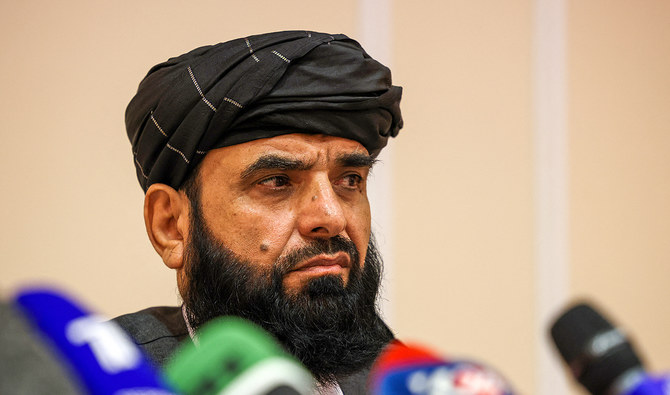
In this file photo, taken on July 9, 2021, Taliban representative Suhail Shaheen attends a press conference in Moscow. (Photo courtesy: AFP/File)
Short Url
Updated 02 May 2023
Follow

Taliban authorities warn UN over being excluded from Afghanistan talks in Doha

  • Doha talks involve envoys from US, Russia, Pakistan, China and 20 other countries and organizations
  • Taliban say any meeting without participation of Afghanistan representatives will be “counter-productive”

DOHA: UN chief Antonio Guterres held a second day of talks with world powers Tuesday on how to deal with Afghanistan’s Taliban leaders amid warnings from the Kabul administration the meeting could be “counter-productive.”

Guterres called the two days of talks in Doha as the United Nations reviews its huge relief operation in Afghanistan following a ban on women working for UN agencies.

Women are already banned from almost all secondary and university education and most government jobs, and women’s groups had feared that the Doha meeting could propose steps toward recognition of the Taliban administration that returned to power in August 2021.

The UN Security Council last week unanimously condemned the action against Afghan women, which the UN says has seriously threatened its efforts to aid the population.

The Taliban authorities, who were not invited to the UN meeting, have rejected the Security Council demand to reverse the ban as interference in an “internal social matter.”

It has also warned over its exclusion from the Doha talks which involve envoys from the United States, Russia, China and 20 other countries and organizations, including major European donors and neighbors such as Pakistan.

“Any meeting without the participation of IEA (Islamic Emirate of Afghanistan) representatives — the main party to the issue — is unproductive and even sometimes counter-productive,” said the head of the Taliban political office in Doha, Suhail Shaheen.

“How can a decision taken at such meetings be acceptable or implemented while we are not part of the process? It is discriminatory and unjustified,” Shaheen said.

UN spokesman Stephane Dujarric said Monday that recognition of the Taliban government “is not up for discussion” at the talks, which are being held behind closed doors.

The meeting would discuss human rights, including women’s rights, Afghanistan’s governance and ways to counter terrorism and drug trafficking, Djurric said.

Guterres wants “a common understanding with the international community on how to engage with the Taliban on these issues,” he added.

The UN review of its Afghanistan operation is due to be completed on Friday. The world body has said it faces an “appalling choice” on whether to stay in the country.


UN rights chief appeals for $400 million as crises mount and funding shrinks

Updated 2 sec ago
Follow

UN rights chief appeals for $400 million as crises mount and funding shrinks

  • The UN office is appealing for $100 million less than last year, after a significant scale back of its work in some areas
  • Volker Turk’s office undertook less than half the number of ⁠human rights monitoring missions compared to 2024
GENEVA: UN human rights chief Volker Turk appealed for $400 million on Thursday to address mounting human rights needs in countries such as Sudan and Myanmar, after donor funding cuts drastically reduced the work of his office and left it in “survival mode.”
The UN office is appealing for $100 million less than last year, after a significant scale back of its work in some areas due to a fall in contributions from countries including the US and Europe.
“We are currently ‌in survival ‌mode, delivering under strain,” Turk told ‌delegates ⁠in a ‌speech in Geneva, urging countries to step up support.
In the last year, Turk’s office raised alarm about human rights violations in Gaza, Sudan, the Democratic Republic of the Congo, Ukraine, and Myanmar, among others.
However, due to slashes in funding, Turk’s office undertook less than half the number of ⁠human rights monitoring missions compared to 2024, and reduced its presence in ‌17 countries, he said. Last year it ‍received $90 million less in ‍funding than it needed, which resulted in 300 job ‍cuts, directly impacting the office’s work, Turk said in December.
“We cannot afford a human rights system in crisis,” he stated.
Turk listed examples of the impacts of cuts, noting the Myanmar program was cut by more than 60 percent in the last year, limiting its ability to gather evidence.
A ⁠UN probe into possible war crimes in the Democratic Republic of the Congo is also struggling to become fully operational due to limited funding, while work to prevent gender-based violence and protect the rights of LGBTIQ+ people globally has been cut up to 75 percent, the office said.
“This means more hate speech and attacks, and fewer laws to stop them,” Turk stated.
The UN human rights office is responsible for investigating rights violations. Its work contributes to ‌UN Security Council deliberations and is widely used by international courts, according to the office.