

3 ancient Roman camps discovered buried in Arabian desert

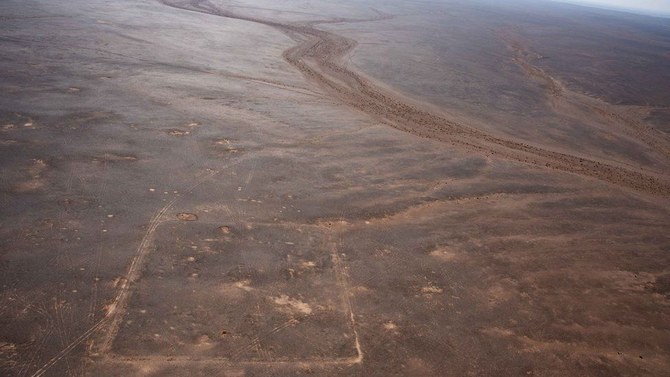
An aerial view of the western camp in Jordan. (APAAME)
Short Url
Updated 27 April 2023
Follow

3 ancient Roman camps discovered buried in Arabian desert

  • The finds shed new light on conquest of Nabataea almost 2,000 years ago
  • Camps spotted by academics at Oxford with help of Google Earth

LONDON: Three 2,000-year-old Roman military camps have been discovered through Google Earth buried in the Arabian desert.

The camps, found by researchers at Oxford University, may have been constructed as part of the Roman Empire’s takeover of the ancient Nabataean Kingdom, the territory of which stretched between the modern kingdoms of Jordan and Saudi Arabia, in A.D. 106 following the death of its last king, Rabbel II Soter. 

Roman sources say the conquest was a peaceful transfer of power, but the new discoveries suggest it may have been more violent than previously believed.

With distances between them ranging from 23 to 27 miles, the camps would almost certainly have been used as temporary accommodation as troops, most likely mounted, made their way across the desert, used for only a few days before the Romans marched on.

Researchers also think that another camp may have been built further west near Bayir, in modern Jordan.

“We are almost certain they were built by the Roman army, given the typical playing card shape of the enclosures with opposing entrances along each side,” said Dr. Michael Fradley.

“The only notable difference between them is that the westernmost camp is significantly larger than the two camps to the east.”

He added: “The level of preservation of the camps is really remarkable, particularly as they may have only been used for a matter of days or weeks.

“They (the Romans) went along a peripheral caravan route linking Bayir and Dumat Al-Jandal (in Saudi Arabia). This suggests a strategy to bypass the more used route down the Wadi Sirhan, adding an element of surprise to the attack.

“It is amazing that we can see this moment in time played out at a landscape scale.”

Roman military expert Dr. Mike Bishop said: “These camps are a spectacular new find and an important new insight into Roman campaigning in Arabia.

“Roman forts and fortresses show how Rome held a province, but temporary camps reveal how they acquired it in the first place.”

Prof. Andrew Wilson, who co-wrote the report on the three camps in the journal Antiquity, said the greater size of the western camp raised questions about the nature of Rome’s conquest of Nabataea.

“These marching camps — if we are correct in dating them to the early second century — suggest the Roman annexation of the Nabataean Kingdom following the death of the last king, Rabbel II Soter in A.D. 106, was not an entirely straightforward affair, and that Rome moved quickly to secure the kingdom.

“Why does the western camp have twice the capacity of the other two? Did the force split, and if so, where did the other half go? Was it half wiped out in a battle, or did they remain in the western camp to resupply the other camps with water?”


The difference between European and Gulf weddings — from a photographer’s point of view

Updated 21 January 2026
Follow

The difference between European and Gulf weddings — from a photographer’s point of view

DUBAI: From her early career in northeast France to working across the Gulf and Europe, wedding photographer Maddy Christina has observed many contrasts between such events in different parts of the world.

Her early years as a photographer were defined by variety; she worked across fashion, family portraits and weddings simultaneously before recognizing how wedding photography brings multiple genres together in a single day. 

Christina said weddings in the region required a shift in both perspective and technique. (Supplied)

“I actually fell into weddings by accident,” Christina told Arab News. “It blends every discipline at once — fashion for the couple session, sports for the reception, documentary work throughout the day, still life with details and jewelry.”

Christina’s connection to the Middle East began through Parisian clients who invited her to Dubai for a post-wedding session: “I instantly connected with the energy of the city,” she said.

Christina’s connection to the Middle East began through Parisian clients who invited her to Dubai for a post-wedding session. (Supplied)

A few years later, a wedding in Kuwait marked the start of her long-term relationship with the region.

Now working extensively across the Gulf Cooperation Council, Christina said weddings in the region required a shift in both perspective and technique.

For Christina, the most meaningful aspect extends beyond the wedding day itself. (Supplied)

“Working across the GCC has opened my mind in ways I didn’t expect,” she said, adding it felt like “resetting everything I thought I knew about weddings” — particularly compared to her experience in Europe.

She said there were clear distinctions between the two regions. “European weddings tend to be more demonstrative and expressive, while brides in the Gulf often place a deeper emphasis on tradition, family bonds and a sense of ceremony,” she said. “The emotional language is different, yet equally beautiful.”

From a technical standpoint, the contrast is just as pronounced: “In the south of France, I was used to shooting outdoors at sunset with couples already comfortable in front of the camera. Here, I often find myself in much smaller spaces, with no windows, artificial light and couples who may be more reserved.”

Christina is drawn to candid moments. (Supplied)

She added that adapting to these conditions pushed her to explore new ways of shaping light and expanded her creative approach.

While Christina is drawn to candid moments, like “guests laughing together, old friends reconnecting, a fleeting emotion passing across someone’s face,” posed pictures remain central to her work.

For Christina, the most meaningful aspect extends beyond the wedding day itself.

“It’s not the decor that makes a wedding unforgettable for me,” she said. “It’s the connection I build with the bride. That long-term bond is what feels truly magical.”