

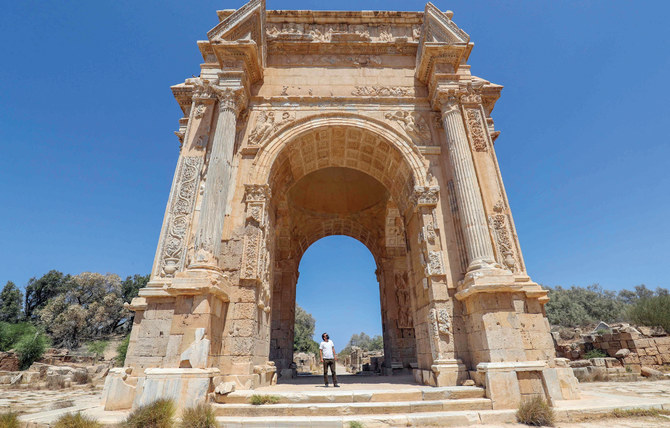
Jewel of Roman Empire lies neglected in Libya chaos

Leptis Magna on the Libyan coast was once among the Roman Empire’s most beautiful cities, but now lies neglected and shunned by tourists. (AFP)
Short Url
Updated 26 September 2021
Follow

Jewel of Roman Empire lies neglected in Libya chaos

  • The violence that wracked Libya after the 2011 revolt that toppled former ruler Muammar Qaddafi stirred fears for the ancient ruins

AL-KHUMS, Libya: Once among the Roman Empire’s most beautiful cities, Leptis Magna lies neglected and shunned by tourists after a decade of war, but some see its potential for rebirth.

There is no queue at the gate and only a handful of visitors, almost all Libyans, wander among the imposing ruins at the UNESCO World Heritage site.

Visiting the area, a former Roman outpost on the south coast of the Mediterranean, is “a voyage in time, a dive into history,” enthuses Abdessalam Oueba, a Libyan visitor in his 60s.

Founded by the Phoenicians then conquered by Rome, the city was the birthplace of Septimius Severus, who rose to become emperor from 193 until 211.

The ruler waged military campaigns across Europe and into modern-day Iraq before dying in York, England, far from the hometown on which he had lavished resources.

Perched on a hillside with a striking view of the Mediterranean, the well-preserved ruins include a large basilica, a racecourse and a theater seating up to 15,000 spectators on arched terraces overlooking the sea.

Among the few visiting tourists are Ihab, from Tripoli, who made the 120-km trip to show his children a site he had visited during his own childhood.

“Leptis Magna is beautiful, the most beautiful Roman site outside Italy,” the 34-year-old doctor said under a clear blue sky. “Yet it’s barely been discovered.”

The violence that wracked Libya after the 2011 revolt that toppled former ruler Muammar Qaddafi stirred fears for the ancient ruins, prompting UN cultural agency UNESCO to place them and four other Libyan sites on a list of global heritage in danger.

But so far, the areas have been mostly spared from the fighting, which has largely paused since an October 2020 ceasefire.

“There haven’t been any direct attacks or threats against Leptis Magna, despite the conflict,” said Azeddine Al-Fakih, head of the site’s antiquities department.

Yet it faces other threats: A lack of resources and government support.

“In 2020, we were finally able to launch projects that should have been finished 50 years ago,” he said, listing toilet facilities, offices and a perimeter fence.

“But archaeological digs have stopped, and maintenance operations are rushed and superficial.”

Fakih admitted that after 10 years of conflict and state collapse, Libya’s current unity government “has bigger problems to deal with.”

There was almost no tourism in Libya under Qaddafi, whose rule from 1969-2011 depended heavily on the country’s vast oil wealth. Tense foreign relations and sanctions also discouraged foreign visitors.

A year-long lull in violence has sparked hopes the country can move on.

Omar Hdidan, a civil engineer who volunteers to promote and maintain Leptis Magna, believes in its potential for tourism.

“It has always been neglected by the state,” the 49-year-old said.

“There are no digs, no new discoveries, no campaign to encourage tourism. But Leptis Magna is more valuable than 10 oil wells.”


Turkiye to forge on with tight economic policy, some fine-tuning, VP Yilmaz says

Updated 2 sec ago
Follow

Turkiye to forge on with tight economic policy, some fine-tuning, VP Yilmaz says

ISTANBUL: Turkiye is committed to carrying on its tight economic policies ​in order to cool inflation, and though it may fine-tune the program it will not change course, Vice President Cevdet Yilmaz said in comments embargoed to Friday.
“There is no plan to pause our program,” Yilmaz said at a briefing with reporters in Istanbul on Thursday. “All programs are dynamic, and adjustments can always be made.”
Yilmaz, who plays a key role overseeing economic policy at the presidency, said any such adjustments would aim to support production, investment and ‌exports while moderating consumption.
Turkiye ‌has pursued tight monetary and fiscal policies ‌for more ⁠than ​two years ‌in order to reduce price pressure, leading to high financing and borrowing costs that have weighed on businesses and households. Inflation has eased slowly but steadily over the last year but remains elevated at 31 percent annually.
Last month, Is Bank CEO Hakan Aran warned that focusing solely on one target — inflation — could create side effects, suggesting a “pause and restart” might be healthy once the program achieves certain targets.
Yılmaz said the ⁠government expects improvements in inflation in the first quarter, which should reflect to market expectations for year-end ‌inflation around 23 percent. The government projects inflation to dip ‍as far as 16 percent by year end, ‍within a 13-19 percent range, and falling to 9 percent in 2027. The central ‍bank forecasts inflation between 13-19 percent by end-2026.
Yilmaz noted inflation fell by nearly 45 points despite pressure from elevated food prices, hit by agricultural frost and drought.
The agricultural sector is expected to support growth and help ease price rises this year, which could ​help achieve official inflation targets, he said.
Yilmaz said the government wants to avoid a rapid drop in inflation that could hurt economic ⁠growth, jobs and social stability.
Turkiye’s economic program was established in 2023 after years of unorthodox easy money that aimed to stoke growth but that sent inflation soaring and the lira plunging. The program aims to dislodge high inflation expectations while boosting production and exports, in order to address long-standing current account deficits.
The central bank, having raised interest rates as high as 50 percent in 2024, eased policy through most of last year, bringing the key rate down to 38 percent.
Asked whether lower rates could trigger an exit from the lira currency, Yilmaz said: “What matters is real interest rates. Lowering rates as inflation falls does not affect real rates, so we do ‌not expect such an impact.”
He added that the government will strengthen mechanisms that selectively support companies while improving overall financial conditions.