‘Dead or alive’: Iraq’s Yazidis await Daesh-abducted kin

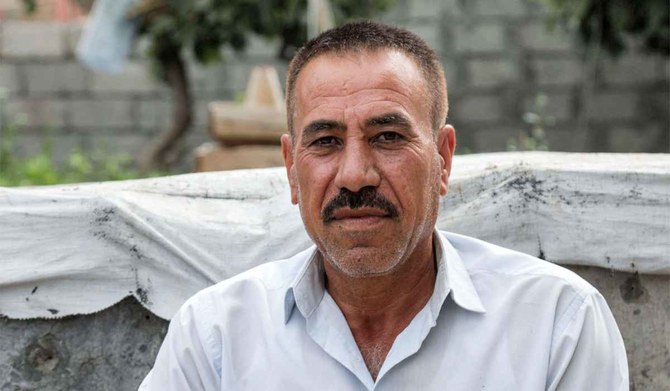
In this picture taken on April 19, 2023, Khaled Taalou, a 49-year-old Iraqi from the Yazidi community working to free missing relatives kidnapped by Daesh group fighters, gives an interview in the Sharya region, some 15 kilometres near the northern Iraqi city of Dohuk. (AFP)
Short Url
Updated 26 April 2023
Follow

‘Dead or alive’: Iraq’s Yazidis await Daesh-abducted kin

  • 19 members of Taalou’s family were abducted, including his brother, sister, their spouses, kids
  • In August 2014, Daesh massacred thousands of Yazidi men, enlisted children, and seized thousands of women to be sold as jihadists’ ‘wives’ or reduced to sexual slavery

SHARYA, Iraq: After paying nearly $100,000 in ransom to free 10 family members, Khaled Taalou, a member of Iraq’s Yazidi minority, is still working to free other missing relatives kidnapped by Daesh group fighters.

Despite his efforts, five more relatives, along with thousands of other Yazidis, remain missing after being abducted by the jihadists.
“We are still looking. We do not lose hope,” the 49-year-old said.
In August 2014, Daesh swept over Mount Sinjar, the Kurdish-speaking minority’s historic home in northern Iraq.
They massacred thousands of Yazidi men, enlisted children, and seized thousands of women to be sold as jihadists’ “wives” or reduced to sexual slavery.
Daesh considered the Yazidis, who follow a non-Muslim monotheistic faith, as heretics.
UN investigators described as genocide the atrocities carried out by Daesh.
Nineteen members of Taalou’s family were abducted, including his brother and sister, along with their spouses and children.
“We borrowed money as we could, here and there, to get them out,” the journalist and writer said.
Now displaced and living in Sharya, a village in Iraqi Kurdistan, after fleeing his home in Sinjar, Taalou has managed to free 10 relatives over seven years.
Expensive releases are negotiated “via networks of traffickers in Iraq and abroad,” he said.
The latest was his brother’s granddaughter in February 2022, located in a Syrian camp. He has learned that along with five relatives who remain missing, two family members were killed in aerial bombardments in the fight against Daesh.
After Daesh’s rapid rise in 2014, Iraq declared victory over the jihadists in 2017 and the group’s last Syrian stronghold was retaken in 2019.
But the toll left behind by their self-proclaimed caliphate is still being counted. Mass graves in Sinjar continue to be exhumed and the International Organization for Migration says more than 2,700 Yazidis remain missing, with some still in Daesh captivity while “the whereabouts of others is uncertain.”
Bahar Elias was separated from her husband Jassem and their son Ahmed, who was barely 19 when the family was kidnapped when Daesh seized Sinjar.
Relatives paid intermediaries $22,000 to secure the release of Bahar and her three younger sisters.
Now living in a camp for displaced people near Sharya, the 40-year-old said she has her “eyes glued to the road” in hopes that her husband and son will return.
She appealed for international assistance to “help us find a trace of our families, to find out if they are dead or alive.”
Knowing their fate, she added, would allow her “to be free from pain.”
Hussein Qaidi, head of a public office in Iraq’s autonomous Kurdistan region working to rescue kidnapped Yazidis, said Daesh abducted 6,417 Yazidis from Sinjar.
More than 3,500 have been rescued in Iraq or from neighboring Syria and Turkiye.
He estimated 2,855 Yazidis remain missing and said his team works tirelessly to “gather the available information and free all the kidnapped.”
Hayam was 17 when Daesh abducted her on Aug. 3, 2014, along with her parents, five sisters and two brothers.
Now living in Sharya, she has managed to rebuild her life after a journey across the territory once controlled by the jihadists.
In an Daesh prison, she met Leila, a fellow Yazidi. In May 2015, Hayam was sold to a Syrian and Leila to an Iraqi.
Four months later, Hayam was given to a man from Dagestan before escaping her ordeal and reaching Iraqi Kurdistan, after a year and a half in captivity.
She has since married Leila’s brother, Marwan, and the couple and their two children have sought asylum in Australia, where Hayam has family awaiting them.
She has the word “huriya” (freedom) tattooed on her wrist and holds no intention of returning to her former home.
“Nothing awaits us in Sinjar,” she said, adding that her family and friends are no longer there.
“Some were killed, others are still captives of Daesh, and others have emigrated. Everything has changed.”


Syrian government and SDF agree to de-escalate after Aleppo violence

Updated 23 December 2025
Follow

Syrian government and SDF agree to de-escalate after Aleppo violence

  • Turkiye views the US-backed SDF, which controls swathes of northeastern Syria, as a ⁠terrorist organization and has warned of military action if the group does not honor the agreement

DAMASCUS: Syrian government forces and the Kurdish-led Syrian Democratic Forces agreed to de-escalate on Monday evening in the northern city of Aleppo, after a wave of attacks that both sides blamed on each other left at least two civilians dead and several wounded.
Syria’s state news agency SANA, citing the defense ministry, said the army’s general command issued an order to stop targeting the SDF’s fire sources. The SDF said in a statement later that it had issued instructions to stop responding ‌to attacks ‌by Syrian government forces following de-escalation contacts.

HIGHLIGHTS

• SDF and Syrian government forces blame each other for Aleppo violence

• Turkiye threatens military action if SDF fails integration deadline

• Aleppo schools and offices closed on Tuesday following the violence

The Syrian health ministry ‌said ⁠two ​people ‌were killed and several were wounded in shelling by the SDF on residential neighborhoods in the city. The injuries included two children and two civil defense workers. The violence erupted hours after Turkish Foreign Minister Hakan Fidan said during a visit to Damascus that the SDF appeared to have no intention of honoring a commitment to integrate into the state’s armed forces by an agreed year-end deadline.
Turkiye views the US-backed SDF, which controls swathes of northeastern Syria, as a ⁠terrorist organization and has warned of military action if the group does not honor the agreement.
Integrating the SDF would ‌mend Syria’s deepest remaining fracture, but failing to do ‍so risks an armed clash that ‍could derail the country’s emergence from 14 years of war and potentially draw in Turkiye, ‍which has threatened an incursion against Kurdish fighters it views as terrorists.
Both sides have accused the other of stalling and acting in bad faith. The SDF is reluctant to give up autonomy it won as the main US ally during the war, which left it with control of Daesh prisons and rich oil resources.
SANA, citing the defense ministry, reported earlier that the SDF had launched a sudden attack on security forces ⁠and the army in the Sheikh Maqsoud and Ashrafiyah neighborhoods of Aleppo, resulting in injuries.
The SDF denied this and said the attack was carried out by factions affiliated with the Syrian government. It said those factions were using tanks and artillery against residential neighborhoods in the city.
The defense ministry denied the SDF’s statements, saying the army was responding to sources of fire from Kurdish forces. “We’re hearing the sounds of artillery and mortar shells, and there is a heavy army presence in most areas of Aleppo,” an eyewitness in Aleppo told Reuters earlier on Monday. Another eyewitness said the sound of strikes had been very strong and described the situation as “terrifying.”
Aleppo’s governor announced a temporary suspension of attendance in all public and private schools ‌and universities on Tuesday, as well as government offices within the city center.