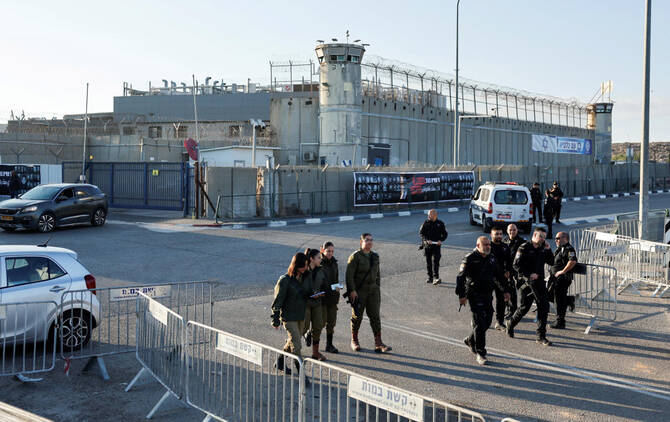
NABLUS: Five months after Israel’s Supreme Court ruled that its prisons were failing to provide enough food for Palestinian detainees and ordered conditions be improved, emaciated prisoners are still emerging with tales of extreme hunger and abuse.
Samer Khawaireh, 45, told Reuters that all he was given to eat in Israel’s Megiddo and Nafha prisons was ten thin pieces of bread over the course of a day, with a bit of hummus and tahini. Twice a week some tuna.
Videos saved on Khawaireh’s phone show him at normal weight before he was detained in the West Bank city of Nablus last April, and clearly emaciated upon his release. He says he lost 22 kg (49 pounds) during nine months in captivity, emerging a month ago covered in scabies sores and so gaunt and dishevelled his 9-year-old son Azadeen didn’t recognize him.
Reuters could not independently determine the total number of prisons where the scarcity of food prevailed, or the total number of inmates who experienced its toll.
Reuters could not independently verify Khawaireh’s diet during his captivity, the reasons for his extreme weight loss, or exactly how widespread such experience is among the 9,000 Palestinians held in Israeli jails.
But it was consistent with descriptions in some reports compiled by lawyers after prison visits. Reuters reviewed 13 such reports from December and January, in which 27 prisoners complained of a lack of food, with most saying provisions had not changed since the court order.
The Association for Civil Rights in Israel (ACRI), which was involved in last year’s landmark court case that led to the order for better treatment for prisoners, has accused the government of harboring a “policy of starvation” in prisons.
The Israel Prisons Service declined to comment on Khawaireh’s individual case but said it “rejects allegations of ‘starvation’ or systematic neglect. Nutrition and medical care are provided based on professional standards and operational procedures.”
The service “operates in accordance with the law and court rulings” and all complaints are investigated through official channels, a spokesperson said.
“Basic rights, including access to food, medical care, and adequate living conditions, are provided in accordance with the law and applicable procedures, by professionally trained staff.”
Khawaireh, a journalist at a Nablus radio station who was held without charge, said he was never told why he was detained in a night raid on his house in April. Israel’s military declined to comment.
RIGHTS GROUP ASKS COURT TO HOLD PRISON SERVICE IN CONTEMPT
Independent verification of the treatment of detainees has become more difficult since the start of the Gaza War, when Israel barred prison visits by the International Committee of the Red Cross, a role the Geneva-based body has played in conflicts around the world for a century.
ACRI has petitioned Israel’s Supreme Court to allow Red Cross access to Palestinian detainees. It has also applied to court to have the prison service held in contempt for failing to comply with last September’s order that it improve conditions.
“All the indications that we’re getting are that not much has changed” since the court ruling, the group’s executive director Noa Sattath told Reuters.
“The prisoners are not getting more food if they ask for it. There hasn’t been any medical examination of the situation of the prisoners, and the prisoners are still hungry.”
The Supreme Court did not respond to a request for comment on the case.
BENEFITS AND INDULGENCES
The number of detainees held by Israel swelled after the Hamas-led attacks on October 7, 2023, with thousands swept up during Israel’s assault on Gaza and a crackdown in the occupied West Bank, though hundreds were freed under a ceasefire last October.
Throughout the war in Gaza, Israel’s Security Minister, Itamar Ben-Gvir, in charge of the prisons service, has compared Israel’s treatment of Palestinians with the abuse faced by Israeli hostages held in Gaza by Hamas, many of whom were released in a state of near starvation that shocked Israelis.
Hamas denies starving hostages, saying they ate as well as their captors under Israeli restrictions on supplies to Gaza.
Sattath, of ACRI, said the treatment of hostages held by militants provides no justification for mistreating Palestinian detainees.
After returning to office atop the most right-wing government in Israel’s history in late 2022, Prime Minister Benjamin Netanyahu put prisons in the hands of Ben-Gvir, a far-right settler activist known for keeping a portrait in his living room of a Jewish gunman who killed 29 Palestinian worshippers in a West Bank mosque.
Among Ben-Gvir’s first acts in office was to shut prison bakeries where Palestinian detainees had been allowed to make their own food, saying he aimed to cancel “benefits and indulgences.”
He has since publicly denounced courts for trying to force prisons to coddle Israel’s enemies. During last year’s court hearings, he called the case “crazy and delusional” in a post on X, mocked the judges for debating “whether the killers’ menu is balanced,” and said he was “here to make sure the terrorists get the bare minimum.”
Ben-Gvir did not respond to a request for comment, including on whether the prison service is now in compliance with the court’s ruling, or whether any policies have been changed in response to it.
ACRI says the far-right’s criticism of judges amounts to a smear campaign intended to intimidate the judiciary. In 2024 the Supreme Court took the unusual step of complaining publicly over posters put up by right-wing activists, denouncing judges.
Hunger, more widely, has been an issue in the war in Gaza, where the United Nations says Israeli supply restrictions caused malnutrition among the more than 2 million Palestinian residents, reaching famine scale in mid-2025. Israel says the extent of hunger was exaggerated and blames Hamas fighters for stealing aid. Hamas denies diverting food, and a US analysis found no evidence that the militants did so systematically.
LAWYERS SAY TEEN DIED IN CUSTODY OF MALNUTRITION
At least 101 Palestinians have died in Israeli custody since the start of the Gaza war, according to the rights group Physicians for Human Rights Israel (PHRI).
Among them was Walid Ahmed, 17, who died in March last year after collapsing and hitting his head in prison, which his lawyers say was a result of illness due to malnutrition.
“His autopsy showed massive weight loss — loss of muscle mass, fat, weakened immune system. When he got an infection, his body couldn’t fight it,” said Ahmed’s lawyer Nadia Daqqa.
Ahmed’s autopsy, reviewed by Reuters, said he suffered from “prolonged malnutrition” and listed starvation, infection and dehydration as potential causes of death.
The prison service declined to comment on Ahmed’s treatment in custody or the cause of his death.
Naji Abbas, PHRI’s director of the prisoners and detainees department, says chronic hunger has made the overall detainee population dangerously susceptible to other ailments.
“When people are being starved, their immune system is weak. So every medical problem, even the simplest one, can become serious,” he said.
Amani Sarahneh, the director of media and documentation for the Palestinian Prisoners Society, who has reviewed hundreds of cases and is in continuous contact with detainees, said the physical consequences are only part of the impact of hunger.
“When you hear detainees describe food, you see how huge a space it takes in their minds, because the human desire to feel full is so basic. Israel uses this heavily: not only physically but psychologically,” she said.
Khawaireh, who has returned to work since his release on January 7, has put weight back on, though he still looks thin.
While in prison, he said he and other detainees sometimes would save up half their allotment of bread for Saturday, so that once a week they can feel full.
“We want to feel, one day, that we are full — even once a week, we want to feel full, we are never full.”


Israeli court ordered prisons to give Palestinian detainees more food. They are still hungry
https://arab.news/pmjm6
Israeli court ordered prisons to give Palestinian detainees more food. They are still hungry

- At least 101 Palestinians have died in Israeli custody since the start of the Gaza war


Iranian strikes kill two in UAE, injure eight in Qatar as regional conflict escalates
- UAE defense ministry said Iran fired 137 missiles and 209 drones at the territory
- Qatar intercepted most of the 65 missiles and 12 drones launched by Iran, said officials
ABU DHABI: Explosions rocked cities across the Gulf on Saturday, killing two people in Abu Dhabi, while smoke and flames rose from Dubai landmark The Palm as Iran launched waves of attacks in retaliation for US and Israeli strikes.
The attacks hit airports in Abu Dhabi, Dubai and Kuwait, as well as Gulf military bases and residential areas, raising fears of a wider conflict and rattling a region long seen as a haven of peace and security.
Across the UAE, Iran fired 137 missiles and 209 drones at the territory, the country’s defense ministry said, as projectiles streaked across the skies of every Gulf state but Oman, a mediator in the recent US-Iran talks.
The UAE defense ministry said most of the missiles and drones were intercepted but at Abu Dhabi’s Zayed International Airport officials said at least one person was killed and seven wounded in an “incident.”
Earlier, falling debris killed a Pakistani civilian in Abu Dhabi, the United Arab Emirates’ capital, officials said.
At Dubai International Airport four people were injured according to airport authorities and four others were also hurt at the luxury Palm development.
In Qatar, officials said Iran launched 65 missiles and 12 drones toward the Gulf state, most of which were intercepted, but eight people were injured in the salvos, with one of them in critical condition.
“We are scared of what the future is for us now, and we can’t say how the next few days are going to be,” Maha Manbaz, a nursing student in Doha told AFP.
Terrified’
Smoke poured from US bases in Abu Dhabi and Bahrain’s capital Manama, home of the American navy’s Fifth Fleet, witnesses saw.
A drone struck Kuwait’s international airport and a base housing US personnel was targeted. Three Kuwaiti soldiers and 12 other people were wounded, authorities said.
After Iran’s Revolutionary Guards reported missile strikes, US Central Command (CENTCOM) said on X that no American naval vessels were hit, damage to US facilities was minimal, and no US casualties had been reported.
Residential buildings were also targeted in Manama, with officials saying firefighters and civil defense teams had been dispatched to the scene.
“The sound of the first explosion terrified me,” said a 50-year-old retiree living near the US base in Manama’s Juffair area, where residents were quickly evacuated.
The UAE, Saudi Arabia and Qatar warned they reserved the right to respond to the attacks.
The oil-and-gas-rich Arab monarchies, lying just across the Gulf from Iran, are long-term American allies and host a clutch of US military bases.
“The Gulf states are sandwiched between Iran and Israel, and have to bear the worst inclinations of both,” said Bader Al-Saif, an assistant professor at Kuwait University.
“Iran’s attacks on the Gulf are misplaced. They’ll only alienate its neighbors and invite further distancing from Iran,” he added.
Conflict is unusual in the Gulf, which has traded on its reputation for stability to become the Middle East’s commercial and diplomatic hub.
‘Significant damage’
The unprecedented barrage targeted Qatar’s Al Udeid base, the region’s biggest US military base, as well as Riyadh and eastern Saudi Arabia.
The UAE, Qatar and Kuwait all announced that their airspace was closed.
An AFP journalist in Qatar saw one missile destroyed in a puff of white smoke, while another in Dubai saw a volley of Patriot interceptors taking off.
Iran fired missiles at Al Udeid last June after US strikes targeted Iranian nuclear facilities during a brief war with Israel.
The escalation also saw Saudi Crown Prince Mohammed bin Salman and UAE President Mohamed bin Zayed speak for the first time since a public row in late December.
The Saudi de facto ruler called the Emirati president and the pair discussed Iran’s retaliatory strikes on the Gulf and expressed solidarity and sympathy.
In Kuwait, an Iranian missile attack caused “significant damage” to the runway at an air base hosting Italian air force personnel, Italian Foreign Minister Antonio Tajani was quoted by the ANSA news agency as saying.
Late on Saturday, Kuwaiti officials said a drone targeted a naval base there with air defense forces intercepting the projectile, according to a post by the defense ministry on X.
For many residents in the Gulf, which has drawn a cosmopolitan, largely expat population, the reaction was one of shock.
“I heard the explosions, I don’t know what I felt,” a Lebanese woman living in Riyadh told AFP.
“We came to the Gulf because it’s known to be safer than Lebanon. Now I don’t know what to do or how to think really.”