

Britain begins evacuation of its nationals from Sudan

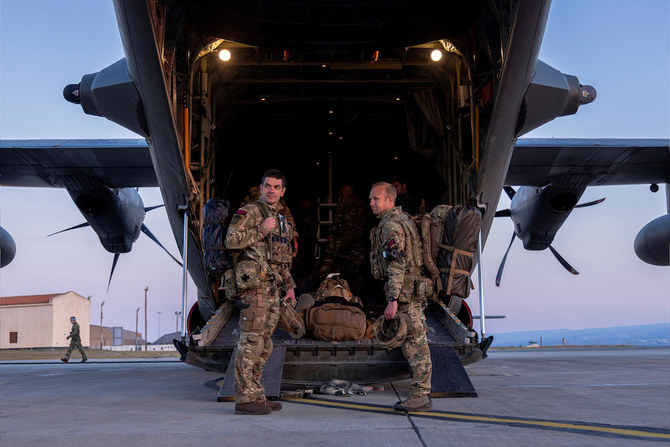
Lieutenant Colonel Oliver Denning and Duncan Maddocks RSM 40 Commando board the C-130 bound for Sudan to evacuate British embassy diplomats and their families in RAF Akrotiri, Cyprus on April 25, 2023. (Reuters)
Short Url
Updated 25 April 2023
Follow

Britain begins evacuation of its nationals from Sudan

  • Britain said military flights would depart from an airfield outside Khartoum, and would be open to those with British passports

LONDON: Britain launched a large-scale evacuation of its citizens from Sudan on Tuesday, joining other nations racing to get their people out of the North African country after its warring factions agreed to a 72-hour cease-fire.

Britain, which has estimated that about 4,000 of its nationals are in Sudan, said military flights would depart from an airfield outside Khartoum, and would be open to those with British passports.

British Prime Minister Rishi Sunak’s spokesperson said that by 1500 GMT one flight had left with two more expected overnight, adding that Britain had the capacity to take over the running of the airfield to allow flights to continue if needed.

“The government has begun a large-scale evacuation of British passport holders from Sudan on RAF flights,” Sunak said on Twitter. “I pay tribute to the British Armed Forces, diplomats and Border Force staff.”

Sunak’s spokesman said flights would continue for as long as possible and British nationals would be taken to Cyprus, with the government facilitating their travel on to Britain.

Cyprus, a former colony and home to two sprawling British military bases, said it had activated a humanitarian rescue mechanism following a British request and would offer reception facilities for the evacuation of third-country civilians.

The flight tracking website Flightradar24 showed an RAF flight from Khartoum landed at the RAF Akrotiri base in Cyprus shortly before 1230 GMT.

British Foreign Secretary James Cleverly said the government was contacting nationals directly on routes for departure but would not be able to provide escorts to the airport.

Cleverly said he had spoken, either directly or through intermediaries, with the leaders of the warring Sudanese factions to facilitate the evacuation.

“We will continue to push for the maintenance of this cease-fire,” Cleverly told reporters in London.

Defense minister Ben Wallace said about 120 members of British armed forces were at the airfield, adding that they were ready to take over the running of the airfield from Germany, who said its last evacuation flight would be on Tuesday.

The British armed forces evacuated diplomatic staff and their family members from Sudan on Saturday and the government had come under criticism from British citizens still stuck there that they were not doing enough to help others.

Britain said it was working with its international partners on the evacuation and would also continue to look at other potential options for getting British nationals out.


Iraq majority bloc backs Nouri al-Maliki as next PM: statement

Updated 8 sec ago
Follow

Iraq majority bloc backs Nouri al-Maliki as next PM: statement

  • The Coordination Framework said that it “decided, by majority vote, to nominate” Al-Maliki for the position
  • The statement spoke of Al-Maliki’s “political and administrative experience and his record in running the state“

BAGHDAD: Iraq’s main Shiite alliance, which holds a parliamentary majority, endorsed on Saturday former prime minister and powerbroker Nouri Al-Maliki as the country’s next premier.
The Coordination Framework, an alliance of Shiite factions with varying links to Iran, said in a statement that it “decided, by majority vote, to nominate” Al-Maliki for the position “as the candidate of the largest parliamentary bloc.”
The statement spoke of Al-Maliki’s “political and administrative experience and his record in running the state.”
A shrewd politician, Al-Maliki, 75, has long been a central figure in Iraq’s politics and its only two-term prime minister (2006-2014) since the US invasion of 2003, which ended decades of rule by the autocratic Sunni president Saddam Hussein.
Since the invasion and by convention in Iraq, a Shiite Muslim holds the powerful post of prime minister, a Sunni is parliament speaker, and the largely ceremonial presidency goes to a Kurd. After Iraq’s November general election, the Coordination Framework, which includes Al-Maliki, formed the majority bloc.
Soon after, it held heated talks to choose the next prime minister, along with other discussions with Sunni and Kurdish parties regarding other posts.
Iraq’s parliament chose a speaker last month and should convene next to elect a new president, who will then appoint a prime minister to replace the incumbent Mohammed Shia Al-Sudani.
Al-Maliki, leader of the State of Law Coalition, remains influential in Iraqi politics despite his controversial past, including widespread accusations of corruption, stoking sectarian tensions, and failing to stop the Daesh group.