Saudi FM: Kingdom will continue efforts to evacuate foreign nationals from Sudan

1 / 11
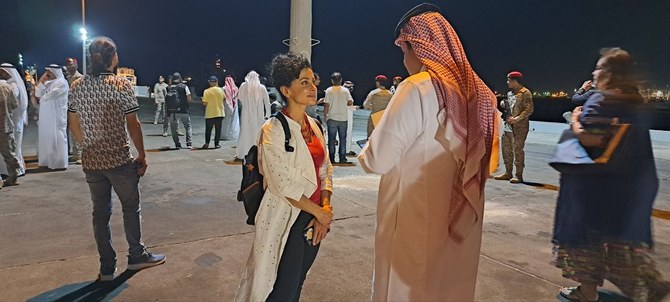
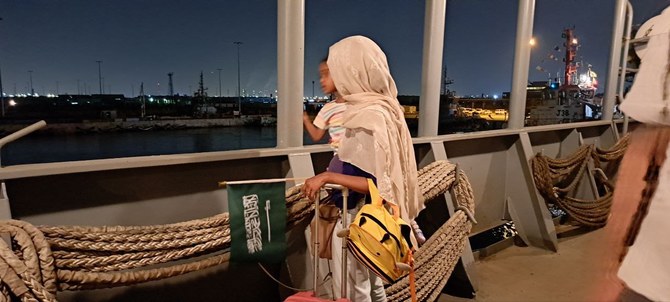
A Saudi ship transporting 199 evacuees of different nationalities from Sudan arrived at the King Faisal Naval Base in Jeddah on Monday. (AN Photo/Mohammad Hashim Nadeem)
2 / 11
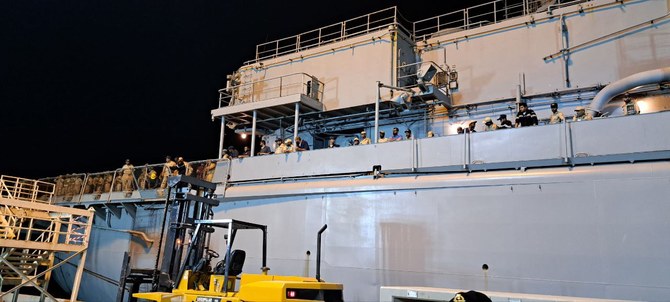
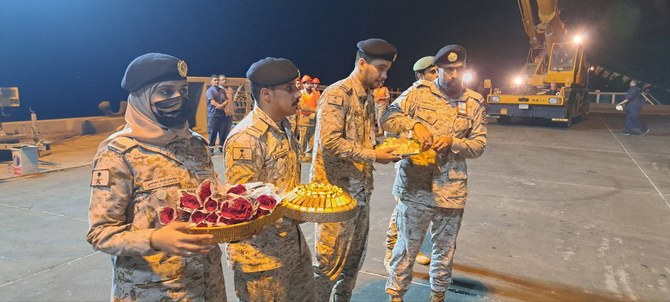
A Saudi ship transporting 199 evacuees of different nationalities from Sudan arrived at the King Faisal Naval Base in Jeddah on Monday. (AN Photo/Mohammad Hashim Nadeem)
3 / 11
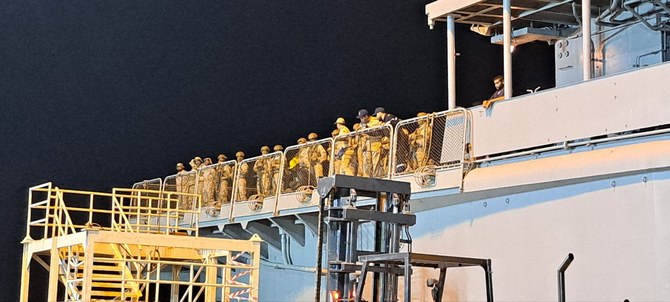
A Saudi ship transporting 199 evacuees of different nationalities from Sudan arrived at the King Faisal Naval Base in Jeddah on Monday. (AN Photo/Mohammad Hashim Nadeem)
4 / 11
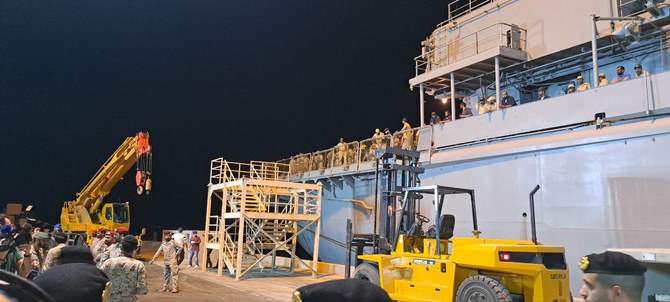
A Saudi ship transporting 199 evacuees of different nationalities from Sudan arrived at the King Faisal Naval Base in Jeddah on Monday. (AN Photo/Mohammad Hashim Nadeem)
5 / 11
A Saudi ship transporting 199 evacuees of different nationalities from Sudan arrived at the King Faisal Naval Base in Jeddah on Monday. (AN Photo/Mohammad Hashim Nadeem)
6 / 11
A Saudi ship transporting 199 evacuees of different nationalities from Sudan arrived at the King Faisal Naval Base in Jeddah on Monday. (AN Photo/Mohammad Hashim Nadeem)
7 / 11
A Saudi ship transporting 199 evacuees of different nationalities from Sudan arrived at the King Faisal Naval Base in Jeddah on Monday. (AN Photo/Mohammad Hashim Nadeem)
8 / 11
A Saudi ship transporting 199 evacuees of different nationalities from Sudan arrived at the King Faisal Naval Base in Jeddah on Monday. (AN Photo/Mohammad Hashim Nadeem)
9 / 11
A Saudi ship transporting 199 evacuees of different nationalities from Sudan arrived at the King Faisal Naval Base in Jeddah on Monday. (AN Photo/Mohammad Hashim Nadeem)
10 / 11
A Saudi ship transporting 199 evacuees of different nationalities from Sudan arrived at the King Faisal Naval Base in Jeddah on Monday. (AN Photo/Mohammad Hashim Nadeem)
11 / 11
A Saudi ship transporting 199 evacuees of different nationalities from Sudan arrived at the King Faisal Naval Base in Jeddah on Monday. (AN Photo/Mohammad Hashim Nadeem)
Short Url
Updated 25 April 2023
Follow

Saudi FM: Kingdom will continue efforts to evacuate foreign nationals from Sudan

  • People from 13 countries have been rescued from Sudan
  • US, UK diplomats tell Arab News they are thankful for Saudi support

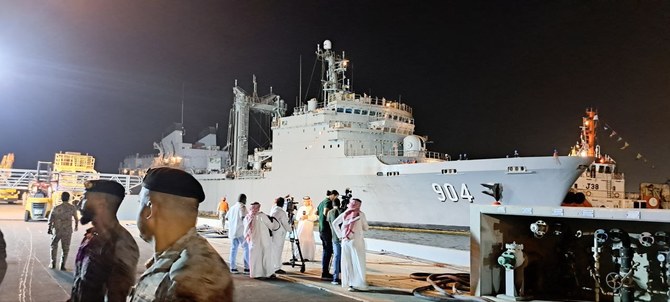
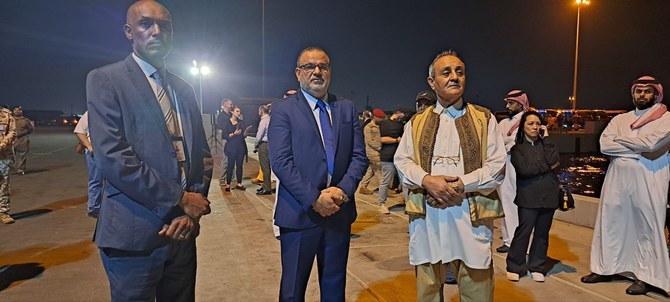
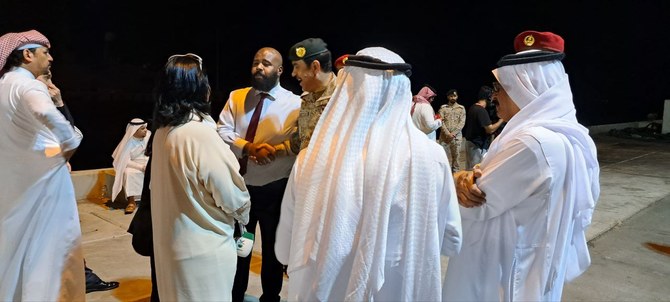
JEDDAH: A Saudi ship transporting 199 evacuees of different nationalities from Sudan arrived at the King Faisal Naval Base in Jeddah on Monday.

A Saudi Ministry of Foreign Affairs statement issued Monday read: “In continuation of the efforts made by the Kingdom of Saudi Arabia under the directives of its wise leadership in evacuating its citizens and nationals of brotherly and friendly countries from the Republic of Sudan to the Kingdom, 10 Saudi citizens arrived in the city of Jeddah this evening, and the number of nationals of brotherly and friendly countries who were evacuated reached 189 people.”

It continued: “This brings the total of those who have been evacuated from Sudan since the start of the evacuation operations to about 356 people, 101 Saudi citizens and 255 others belonging to 26 nationalities.”

Saudi Foreign Minister Prince Faisal bin Farhan on Tuesday said: “We are actively engaged with our brothers in Sudan to ensure safe and secure passages with the aim of facilitating the evacuations. The Kingdom of Saudi Arabia will continue its efforts and offer assistance to ensure the safe evacuation of foreign nationals to their destinations.”

Saudi Arabia also renewed a call on Monday for a speedy cessation of military activities in Sudan. 

The evacuees included 104 Libyan citizens, 45 Lebanese, 15 Syrians, four Sudanese, three Iraqis, two Turkish people and one Swedish national.

Opinion

This section contains relevant reference points, placed in (Opinion field)

As well as the 10 Saudi citizens also on board the ship, there were five British people and two evacuees from each Qatar, US and Italy, in addition to three nationals from the Netherlands and a Tanzanian person.

“Let me repeat what President Biden said on Sunday, we are thankful to Saudi Arabia and the people of Saudi Arabia,” Faris Y. Asad, Consul General of the US, told Arab News. “We are also thankful to our friends and partners in the Kingdom for all their assistance.”

He continued: “The Saudi government has been very forthright with us, with what's going on, so we're very appreciative of that, we look forward today to the arrival of our citizens.

“We have people from all different countries, we have been very impressed and thankful for that, for us, as a US government, there is no higher priority than the safety of our citizens abroad,” he added.


GALLERY

Saudi ship arrives in Jeddah carrying evacuees from Sudan


Speaking partly in Arabic, Cecille El-Beleidi, the British Consul-General, thanked the Kingdom for its efforts.

“I can confirm that a number of British nationals have made their way from Sudan to Jeddah,” she told Arab News. “They have been met by British diplomats and are receiving the full consular services,” she added.

Irene Buongiorno, deputy consul-general of Italy, also told Arab News that the communication between her office and Saudi foreign minister Prince Faisal bin Farhan had been “very effective.”

She continued: “I have no other feeling than appreciation, for all this happening tonight. It is a very nice feeling (inside), we are waiting for two Italian ladies who are arriving.”


Greening the rooftops: Can green roofs take root in Saudi Arabia’s cities?

Updated 8 sec ago
Follow

Greening the rooftops: Can green roofs take root in Saudi Arabia’s cities?

  • As giga-projects reshape the Kingdom, experts push for cooler, biodiverse cities

RIYADH: On Feb. 11, Riyadh marked a pivotal moment in Saudi Arabia’s sustainability journey with the official launch of the Saudi Green Building Alliance.

Announced during the Developers and Green Building Leaders Forum, the initiative signals a shift toward embedding environmental performance at the core of Saudi Arabia’s rapidly expanding built environment.

“SGBA is Saudi Arabia’s national green building council — an independent, nonprofit platform that brings together government, developers, investors, designers, contractors, and solution providers to accelerate sustainable, low-carbon, climate-resilient buildings and cities across the Kingdom,” said Mohammed Al-Surf, founder and CEO of SGBA.

“Our role is to align the market, support standards and best practice, build capacity, and help translate Vision 2030 and the Saudi Green Initiative into practical action in the built environment.”

The Saudi Green Building Forum participated in an international event in January 2026.  (Photo courtesy of Asharq Al-Awsat)

Saudi Arabia is in the midst of one of the largest urban development cycles globally. New districts are taking shape, giga-projects are redefining skylines, and cities such as Riyadh and Jeddah are expanding at unprecedented speed. According to Al-Surf, the defining question is whether this growth will lock in decades of inefficiency and emissions — or set a global benchmark for resilient, climate-smart cities aligned with Vision 2030 and the Saudi Green Initiative.

DID YOU KNOW?

• Energy savings and asset value gains can offset upfront installation costs over time.

• Underused building tops represent one of the largest untapped spaces in urban Saudi Arabia.

• In arid climates, climate-fit design makes greening viable with non-potable water reuse.

Across leading global cities, green rooftops are no longer seen as decorative luxuries but as functional infrastructure. In Saudi Arabia, they intersect directly with national priorities around livability, emissions reduction, and quality of life.

“Green rooftops are not just aesthetics — they are urban infrastructure. In a Vision 2030 context, they can support: Heat reduction and comfort in cities, Energy efficiency and peak load reduction, Healthier, more livable neighborhoods, Nature-based solutions that improve biodiversity and stormwater performance. They’re a practical way to bring climate resilience and quality of life into everyday buildings.” Al-Surf said.

“In Saudi cities, where roofs are a major source of heat gain, vegetated systems can significantly reduce surface temperatures, lower indoor cooling demand, and extend the lifespan of roofing membranes by protecting them from thermal stress.”

In Riyadh, where summer temperatures frequently exceed 45°C, urban heat is more than discomfort — it is a public health issue. Green rooftops can help mitigate the urban heat-island effect by cooling surrounding microclimates and reducing heat stress, particularly in dense neighborhoods. Their impact extends beyond temperature regulation, contributing to environmental resilience and community wellbeing.

Can green roofs work in the desert?

Skepticism persists about whether rooftop greening can truly succeed in arid, high-heat environments. The challenges are undeniable: Water scarcity, extreme summer temperatures, dust accumulation, intense ultraviolet exposure, and long-term maintenance demands all complicate rooftop planting in desert climates.

Yet technological and design advances are reshaping what is possible. Drought-tolerant native species, engineered lightweight soil substrates, drip irrigation systems, and smart water reuse technologies are making rooftop greening increasingly viable. Climate-responsive design remains essential.

Addressing misconceptions is equally important. Al-Surf said: “Three common misconceptions that green roofs are only for Europe. Not true — they just need Saudi-appropriate design. They require lots of water. (But ) not with xeriscape principles, smart irrigation, and non-potable reuse. They’re just decoration. (In reality) They’re thermal, social, and resilience infrastructure.”

One of the most persistent myths is that green roofs waste water. In practice, modern systems prioritize efficiency through xeriscaping principles, soil moisture sensors, weather-based irrigation controls, and the use of treated or non-potable water.

Olivia Jurado, an eco-holistic wellness practitioner who helped establish a regenerative rooftop garden in Dubai, points to regional examples as proof of concept.

“Many people believe it is not possible to grow green spaces in the desert,” she said. “But with the right planting methods and knowledge of what thrives locally, urban rooftop gardens can grow and flourish — and they don’t require excessive tending once mature.”

Opinion

This section contains relevant reference points, placed in (Opinion field)

She underscores the broader ecological and social dividends, from supporting pollinators such as bees and butterflies to creating small biodiversity corridors within cities and offering experiential learning spaces for schools and workplaces.

“Green rooftops provide so many benefits for the community and the environment. Including measurably reducing temperature, providing green spaces for wellbeing and connection to nature. They also help build community by providing a green space for connection, while tending to the space provides further learning opportunities. Rooftop and urban gardens also contribute to supporting and inviting pollinators, such as bees and butterflies, which are so important to our ecosystems.” Jurado said.

Many people believe that it is not possible to grow green spaces in the desert but it has been proven regionally that with the right planting methods and knowing the types of plants that thrive in the region (especially with regenerative gardening practices) urban rooftop gardens can and do indeed grow and thrive and they do not require much tending to once they are mature.

“Every building and community should be encouraged and incentivized to grown their own gardens, it would not only beautify the urban spaces and help cool them, it would also provide a space of wellbeing for their respective communities.”

“It would be amazing to see urban rooftop gardens peeking from the tops of a majority of buildings by 2030.”

For developers, cost often becomes the deciding factor. Green roofs require upfront investment and are frequently cut during value engineering. However, when positioned as long-term performance infrastructure rather than aesthetic add-ons, the financial case becomes more compelling. Reduced cooling loads translate into energy savings; protected roofing membranes extend asset lifespan; premium amenities enhance property value; and stronger ESG credentials improve market positioning.

“The business case is strongest when you frame green roofs as: Energy and thermal risk management, Asset value and tenant premium, Lifecycle savings, Certification and market access,” Al-Surf explained. While upfront costs are real, returns improve when systems are climate-fit, scaled appropriately, and designed as functional amenities rather than symbolic gestures.

Looking ahead, the Saudi Green Building Alliance plans to develop national guidelines tailored to arid climates, establish demonstration rooftops across regions, and cultivate local expertise.

As Saudi Arabia’s skylines continue to rise, rooftops remain vast and largely untapped surfaces. By 2030, they could evolve into gardens, habitats, and cooling systems integrated into everyday urban life — proof that even in the desert, cities can grow greener from the top down.