



ISLAMKOT, Tharparkar: The young girl adjusted the red sash, the words “head girl” written on it in bright yellow letters, patted down her school uniform and then revved up her rickshaw.
Meet Aasia Bheel, 16, who drives herself and other girls to their school located about 15 kilometers from their village in Pakistan’s Tharparkar desert region, known for its vast arid lands, harsh climate and droughts.
Tharparkar, in the southern Sindh province, ranks 21 out of 24 districts in the province for school infrastructure, facilitation and dropouts. The district is considered one of the poorest in Sindh and Pakistan, with 87 percent of its population living below the poverty line, according to data from the Centre on Integrated Rural Development for Asia and the Pacific.
Thus, like many other girls from the area, Bheel had to drop out after completing primary school in her village, Mansingh Bheel, 30 kilometers away from the nearest city of Islamkot, as there was no secondary school in her town. Other girls in her village also dropped out as they could not commute to schools outside their hometowns due to financial reasons or because their parents were not interested in making the effort to educate them.
Help came from The Citizens Foundation (TCF), one of Pakistan’s leading organizations in the field of education for the less privileged, which operates over 1,800 schools across the country, and the non-profit Thar Foundation, which was established in 2014 to address socio-economic challenges in the desert region.
“When I joined TCF Jiwan Das School, there was no transport facility to go there, and it was very difficult for me to reach my school on time,” Bheel told Arab News. “After a few months, the Thar Foundation found a solution to the problem, trained me to ride a rickshaw, and gave me one of these vehicles to help other dropout girls.”
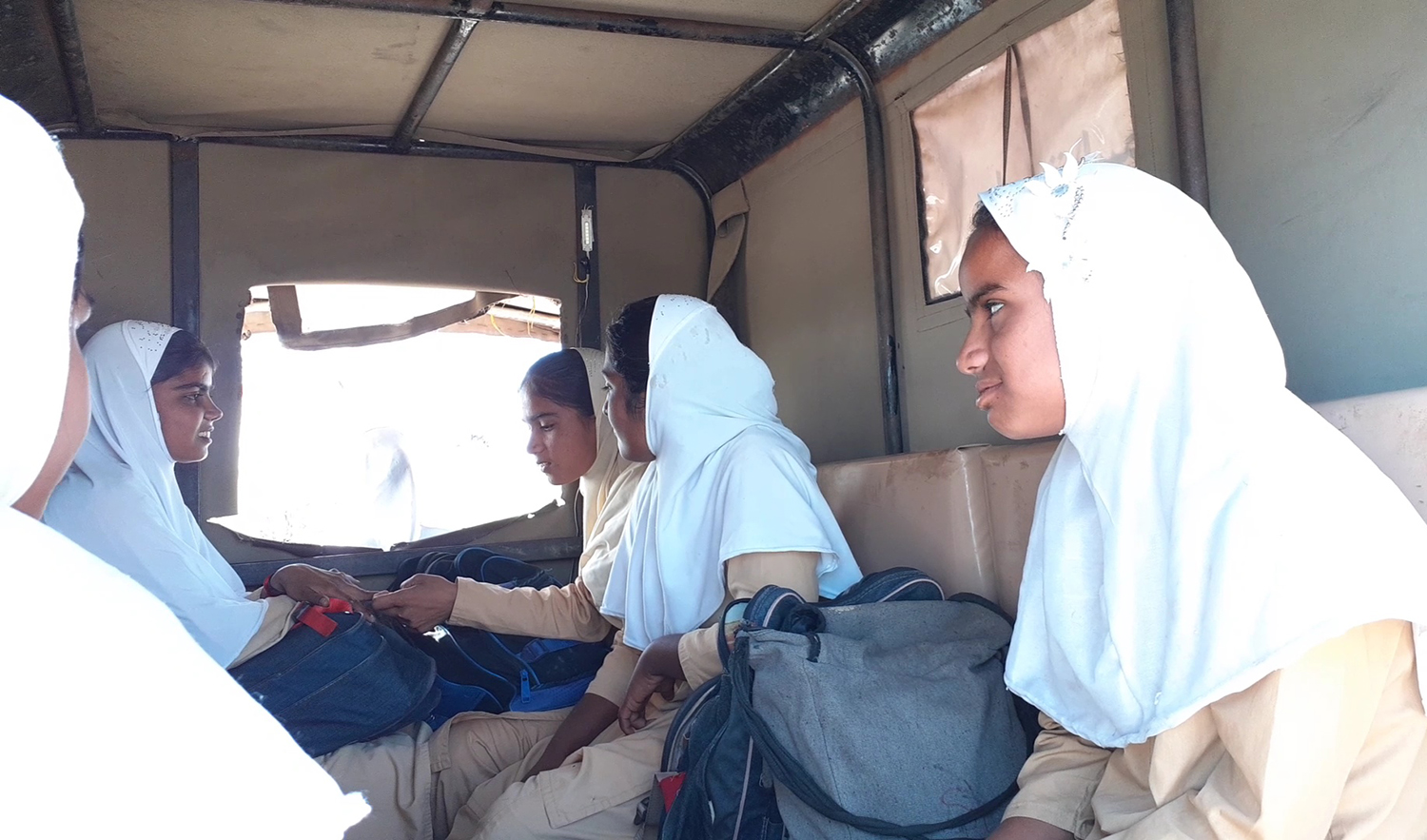
16 Years old Asia gives daily pick and drop to girls of her village in Tharparkar, Pakistan on April 6, 2023. (AN photo)
Initially, only five girls would ride with Bheel but then she started working on convincing more parents on how educating their daughters would improve their lives.
“They agreed,” she said. “Now more than 15 girls accompany me to school in my rickshaw.”
Thar Foundation education officer Sonia Chachar said aiming to solve the problem of girls’ commuting to school, the non-profit came up with the solution to find someone from within the community to drive girls. The Foundation then visited many villages to identify a girl who would be most suitable to implement the idea.
Ultimately, they met Bheel and convinced her parents to let her become part of the project. The Foundation gave her a month's training as a driver, got her a driving license and then gave her a rickshaw to provide pick and drop facility to village girls.
“There is often a trend in villages that ... girls stay at home after the fifth grade,” Chachar said.
“Because secondary school was far away [from Bheel’s hometown], few girls could continue their education. Keeping that in mind, the concept of this [program] was to train a village girl to drive a rickshaw so that she could go to school herself and provide pick and drop facility to dropout girls of that village so that those girls too may continue their education.”
All the girls in last year’s fifth-grade enrollment were now going to the TCF Jiwan Das School and continuing their education, Chachar added. The Thar Foundation’s program to provide access to education to young girls in the region is now in its second year.

Asia Bheel, front right, with her classmates at her school in Tharparkar, Pakistan on April 6, 2023. (AN photo)
Apart from the Foundation, Bheel’s 50-year-old father, Harchand Bheel, who uses the rickshaw after school hours to earn a living for the family, also supported his daughter’s quest for education.
“Initially, no one was willing to send their daughters to school,” he said. “Villagers used to send boys to school but not girls. They also forbade me from sending my daughters to school, saying it was not our custom … But I said I would educate my daughters.”
Bheel was herself quite adamant that she would continue her education.
“My daughter was very much determined to study, she said 'baba, send me to school so that I may become a doctor or an engineer’,” the girl’s father said.
“Her thinking is quite positive and she guides me too. My daughter goes to school every day, she is very intelligent and the monitor of her class.”


