


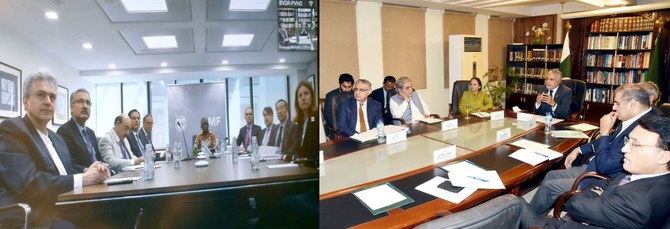

ISLAMABAD: The International Monetary Fund (IMF) has welcomed the announcement of financial support to Pakistan by key bilateral partners, including Saudi Arabia and the United Arab Emirates, the IMF mission chief said on Saturday, adding the global lender still seeks "necessary" assurances to pave way for a bailout deal.
Pakistan availed a $6 billion Extended Funds Facility (EFF) from the IMF in 2019 which was topped up to $7 billion last year. The international lender delayed the release of the next tranche under the loan program amounting to $1.1 billion even as the country implemented tough economic conditions imposed by it.
On Saturday, the UAE confirmed financial support of $1 billion to Pakistan, becoming the third country, after Saudi Arabia and longtime ally China, to come to Pakistan’s assistance, as external financing is needed to fully fund the balance of payments gap for the fiscal year that ends in June.
The commitment was one of the IMF’s last requirements before approving a staff-level pact to release a tranche of $1.1 billion to the South Asian nation, which has been delayed for months and is crucial for Pakistan to resolve the crisis.
“We welcome the recent announcement of important financial support to Pakistan from key bilateral partners. During the meetings between the Pakistani delegation and IMF staff and management, there was agreement on the need to maintain strong policies and secure sufficient financing to support the authorities’ implementation efforts,” IMF Mission Chief to Pakistan Nathan Porter said in a statement.
“The IMF is supporting these efforts and looks forward to obtaining the necessary financing assurances as soon as possible to pave the way for the successful completion of the 9th EFF review.”
Pakistan’s foreign exchange reserves have fallen to cover barely a month of imports after the IMF funding stalled in November, hit by snags over fiscal policy adjustments after officials of the lender visited Islamabad in February for talks.
Last week, Saudi Arabia told the IMF it would provide financing of $2 billion to Pakistan. On Saturday, Jawad Sohrab, an aide to Pakistan Prime Minister Shehbaz Sharif, said Islamabad would receive the $2 billion deposit from the Kingdom “within a few days.”
“Pakistan will receive $2 billion deposit in the SBP within a few days from KSA. A further $10 billion pledged by the Saudi Crown Prince will be invested in the Energy & IT sectors over a period of 2 years. More crucially, large numbers of manpower from Pakistan will be engaged in the Saudi Vision 2030,” Sohrab said on Twitter.
“I acknowledge & thank [for] the Saudi diplomatic & financial support for Pakistan throughout our history, especially during this critical phase.”
Met Saudi ambassador to Pakistan,H. E. Nawaf bin Said Al-Maliki @AmbassadorNawaf in Islamabad. Pakistan will receive $2 billion deposit in the SBP within a few days from KSA. A further $10 billion pledged by the Saudi Crown Prince will be invested in the Energy & IT sectors over… pic.twitter.com/iE3p66w8bI
— Jawad Sohrab (@JawadSohrab) April 14, 2023
Pakistan had to complete actions demanded by the IMF, such as reversing subsidies in its power, export and farming sectors, hikes in the prices of energy and fuel, and a permanent power surcharge, among other measures. These steps included jacking up its key policy rate to an all-time high of 21 percent, a market-based exchange rate, arranging for external financing, and raising more than 170 billion rupees ($613 million) in new taxes. The fiscal adjustments have already fueled Pakistan’s highest inflation ever, which climbed in March to more than 35 percent on the year.
A final issue to be resolved is a fuel pricing scheme meant to bring relief to Pakistan’s lower middle class and poor from crippling inflation. The IMF has asked how it will be funded.
The IMF program will disburse another tranche of $1.1 billion to Pakistan before it concludes in June.


