

Zahi Hawass calls for removal of ‘offensive’ Champollion statue at College de France

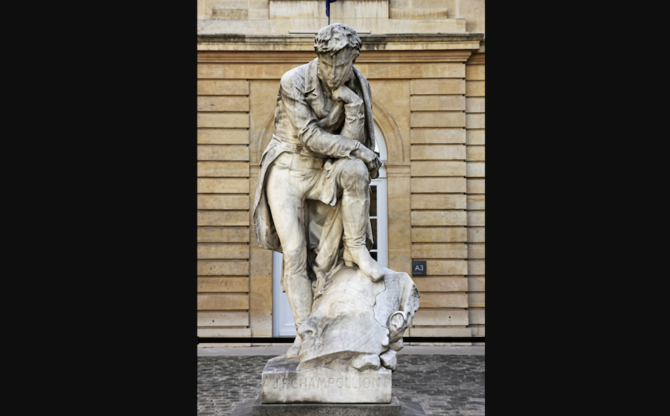
The statue in question, located in the courtyard of College de France, depicts Champollion standing with his foot on the head of the statue of Ramses. (Wikimedia Commons/NonOmnisMoriar/CC BY-SA 3.0)
Short Url
Updated 09 April 2023
Follow

Zahi Hawass calls for removal of ‘offensive’ Champollion statue at College de France

  • Artwork depicts French archeologist with foot on head of Ramses
  • Egypt repeats request for the return of an array of precious antiquities

CAIRO: Dr. Zahi Hawass, the world-renowned archaeologist and Egyptologist, has called for the removal or relocation of the statue of French archeologist Jean Francois Champollion, which is located in the courtyard of College de France, because it is offensive to the Egyptian people.

The statue depicts Champollion standing with his foot on the head of the statue of Ramses.

Hawass made the request during a lecture recently delivered at a major antiquities exhibition in Paris entitled “Ramses the Great and the Gold of the Pharaohs,” which continues until Sept. 17.

“This statue shows contempt and a lack of appreciation that is not reciprocated by the Egyptian people, who appreciated Champollion’s role in the field of Egyptology and named a street after him,” Hawass said.

“Therefore, we demand the same amount of respect.”

In addition to the coffin of one of ancient Egypt’s longest-ruling pharaohs, Ramses II, the exhibition includes an array of ancient Egyptian artefacts, including solid gold and silver jewelry, statues, amulets, masks and other sarcophagi.

State-of-the-art multimedia reproductions are showcasing ancient Egyptian civilization and provide visitors insight into the life and accomplishments of Ramses II.

The traveling exhibition has been held in several major cities.

It was inaugurated in Houston in November 2021 before moving to San Francisco in August last year.

Champollion’s statue is made from limestone, crafted from a single stone block. Champollion is the French scholar who unlocked the secrets of ancient Egypt’s hieroglyphs. It was sculpted by Frederic Auguste Bartholdi in 1875.

Meanwhile, Hawass also called on France to return other antiquities. “The Zodiac ceiling (Dendera zodiac) currently displayed in the Louvre Museum must be returned to its original home, to be placed in the Dendera Temple in Qena Governorate (southern Egypt).”

The Dendera zodiac is an ancient Egyptian depiction of the sky and stars. It is a circular bas-relief carving from the ceiling of the Temple of Hathor in Dendera.

The zodiac is one of the oldest known depictions of the constellations.

Gen. Louis Desaix, a member of Napoleon’s expedition to Egypt, was so captivated by the Zodiac Ceiling that he commissioned artist Denon to draw it for the Description de L’Egypte, the record of the expedition's exploration of Egypt.

The ceiling’s beauty and significance did not go unnoticed by French collector Sebastien Saulnier. He decided that such a remarkable piece should belong to France.

However, Saulnier was determined to keep his plan a secret and announced that he was excavating at Thebes, where he purchased mummies and antiquities to cover his tracks.

During this time, some English visitors were also sketching at Dendera, and only after they left did Saulnier return.

With the help of his French agent, Saulnier removed the Ceiling of the Temple and transported it to Paris.

The ceiling was eventually sold to King Louis XVIII for 150,000 francs.

Last October, Hawass launched an electronic signature campaign to demand the return of the Rosetta Stone from the British Museum in London and the Zodiac Ceiling from the Louvre Museum in France.

Hawass said at the time: “The Zodiac is considered a unique and important Egyptian artifact, and removing it from its original location is immoral as it is a symbol of Egyptian civilization that must be returned to its rightful place.”


Lebanese finance minister denies any plans for a Kushner-run economic zone in the south

Updated 22 January 2026
Follow

Lebanese finance minister denies any plans for a Kushner-run economic zone in the south

  • Proposal was made by US Envoy Morgan Ortagus but was ‘killed on the spot’
  • Priority is to regain control of state in all aspects, Yassine Jaber tells Arab News

DAVOS: Lebanon’s finance minister dismissed any plans of turning Lebanon’s battered southern region into an economic zone, telling Arab News on the sidelines of the World Economic Forum’s meeting in Davos that the proposal had died “on the spot.”

Yassine Jaber explained that US Envoy to Lebanon Morgan Ortagus had proposed the idea last december for the region, which has faced daily airstrikes by Israel, and it was immediately dismissed.

Jaber’s comments, made to Arab News on the sidelines of the World Economic Forum in Davos, were in response to reports which appeared in Lebanese media in December which suggested that parts of southern Lebanon would be turned into an economic zone, managed by a plan proposed by Jared Kushner, US President Donald Trump’s son in law.

Meanwhile, Jaber also dismissed information which had surfaced in Davos over the past two days of a bilateral meeting between Lebanese ministers, US Middle East Envoy Steve Witkoff and Kushner.

Jaber said that the meeting on Tuesday was a gathering of “all Arab ministers of finance and foreign affairs, where they (Witkoff and Kushner) came in for a small while, and explained to the audience the idea about deciding the board of peace for Gaza.”

He stressed that it did not develop beyond that.

When asked about attracting investment and boosting the economy, Jaber said: “The reality now is that we need to reach the situation where there is stability that will allow the Lebanese army, so the (Israeli) aggression has to stop.”

Over the past few years, Lebanon has witnessed one catastrophe after another: one of the world’s worst economic meltdowns, the largest non-nuclear explosion in its capital’s port, a paralyzed parliament and a war with Israel.

A formal mechanism was put in place between Lebanon and Israel to maintain a ceasefire and the plan to disarm Hezbollah in areas below the Litani river.

But, the minister said, Israel’s next step is not always so predictable.

“They’re actually putting pressure on the whole region. So, a lot of effort is being put on that issue,” he added.

“There are still attacks in the south of the country also, so stability is a top necessity that will really succeed in pushing the economy forward and making the reforms beneficial,” he said.

Lawmakers had also enacted reforms to overhaul the banking sector, curb the cash economy and abolish bank secrecy, alongside a bank resolution framework.

Jaber also stressed that the government had recently passed a “gap law” intended to help depositors recover funds and restore the banking system’s functionality.

“One of the priorities we have is really to deal with all the losses of the war, basically reconstruction … and we have started to get loans for reconstructing the destroyed infrastructure in the attacked areas.”

As Hezbollah was battered during the war, Lebanon had a political breakthrough as the army’s general, Joseph Aoun, was inaugurated as president. His chosen prime minister was the former president of the International Court of Justice, Nawaf Salam.

This year marks the first time a solid delegation from the country makes its way to Davos, with Salam being joined by Jaber, Economy and Trade Minister Amr Bisat, and Telecoms Minister Charles Al-Hage.

“Our priority is to really regain the role of the state in all aspects, and specifically in rebuilding the institutions,” Jaber said.