

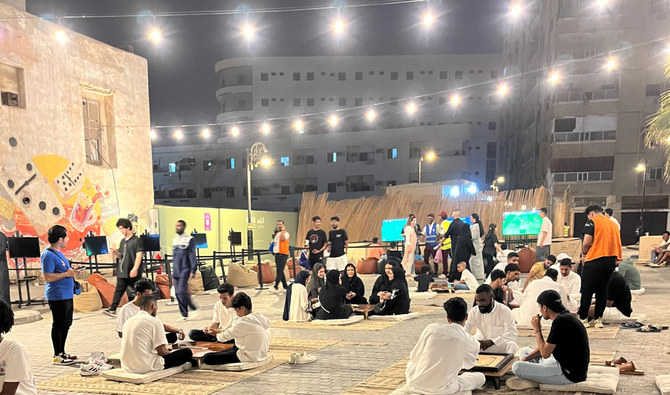

JEDDAH: The narrow alleys of the historic Al-Balad area of Jeddah have become filled with light and laughter as part of a program of evening cultural and entertainment activities for Ramadan.
Organized by the Saudi Ministry of Culture, events are taking place in special zones set up throughout the district.
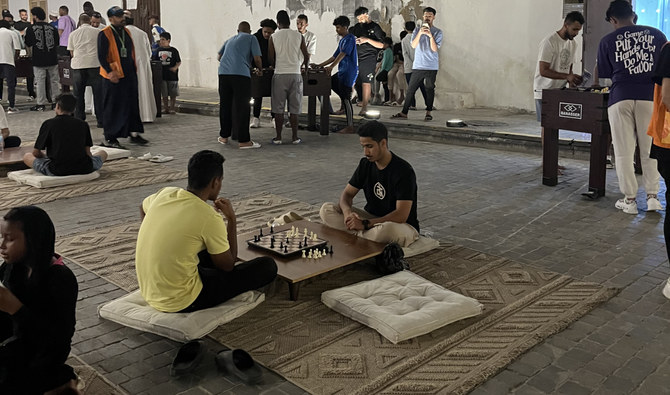
Visitors at the Bab Al-Balad entrance are greeted with traditional Saudi coffee, while in the Mirkaz area they can play games, try their hand at arts and crafts, or sample gourmet food.
The Sardek zone features a Ramadan tent, cinema of the past, roaming characters, and a puppet theater.
The nights, part of the Ramadan Season of festivities, also include live cooking shows and Qur’an recitation contests.
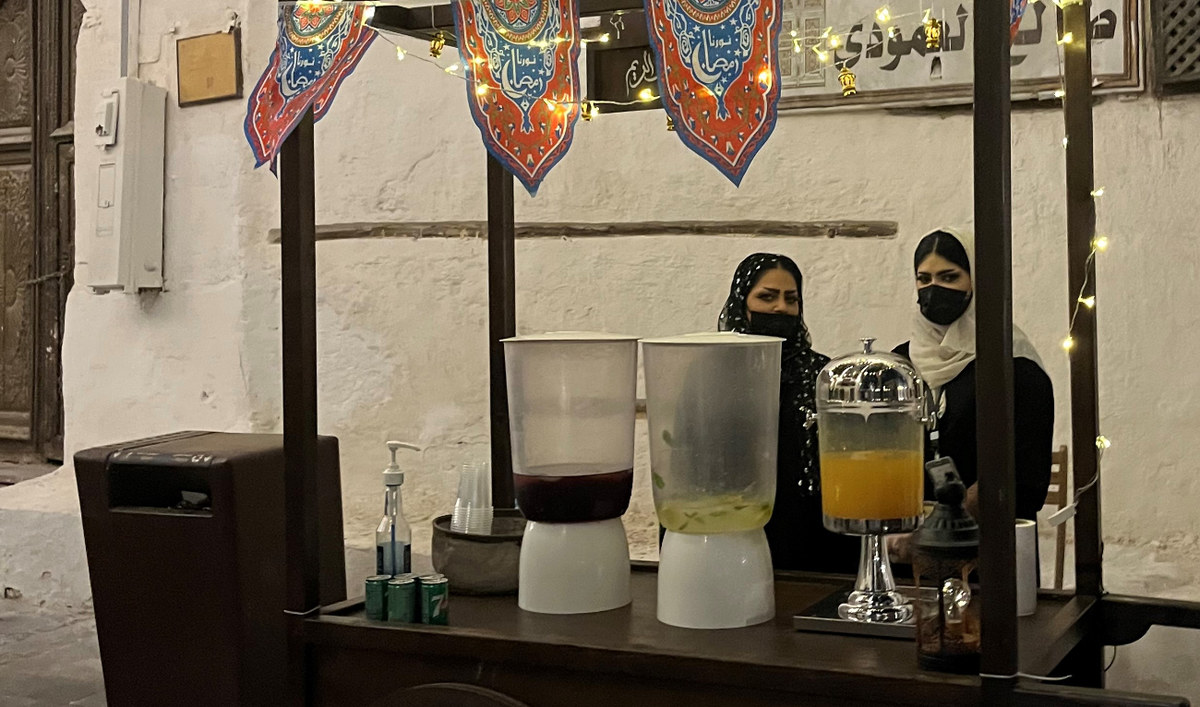
Visitors at the Bab Al-Balad entrance are greeted with traditional Saudi coffee, while in the Mirkaz area they can play games, try their hand at arts and crafts, or sample gourmet food. (Supplied)
A bustling market offers a range of products including perfumes, pickles, tailor-made clothing, and accessories, or festivalgoers can watch games and popular Ramadan TV shows in an outdoor seating area.
Wearing Hijazi attire, Sari Salem Hariri, co-founder and general manager of Al-Mugasap, a Saudi traditional fashion clothing brand, said: “I am very excited to participate in the season and revive the Saudi traditional attire.
“We have installed a booth for visitors to try out the outfits and make a memory of our deep-rooted customs and traditions.”
Badriya Suleimany, who was selling homemade pickles at the event with her daughters, said: “I feel empowered to be a part of the Ramadan Season. I have been doing this business for the last five years, but this is the first time I have been out in the open area and meeting people from different nationalities.
“The real Ramadan vibes are in Al-Balad and it is something which everyone should visit to learn about our culture and holy month traditions.”
Visitors to Al-Balad can also listen to a Musaharati, a person who traditionally walks around a neighborhood beating a drum and chanting poetry to wake people for sahoor. And at various intervals, men in traditional costumes can be seen dancing to traditional songs.
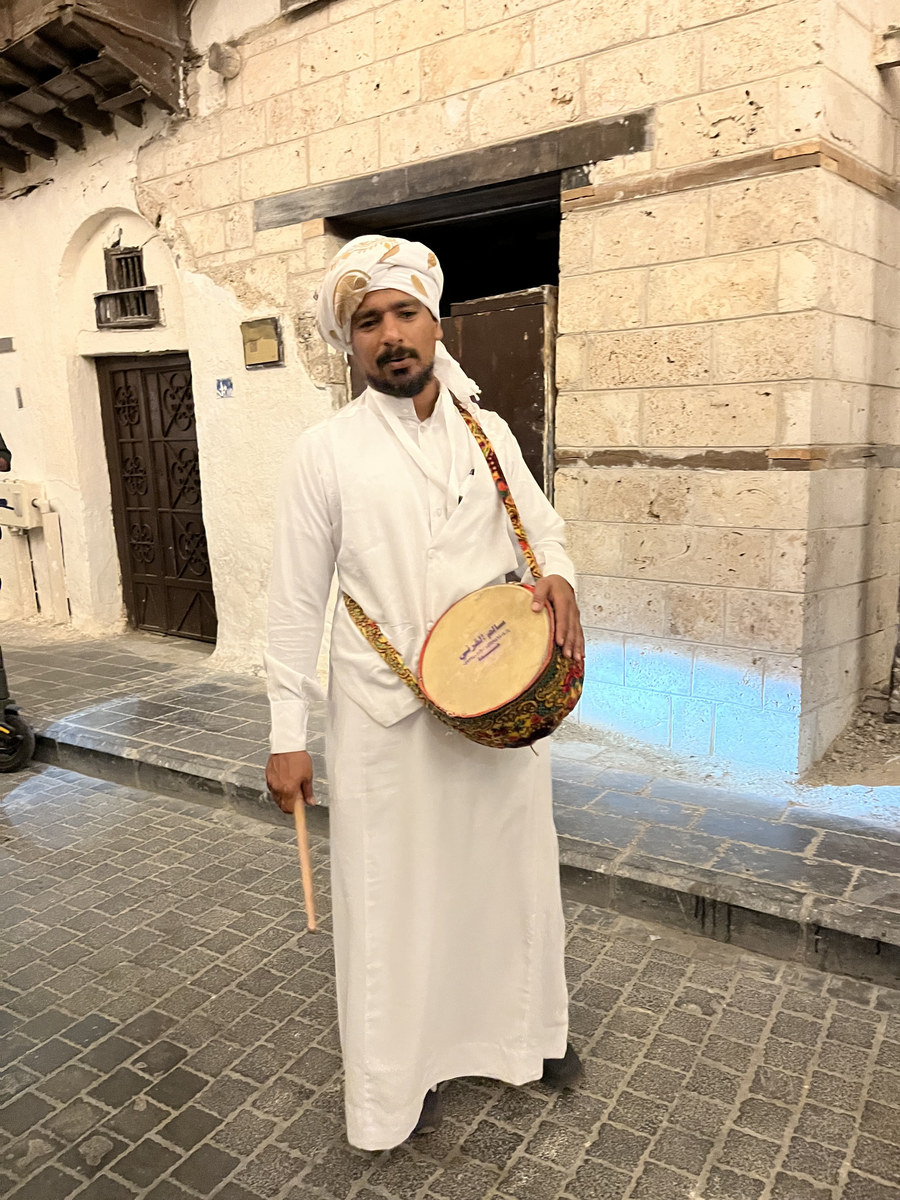
The Musaharati traditionally walks around neighborhoods beating a drum and chanting poetry to wake people for Sahoor. (Supplied)
In addition, storytellers, known as Hakawati, can be heard narrating old Ramadan tales in Hazzazi square.
Saeed Al-Ghamdi, a resident of Jeddah had taken his grandchildren to the event especially for the Hakawati session.
He said: “In the old days, we used to gather and entertain ourselves with storytelling. There used to be master storytellers who shared Islamic tales and history as well as their own real-life stories. We learned from them and gained knowledge.
“Seeing this tradition back here in the festival made me nostalgic and I am glad to share with my grandchildren the beauty of Hakawati.”
Osman Abdullah, 70, from Jeddah, said: “After the Taraweeh, I used to spend time with friends in the neighborhood discussing and sharing religious Islamic stories. Coming to this historic district and witnessing the energetic environment took me back to those days.”
He added that Ramadan nights were special as they were a time when people not only sought spiritual development but socialized.
Another participant, Hadeel Alabbasi, co-founder and academic manager of Al-Kuttab language institute, said: “We invite family and friends to enjoy their time learning calligraphy, poetry, and Arabic this year while experiencing Al-Balad through us where we present the opportunity to learn about the values of Ramadan and the culture.”
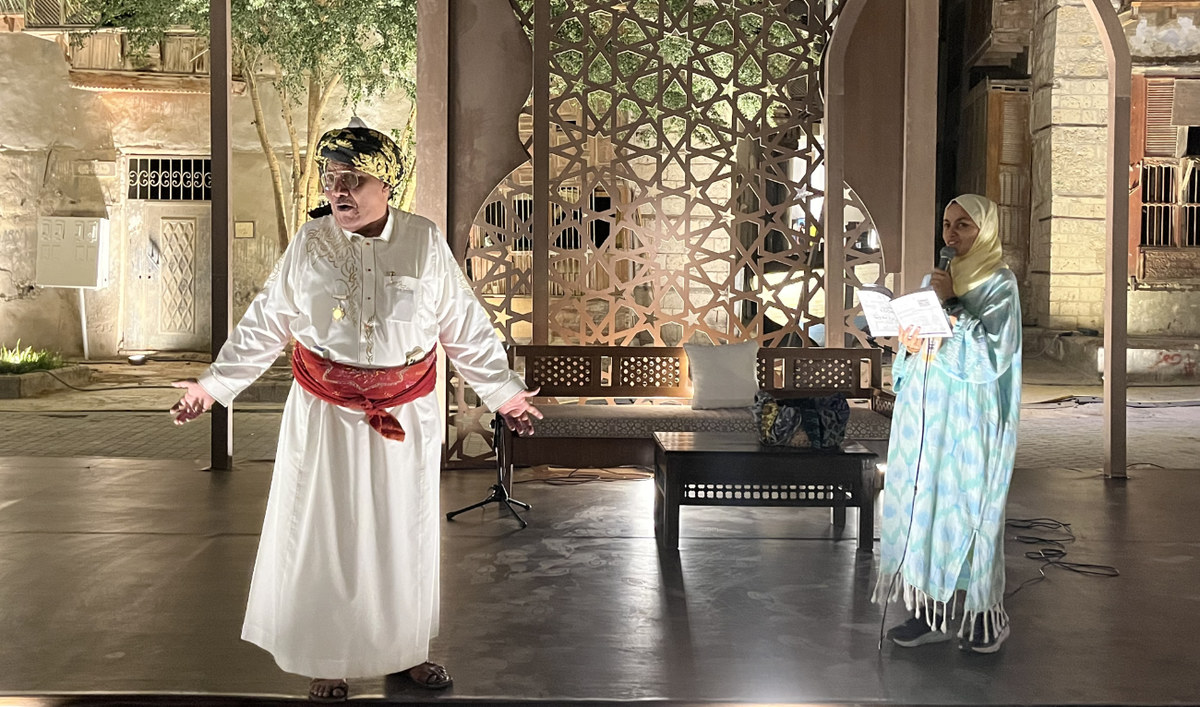
A riddles session at the Hazzazi area. (Supplied)
At the Hazzazi area, located in Rubat Al-Khunji Al-Saghir, activities include making accessories, and learning about the history of the area through stories, solving riddles, playing traditional games, hunting for Ramadan treasure, and listening to poetry.
Sarah Hassan, who lives in Australia but always returns to her hometown of Jeddah for Ramadan, said: “I make sure to spend my entire Ramadan in Jeddah because of the vibe which is not the same anywhere in the world. Saudi Arabia is the best place to be during the holy month.
“Coming to Al-Balad with my children, I can teach them the culture and show them how Ramadan is celebrated in the country. We had a good time walking the streets, trying snacks like balila, French fries, luqaimat, and sipping the very famous Vimto drink.”
The ministry has also organized a history of Jeddah exhibition highlighting important archaeological sites, plus a separate display showcasing ancient coins and stamps from different periods in Jeddah’s past.


