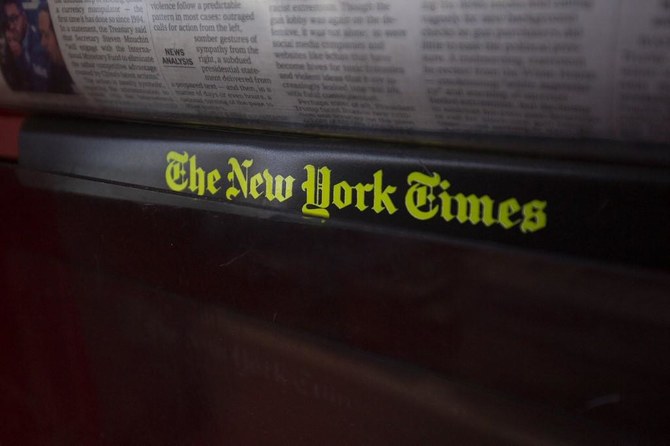
LONDON: Twitter has removed the verification check mark on the main account of The New York Times, one of CEO Elon Musk’s most despised news organizations.
The removal comes as many of Twitter’s high-profile users are bracing for the loss of the blue check marks that helped verify their identity and distinguish them from impostors on the social media platform.
Musk, who owns Twitter, set a deadline of Saturday for verified users to buy a premium Twitter subscription or lose the checks on their profiles. The Times said in a story Thursday that it would not pay Twitter for verification of its institutional accounts.
Early Sunday, Musk tweeted that the Times’ check mark would be removed. Later he posted disparaging remarks about the newspaper, which has aggressively reported on Twitter and on flaws with partially automated driving systems at Tesla, the electric car company, which he also runs.
Other Times accounts such as its business news and opinion pages still had either blue or gold check marks on Sunday, as did multiple reporters for the news organization.
“We aren’t planning to pay the monthly fee for check mark status for our institutional Twitter accounts,” the Times said in a statement Sunday. “We also will not reimburse reporters for Twitter Blue for personal accounts, except in rare instances where this status would be essential for reporting purposes,” the newspaper said in a statement Sunday.
The Associated Press, which has said it also will not pay for the check marks, still had them on its accounts at midday Sunday.
Twitter did not answer emailed questions Sunday about the removal of The New York Times check mark.
The costs of keeping the check marks ranges from $8 a month for individual web users to a starting price of $1,000 monthly to verify an organization, plus $50 monthly for each affiliate or employee account. Twitter does not verify the individual accounts to ensure they are who they say they are, as was the case with the previous blue check doled out to public figures and others during the platform’s pre-Musk administration.
While the cost of Twitter Blue subscriptions might seem like nothing for Twitter’s most famous commentators, celebrity users from basketball star LeBron James to Star Trek’s William Shatner have balked at joining. Seinfeld actor Jason Alexander pledged to leave the platform if Musk takes his blue check away.
The White House is also passing on enrolling in premium accounts, according to a memo sent to staff. While Twitter has granted a free gray mark for President Joe Biden and members of his Cabinet, lower-level staff won’t get Twitter Blue benefits unless they pay for it themselves.
“If you see impersonations that you believe violate Twitter’s stated impersonation policies, alert Twitter using Twitter’s public impersonation portal,” said the staff memo from White House official Rob Flaherty.
Alexander, the actor, said there are bigger issues in the world but without the blue mark, “anyone can allege to be me” so if he loses it, he’s gone.
“Anyone appearing with it=an imposter. I tell you this while I’m still official,” he tweeted.
After buying Twitter for $44 billion in October, Musk has been trying to boost the struggling platform’s revenue by pushing more people to pay for a premium subscription. But his move also reflects his assertion that the blue verification marks have become an undeserved or “corrupt” status symbol for elite personalities, news reporters and others granted verification for free by Twitter’s previous leadership.
Along with shielding celebrities from impersonators, one of Twitter’s main reasons to mark profiles with a blue check mark starting about 14 years ago was to verify politicians, activists and people who suddenly find themselves in the news, as well as little-known journalists at small publications around the globe, as an extra tool to curb misinformation coming from accounts that are impersonating people. Most “legacy blue checks” are not household names and weren’t meant to be.
One of Musk’s first product moves after taking over Twitter was to launch a service granting blue checks to anyone willing to pay $8 a month. But it was quickly inundated by impostor accounts, including those impersonating Nintendo, pharmaceutical company Eli Lilly and Musk’s businesses Tesla and SpaceX, so Twitter had to temporarily suspend the service days after its launch.
The relaunched service costs $8 a month for web users and $11 a month for users of its iPhone or Android apps. Subscribers are supposed to see fewer ads, be able to post longer videos and have their tweets featured more prominently.

Twitter pulls check mark from main New York Times account
https://arab.news/vcxc8
Twitter pulls check mark from main New York Times account
- The New York Times becomes first high-profile organization to lose blue badge
- Decision came after newspaper said it would not pay Twitter for verification
MenaML hosts 2026 Winter School in Saudi Arabia to boost AI education, collaboration in region
- Second edition of Winter School will be hosted in partnership with KAUST
DUBAI: The Middle East and North Africa Machine Learning Winter School will host its second edition in Saudi Arabia this year, in partnership with the King Abdullah University of Science and Technology.
The non-profit held its inaugural edition in Doha last year in partnership with the Qatar Computing Research Institute.
The initiative began when like-minded individuals from Google DeepMind and QCRI came together to launch a platform connecting a “community of top-tier AI practitioners with a shared interest in shaping the future of the MENA region,” Sami Alabed, a research scientist at Google DeepMind and one of the co-founders of MenaML, told Arab News.
Along with Alabed, the core team includes Maria Abi Raad and Amal Rannen-Triki from Google DeepMind, as well as Safa Messaoud and Yazan Boshmaf from QCRI.
Messaoud said that the school has three goals: building local talent in artificial intelligence, enhancing employability and connection, and reversing brain drain while fostering regional opportunity.
AI has dominated boardrooms and courtrooms alike globally, but “AI research and education in MENA are currently in a nascent, yet booming, stage,” she added.
Launched at a pivotal moment for the region, the initiative was timed to ensure “regional representation in the global AI story while cultivating AI models that are culturally aligned,” said Rannen-Triki.
The school’s vision is to cultivate researchers capable of developing “sophisticated, culturally aligned AI models” that reflect the region’s values and linguistic and cultural diversity, said Messaoud.
This approach, she added, enables the region to contribute meaningfully to the global AI ecosystem while ensuring that AI technologies remain locally relevant and ethically grounded.
MenaML aims to host its annual program in a different city each year, partnering with reputable institutions in each host location.
“Innovation does not happen in silos; breakthroughs are born from collaboration that extends beyond borders and lab lines,” said Alabed.
“Bringing together frontier labs to share their knowledge echoes this message, where each partner brings a unique viewpoint,” he added.
This year, MenaML has partnered with KAUST, which “offers deep dives into specialized areas critical to the region, blending collaborative spaces with self-learning and placement programs,” said Abi Raad.
The program, developed in partnership with KAUST, brings together speakers from 16 institutions and focuses on four key areas: AI and society, AI and sciences, AI development, and regional initiatives.
“These themes align with the scientific priorities and research excellence pillars of KAUST as well as the needs of regional industries seeking to deploy AI safely and effectively,” said Bernard Ghanem, professor of electrical and computer engineering and computer science at KAUST and director of the Center of Excellence in Generative AI.
The program will also highlight efficiency in AI systems, with the overall goal of equipping “participants with the conceptual and practical understanding needed to contribute meaningfully to next-generation AI research and development,” he told Arab News.
For KAUST, hosting the MenaML Winter School aligns with Saudi Arabia’s ambition to become a global hub for AI research under Vision 2030.
By attracting top researchers, industry partners, and young talent to the Kingdom, it helps cement the Kingdom’s position as a center for AI excellence, Ghanem said.
It also aligns closely with Vision 2030’s “goals of building human capital, fostering innovation, and developing a knowledge-based economy” and “contributes to the long-term development of a world-leading AI ecosystem in Saudi Arabia,” he added.

Although the program accepts students from around the world, participants must demonstrate a connection to the MENA region, Abi Raad said.
The goal is to build bridges between those who may have left the region and those who remain, enabling them to start conversations and collaborate, she added.
A certain percentage of spots is reserved for participants from the host country, while a small percentage is allocated to fully international students with no regional ties, with the objective of offering them a glimpse into the regional AI ecosystem.
Looking ahead, MenaML envisions growing from an annual event into a sustainable, central pillar of the regional AI ecosystem, inspired by the growth trajectory of global movements like TED or the Deep Learning Indaba, a sister organization supporting AI research and education in Africa.
Boshmaf said MenaML’s long-term ambition is to evolve beyond its flagship event into a broader movement, anchored by local MenaMLx chapters across the region.
Over time, the initiative aims to play a central role in strengthening the regional AI ecosystem by working with governments and the private sector to support workforce development, AI governance and safety education, and collaborative research, while raising the region’s global visibility through its talent network and international partnerships.
He added: “If TED is the global stage for ‘ideas worth spreading,’ MenaML is to be the regional stage for ‘AI ideas worth building.’”
The MenaML Winter School will run from Jan. 24 to 29 at KAUST in Saudi Arabia.


