

Pakistan, UAE to set up data-sharing system, enhance seismology and meteorology capabilities

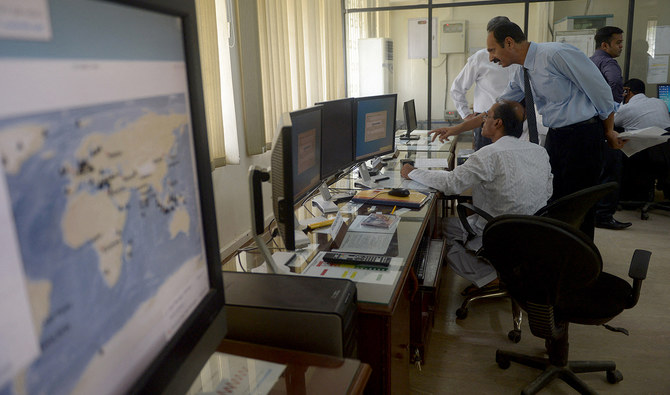
This file photo, taken on September 10, 2014, shows a Pakistani team member working at Met Office in Karachi. (Photo courtesy: AFP/File)
Short Url
Updated 31 March 2023
Follow

Pakistan, UAE to set up data-sharing system, enhance seismology and meteorology capabilities

  • The joint project will cover climate hazards such as rains leading to floods, earthquakes and their impact on the sea
  • Cooperation will aim at better understanding of potential for seismic activities to generate tsunamis in Arabian Sea, Sea of Oman

ISLAMABAD: Pakistani weather bureaus and the meteorology department in the United Arab Emirates (UAE) have signed an agreement to cooperate on improving their respective capabilities in the fields of seismology and meteorology and set up a monitoring and data-sharing system to cover a range of climate disasters, particularly earthquakes and tsunamis, a senior official at the Pakistan Meteorological Department (PMD) said this week.

UAE’s National Center of Meteorology (NCM) director, Dr. Abdullah Ahmed Al Mandoos, and PMD Director-General Mahr Sahibzad Khan signed a Letter of Agreement earlier this month on the sidelines of the World Meteorological Organization (WMO) regional conference in Abu Dhabi.

Last year’s heatwave and devastating floods in Pakistan were a stark reminder that climate change-induced disasters can significantly set back the country’s development ambitions and its ability to reduce poverty. The disasters caused more than 1,700 deaths and displaced more than 8 million people, with more than $30 billion in damages and economic losses. Last week, a 6.5-magnitude earthquake killed at least 10 people and injured over 60 in Pakistan’s northwestern Khyber Pakhtunkhwa province.

In the UAE, the continuing rise in temperatures caused by global warming contributes to water scarcity, drought and a rising sea level in the Gulf of Oman. The Gulf nation, with infrequent precipitation and high temperatures, also faces long-term aridity.

“Pakistan and the UAE recently signed a Letter of Agreement to enhance our seismology and meteorology capabilities,” Zahid Rafi, a director at PMD’s Seismology Division, who was the focal person from Pakistan at the WMO conference, told Arab News.

“Under the agreement, we will link all our stations with the UAE through satellite in the next two weeks and our technical teams are working together to connect both countries’ stations.”

“The cooperation between the two countries will extend to a range of areas, including marine meteorological services, hydrology, flood forecasting, seismology, and scientific research aimed at better understanding of the potential for seismic activities to generate tsunamis in the Arabian Sea and the Sea of Oman,” Rafi added.

Through the cooperation, both countries will establish a multi-hazard system that would be “particularly advantageous for Pakistan,” given the intensity of climate-related activities in the region, the PMD director said. The project would cover various climatic hazards, such as sudden rains leading to flooding and earthquakes as well as their impact on the sea.

Rafi said Pakistan and the UAE would work to develop specialized capacities for tsunami research through round-the-clock exchange of seismic data, which would be integrated with weather data to enable faster and more reliable forecast of tsunamis in the Gulf of Oman, potentially affecting coastal areas in Pakistan and the northeast of the UAE.

The collaborative efforts would also enhance technical cooperation and expertise exchange by providing support to the Tsunami Early Warning Centers (TEWC) of Pakistan and the UAE through advanced forecast modeling software, specifically designed to support tsunami forecast operations.

The agreement between Pakistan and the UAE is based on a mechanism established between Pakistan and Oman in 2015 under which the two countries share data and other information to improve safety through better monitoring.

“Oman has developed a system on the coastal line of their sea, which is quite close to our Gwadar and Makran coast which is a hazard-related system, like a tsunami caused by an earthquake in the sea, or a large wave that comes and is not detected, causing problems for sea vessels,” Rafi said.

Both countries began data sharing to improve monitoring on the economically vital route, he added.

Seeing the success of the cooperation, the official said, the UAE’s National Center of Meteorology contacted the Pakistan government and requested establishing a similar data-sharing system to monitor meteorological and seismic hazards in the region.

As per the agreement, Rafi said, Pakistan and the UAE would have access to each other’s data and remain in constant contact to increase the capability and coverage of their respective networks.

“The project involves not just data sharing but also technical cooperation and whenever we need anything, they will provide it to us, and if they need anything from us, we will provide it to them,” Rafi said.

UAE’s National Center of Meteorology could not be reached for comment.


Imran Khan’s party shutdown draws mixed response; government calls it ‘ineffective’

Updated 4 sec ago
Follow

Imran Khan’s party shutdown draws mixed response; government calls it ‘ineffective’

  • Ex-PM Khan’s PTI party had called for a ‘shutter-down strike’ to protest Feb. 8, 2024 general election results
  • While businesses reportedly remained closed in Khyber Pakhtunkhwa, they continued as normal elsewhere

ISLAMABAD: A nationwide “shutter-down strike” called by former prime minister Imran Khan’s party drew a mixed response in Pakistan on Sunday, underscoring political polarization in the country two years after a controversial general election.

Khan’s Pakistan Tehreek-e-Insaf (PIT) opposition party had urged the masses to shut businesses across the country to protest alleged rigging on the second anniversary of the Feb. 8, 2024 general election.

Local media reported a majority of businesses remained closed in the Khyber Pakhtunkhwa (KP) province, governed by the PTI, while business continued as normal in other provinces as several trade associations distanced themselves from the strike call.

Arab News visited major markets in Islamabad’s G-6, G-9, I-8 and F-6 sectors, as well as commercial hubs in Rawalpindi, which largely remained operational on Sunday, a public holiday when shops, restaurants and malls typically remain open in Pakistan.

“Pakistan’s constitution says people will elect their representatives. But on 8th February 2024, people were barred from exercising their voting right freely,” Allama Raja Nasir Abbas Jafri, the PTI opposition leader in the Senate, said at a protest march near Islamabad’s iconic Faisal Mosque.

Millions of Pakistanis voted for national and provincial candidates during the Feb. 8, 2024 election, which was marred by a nationwide shutdown of cellphone networks and delayed results, leading to widespread allegations of election manipulation by the PTI and other opposition parties. The caretaker government at the time and the Election Commission of Pakistan (ECP) both rejected the allegations.

Khan’s PTI candidates contested the Feb. 8 elections as independents after the party was barred from the polls. They won the most seats but fell short of the majority needed to form a government, which was made by a smattering of rival political parties led by Prime Minister Shehbaz Sharif. The government insists the polling was conducted transparently and that Khan’s party was not denied a fair chance.

Authorities in the Pakistani capital deployed a heavy police contingent on the main road leading to the Faisal Mosque on Sunday. Despite police presence and the reported arrest of some PTI workers, Jafri led local PTI members and dozens of supporters who chanted slogans against the government at the march.

“We promise we will never forget 8th February,” Jafri said.

The PTI said its strike call was “successful” and shared videos on official social media accounts showing closed shops and markets in various parts of the country.

The government, however, dismissed the protest as “ineffective.”

“The public is fed up with protest politics and has strongly rejected PTI’s call,” Pakistan’s Information Minister Attaullah Tarar said on X.

“It’s Sunday, yet there is still hustle and bustle.”

Ajmal Baloch, All Pakistan Traders Association president, said they neither support such protest calls, nor prevent individuals from closing shops based on personal political affiliation.

“It’s a call from a political party and we do not close businesses on calls of any political party,” Baloch told Arab News.

“We only give calls of strike on issues related to traders.”

Khan was ousted from power in April 2022 after what is widely believed to be a falling out with the country’s powerful generals. The army denies it interferes in politics. Khan has been in prison since August 2023 and faces a slew of legal challenges that ruled him out of the Feb. 8 general elections and which he says are politically motivated to keep him and his party away from power.

In Jan. 2025, an accountability court convicted Khan and his wife in the £190 million Al-Qadir Trust land corruption case, sentencing him to 14 years and her to seven years after finding that the trust was used to acquire land and funds in exchange for alleged favors. The couple denies any wrongdoing.