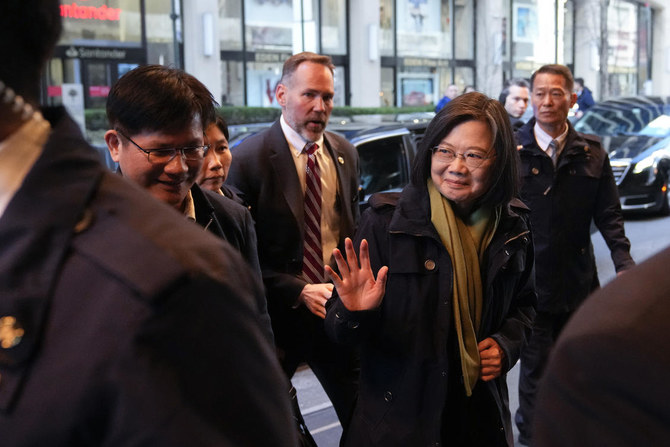
MEXICO CITY: As Taiwan’s diplomatic partners dwindle and turn instead to rival China, Taiwanese president Tsai Ing-wen is aiming to shore up ties with the self-governing island’s remaining allies during a trip this week to Central America.
In a speech addressed to leaders of Guatemala and Belize shortly before departing, Tsai framed the trip as a chance to show Taiwan’s commitment to democratic values globally.
“External pressure will not obstruct our resolution to go on the world stage. We will be calm, self-confident, we will not submit but also not provoke,” said Tsai, who will also meet with US House Speaker Kevin McCarthy in a stopover in the United States.
But the trip also is aimed to solidifying ties in Latin America as China funnels money into the region and pressures its countries to break off relations with the self-governed democratic island.
In Guatemala and Belize, Tsai is expected to bring an open checkbook. But in a region under growing Chinese influence, analysts say that Taiwan may already have lost the long game.
“These countries, they are symbolic. And I don’t think Taiwan wants to lose any of them,” said June Teufel Dreyer, a political scientist at University of Miami. “But if China is going to indulge in checkbook diplomacy, I don’t think Taiwan can compete and it knows it.”
The visit comes just days after Honduras became the latest country to break with Taiwan in favor of establishing ties with China.
Honduras follows in the footsteps of Nicaragua, El Salvador, the Dominican Republic, Panama and Costa Rica in ditching Taiwan. In some cases, China was said to have dangled hefty investment packages and loans in exchange for switching allegiances.
As the Asian superpower has sought to isolate Taiwan and expand its power on the global stage, Chinese trade and investment in Latin America has soared.
Between 2005 and 2020, the Chinese have invested more than $130 billion in Latin America, according to the United States Institute of Peace. Trade between China and the region has also shot up, and is expected to reach more than $700 billion by 2035.
Honduras’ move came in conjunction with the construction of a hydroelectric dam project built by the Chinese company SINOHYDRO with about $300 million in Chinese government financing.
It left Taiwan with no more than 13 official diplomatic partners. More than half of those are small countries in Latin America and the Caribbean: Belize, Guatemala, Paraguay, Haiti, Saint Kitts and Nevis, Saint Lucia, Saint Vincent and the Grenadines.
At the same time Chinese influence has grown, lagging spending by the US — Taiwan’s primary ally and source of defensive weaponry — has caused its sway in Latin America to slip.
For decades, China has claimed Taiwan as its own territory to be brought under its control by force if necessary, but the Taiwanese public overwhelmingly favors the current state of de-facto independence.
China has spent a great amount of effort in its campaign to diplomatically isolate Taiwan ever since Tsai’s election in 2016, successfully convincing nine countries to break off relations with Taipei since she has been in office.
China’s government views Tsai and her independence-leaning Democratic Progressive Party as separatists.
In recent months, tensions have only intensified as relations between Beijing and Washington have spiraled. As a result, regions like Central America have grown in geopolitical importance.
“While our policy has not changed, what has changed is Beijing’s growing coercion – like trying to cut off Taiwan’s relations with countries around the world,” US Secretary of State Antony Blinken said in a speech about China relations last year.
Guatemala and Belize are among those who have remained steadfast supporters of Taiwan, Guatemala’s government reaffirming in March its “recognition of Taiwan as an independent nation with which democratic values and mutual respect are shared.”
Yet analysts say their allegiance is also a political calculation.
Tiziano Breda, researcher at International Affairs Institute, said that position will likely be wielded politically, used as a potential shield against pressure from the US
The US government, for example, has been highly critical of the administration of President Alejandro Giammattei for not doing enough to crack down on corruption.
“It’s a card these countries wait to play,” Breda said.
Dreyer of University of Miami said many of Taiwan’s allies will use their relationship with both China and Taiwan as a “bargaining chip” to seek greater investment and monetary benefits from both countries.
She said in Ing-wen’s meetings with Guatemala and Belize, the president is likely to offer investment and development projects contingent on maintaining good relations with her country.
But Dreyer noted that given the power China wields on a world stage, it’s only a matter of time before the economic superpower pulls Taiwan’s final diplomatic partners onto their side.
The Chinese “are not only willing to wait, but eager to wait until they think the time is ripe,” Dreyer said. “They want the most auspicious moment possible.”


![]()

Taiwan leader scrambles for allies in Central America visit
Short Url
https://arab.news/9bayz
Taiwan leader scrambles for allies in Central America visit
- In a region under growing Chinese influence, analysts say that Taiwan may already have lost the long game


Latest updates


© 2026 SAUDI RESEARCH & PUBLISHING COMPANY, All Rights Reserved And subject to Terms of Use Agreement.