

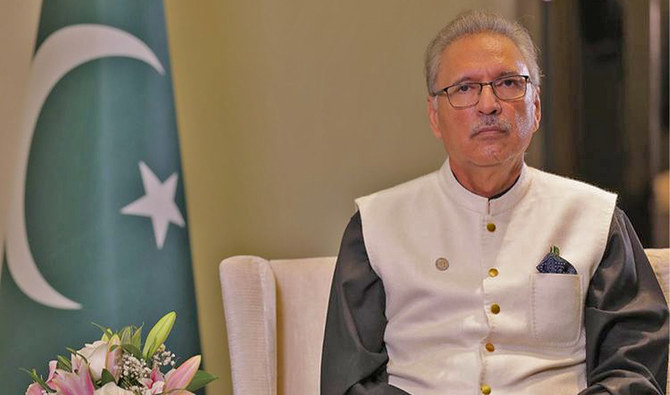

ISLAMABAD: President Arif Alvi said on Wednesday he was doubtful that Pakistan would even hold general elections in October after the election commission decided to postpone the polls in Punjab and Khyber Pakhtunkhwa provinces in a move that further deepened political uncertainty and turmoil in the country.
The election dates in the two provinces came up for discussion after former prime minister Imran Khan’s Pakistan Tehreek-e-Insaf (PTI) party decided to dissolve their assemblies in January while trying to build pressure on the government to hold snap elections in the country.
After much political wrangling that led to judicial proceedings to settle the issue, the Election Commission of Pakistan (ECP) announced to hold general elections in Punjab and Khyber Pakhtunkhwa provinces on April 30 and May 28, respectively.
However, it later revisited the election schedule, citing security, administrative and financial reasons, and postponed the polls to October 8.
Discussing the current political developments in an interview with Geo News, Alvi said he had a feeling for the last 10 months that Pakistan’s constitution was facing challenges.
“Even before Imran Khan dissolved the assemblies, I told him and also highlighted in my speeches that even the October elections seemed to be under threat,” he said.
“The incumbent government says that Pakistan was moving toward a disaster when it decided to sacrifice [its political capital] to stabilize things,” he continued. “However, the public is not willing to accept it. That is why the government believes it has sacrificed a great deal and will be wiped out in the elections.”
The president maintained he was trying to play a constructive role in the country which was witnessing a highly polarized environment. However, he pointed out crisis solving was never easy when different political stakeholders take extreme positions.
Referring to his recent correspondence with Prime Minister Shehbaz Sharif, wherein Alvi raised concerns about rights violations in the country, he said he was “saddened” to be labelled a PTI partisan since he was trying to raise genuine concern over the constitutional and political crisis in the country.
The Pakistani president originally belongs to Khan’s political faction and was appointed to the top executive office by the former prime minister.
He also questioned the timings of a recent legislation in the country’s parliament to regulate the powers of Pakistan’s chief justice after the top court took up a PTI petition challenging the ECP’s decision to postpone the Punjab polls.


